The story is about two cops patrolling a small town, and the many things they encounter over the course of one night. But slowly, we become aware that some of these many things may be linked to a crime. The rest of this review may contain spoilers.
Shahi Kabir is the screenwriter of Joseph, Officer on Duty, and the excellent Nayattu. As director, we got Ela Veezha Poonchira, and now we have Ronth. All these films are stories about the police, and not just in the investigative sense. Shahi was in the force, and he wants us to see cops as human beings. They may wield power, they may wield a stick, but they can also be as vulnerable, as human as the rest of us. They worry that the government may slash their salary. A female cop asks her male colleague to step away while she makes a call home, because her husband is a suspicious man. Housewives who are seen with policemen are sometimes mistaken for sex workers who have been arrested. And even within the police ecosystem, a cop may find himself sacrificed so that the top brass can claim that justice has been done.
Shahi Kabir’s policemen deal with suicides in the family. They deal with deaths, sometimes of a child and other times of an adult. And these tragedies leave them with mental scars that make them lash out when they see the public behaving in ways that trigger these memories. These are some of the layers of Ronth, which follows two patrol cops over the course of one night during Christmastime. Yohannan (Dileesh Pothan) has put in over two decades of service. Dinnath (Roshan Matthew) is this film’s rookie cop, assigned to drive the patrol vehicle as the two men prowl around the small town to prevent crimes, to instil fear so that people will behave themselves. Yohannan and Dinnath stop and address a bunch of youths on the road, who could be potential troublemakers. Then they attend to a call about a young woman who is missing. Then they come across a man with mental health issues, someone who is armed and dangerous.
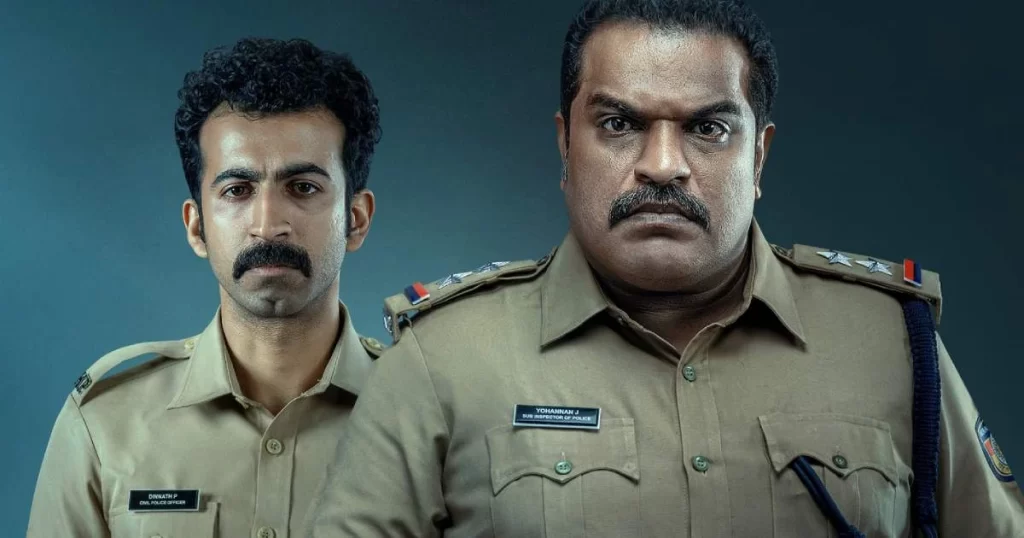
The brilliant screenplay is structured as a series of such events, and in between, we get glimpses of the personal sides of Yohannan and Dinnath. There are very funny episodes like the one where Yohannan makes Dinnath look like a fool, or the one where Yohannan makes a confession to a priest and ends up being the butt of a joke. But over time, we see their insecurities. We see the contrast between the stern policemen that they want the world to see them as and the very emotional human beings that they really are. We visit their homes, where we see them in their most fragile emotional states. As colleagues often do, Yohannan and Dinnath do end up watching out for each other, confiding in each other. And all the while, God seems to be watching. There are numerous references to Christmas, and these are reminders that a joyful holiday season for the others is a period of work for these policemen.
The imperfections of these men are shown in an instance of a bribe being taken and – later – a bribe being used as a kind of punishment. These are truly scenes that we don’t usually get in police stories. But after a point, we begin to wonder about this story. Yes, we are seeing a series of events, but is that all? Is the idea just to give us a feel of what a patrol cop’s life is like (both professionally and personally), or is there a larger picture? And that’s part of the beauty of the writing. The screenplay is deceptive. It makes us think we are watching random and disconnected events, and slowly, we realise that some of these events are part of what leads to the devastating final portions. Ronth, by the end, becomes a crime drama.
Many films open on a high point that is taken from a scene that occurs somewhere in the middle. The reason for this high point is twofold. One, it makes us sit up with a jolt. We are instantly invested, as opposed to “easing” into a movie that begins in a more leisurely fashion. But more importantly, this opening “high moment” tells us to wait for this scene to unfold in full, and this puts us in a state of anticipation. In Ronth, this technique is used beautifully. The big moment at the opening is something we register, and yet, it is presented in a very casual manner. Only at the end, do we make a connection. It’s that subtle – as subtle as the central performances by Dileesh Pothan and Roshan Matthew. They work beautifully together, carrying this particular story and also putting a face to the many cops who we just think of as men in uniform. These two actors take us beyond the uniforms and make us see two very real people.