The melodramatic story of an army officer who has to make hard choices is not convincingly done. The film is big, broad, and it offers no surprises. The rest of this review may contain spoilers.
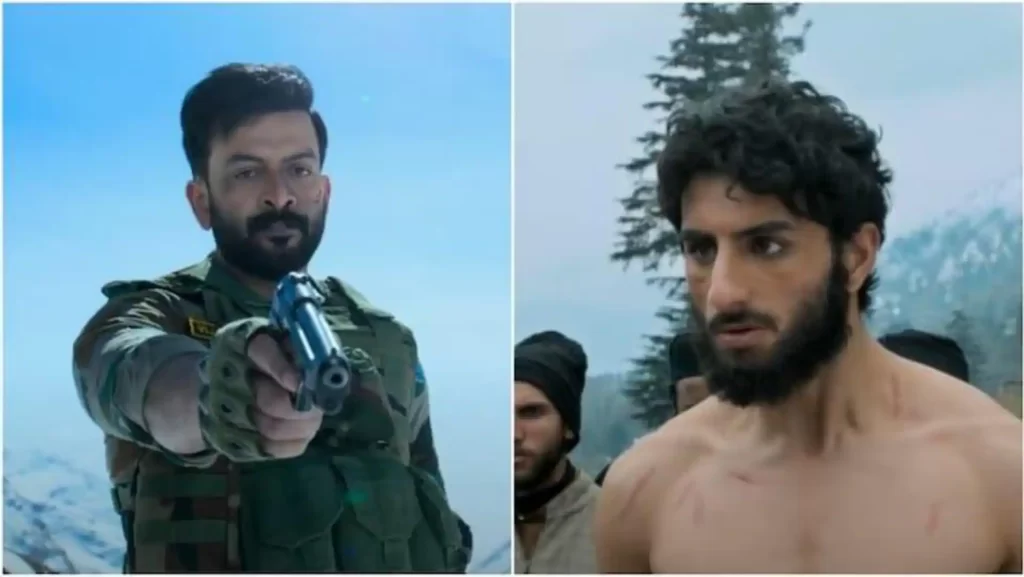
Earlier this year, Boman Irani made his directorial debut with The Mehta Boys, which was about a troubled father-son relationship. Now, his son Kayoze Irani makes his feature-length directorial debut with Sarzameen, which is about… a troubled father-son relationship. Apart from the one-line, the films are vastly different in tone and temperament (and The Mehta Boys is a far superior achievement), but this fact about a father and a son debuting with movies about fathers and sons in the same year could be a nice bit of trivia for future quizzers. For the rest of us, though, Sarzameen is an unimpressive affair set in the troubled land of Kashmir. Prithviraj Sukumaran plays Vijay Menon, an army officer married to Meher (Kajol). In an early scene, he gets news about terrorists. He gets to do a slo-mo run. He gets to do some shooting. He gets to do some hand combat. After establishing his heroism, the film establishes his vulnerability. Back home, in a party Meher throws for his promotion, their son Harman reads out an “I am proud of you, papa” speech he’s prepared. But Vijay is embarrassed because Harman has a stammer. The speech makes Vijay uncomfortable because he is dealing with his own issues with a daddy who demanded nothing but perfection.
This scene is the first time you sense something is off. Wouldn’t Meher know Vijay’s feelings about Harman. Why would she make the poor boy speak in front of a huge gathering? And later, she says Vijay is ashamed of his son, as though she’s made a brand-new discovery, when this fact must have been a long-simmering bit of angst in the family. That’s Sarzameen in a nutshell. It’s big. It’s broad. It has no surprises. At another point, after Harman is kidnapped, we are meant to think that Vijay is going to set free two terrorists in return for his son. The scene goes on and on, with Vijay following the two men to the point of exchange, and it’s intercut with visuals of Vijay joining the army and swearing to protect his country at all cost. We instantly know that he’s not going to let those terrorists get away. Until a big twist in the second half, Sarzameen is nothing if not predictable.
It plays like the Dilip Kumar-Amitabh Bachchan conflict in Shakti, with a dash of the Sanjay Dutt-Hrithik Roshan conflict in Mission: Kashmir. But nothing sticks because of the storytelling style, with lines like “Sarzameen ki salaamat se badhkar mere liye kuch nahin hai.” We get gauzy flashbacks of happier days. We get a scene of Meher melodramatically sinking to her knees when she sees her son again, as a song in the background goes “Aa gale lag jaa / ab door na jaa”. The loud score has violins smoothing over everything, leaving no rough edges. The climax is meant to be nailbiting, with a bomb at the inauguration of a dam, but the whole thing plays out with the urgency of a music video. At many points, you wish they’d simply get on with it. This style itself is not an issue. The problem is that the director seems to have no rooting or conviction in it, and every stylistic choice seems to exist only because it worked in some other movie.
The other big problem is Ibrahim Ali Khan’s performance. He was self-conscious and near-robotic in Nadaaniyan, too, but in that candyflossy film, these traits fit his character of someone awkward with their emotions. But Sarzameen is a full-blown drama, and Ibrahim gives the impression of someone trying to decide how best to arrange his facial features after the director called “Action”. It doesn’t help that he is cast with pros like Prithviraj and Kajol. But then, even these pros can’t do much with this generic writing. There’s a scene where Vijay apologises to his son. How awkward this moment must be for the man, given his troubled relationship with the boy. But the writing has all the weight of someone saying sorry for forgetting to buy milk on the way home. As for the big twist I mentioned earlier, it comes out of nowhere and it’s utterly ludicrous.
The smaller emotions don’t work, either. We get men posing with guns instead of shooting right away. We get a nafrat-versus-mohabbat moral science lesson. The only scene I liked was the one where Harman finds a kind of father figure. (KC Shankar plays this character beautifully). For once, Sarzameen dips into some real emotion, that of a boy who yearns for kinship with his father and finds it with another man. The scene is lit with warm tones, in low light – there’s actually some texture to add to the emotional texture, as opposed to the rest of the brightly lit frames. Sarzameen is like Fanaa. It takes a troubling topic and glosses it up. The result is utterly underwhelming.