
Ishaan Khatter and Vishal Jethwa play the two friends. The film’s first half depicts their struggles in battling discrimination and getting a job, and the second half has them staring at a fate that’s even more horrible. The poetry of ‘Masaan’, Neeraj’s first film, is replaced by hard-hitting prose, and this change in flavour works more often than it doesn’t. That’s the brief review. A longer one follows, and it may contain spoilers.
Neeraj Ghaywan’s Homebound is the story of two friends from two non-dominant communities. Chandan (Vishal Jethwa) is from a Dalit family, and Shoaib (Ishaan Khatter) is Muslim. In the opening stretch, Chandan and Shoaib seem to be wearing identical brown sweaters, and I had to look closer to realise that the designs on their sweaters were a little different. Visually and thematically, the film fuses these two “others” as one, even though they are fighting different battles. When we first see Chandan and Shoaib, they are in a very crowded railway station, where hundreds of young men and women like them are waiting to board a train that will take them to their exam centre. What we see at this railway station is just one bunch. Some 25 lakh such people spread across several such places of transport are competing for 3500 seats in the police force. Chandan and Shoaib write the exam, and then they wait. And they wait. The results aren’t going to arrive anytime soon.
Homebound is based on an essay written by Basharat Peer, which was published in the New York Times – and it is a film of two-s. Like in Neeraj’s first feature, Masaan, we get two story tracks following these two friends. The screenplay is divided into two halves: first, we follow the narrative of finding a job, and then, we follow the narrative that unfolds when the COVID lockdowns are enforced. The film has two other viewpoints delivered through two female characters. One of them is Chandan’s sister, Vaishali (Harshika Parmar). She wanted to go to college, but given the family’s economic situation, only one of the siblings could get this privilege, and that’s the male child. So even within a Dalit household, we see that there’s a hierarchy.
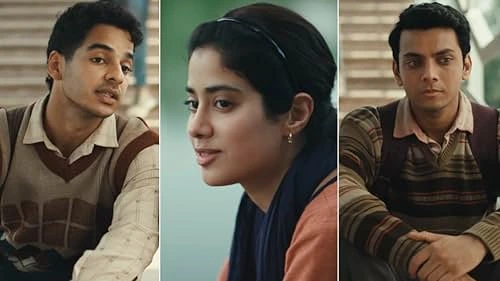
The other important female character is Sudha, played by Janhvi Kapoor. She loves Chandan, and she is a Dalit, too. (Her sister gets married in a Buddhist ceremony.) She wants Chandan to study so that he can go further than the constable job he’s likely to get. She knows what she’s talking about, because her father was a lineman, and he will retire as a lineman . You need a college degree to get a good job. She is looking at life the way Ambedkar did: first educate, then organise, then agitate. But Chandan just wants the job. He doesn’t care whether it is good or not, the way Sudha defines it. And through this interaction between Sudha and Chandan, the film poses an important question of how difficult it can be, sometimes, to look at the big picture of societal reform when the immediate need is food on the table.
There’s also the two attitudes of the oppressed: the ones who prefer to hide, like Chandan, and the ones like Shoaib who are open about their identity. Shoaib has the option of escaping to Dubai, but he says that instead of going to another place and changing himself, he’d rather stay here and change the system from within. He can probably afford this attitude because his Muslim-ness is impossible to hide. It’s there in his very name. Chandan, on the other hand, applies for jobs in the General Category, as opposed to the SC Category. He is scared that if he gets in through a quota, he will be treated badly at work. He fears that even if he gets that police job, he will be asked to sweep floors. His fears are not unfounded. His mother (Shalini Vatsa) is dismissed from the school she cooks in because the dominant castes do not want their children eating the food she makes. A meek officer tries to tell those parents that this sort of discrimination is a punishable crime, but the parents don’t care. They have the courage that comes from centuries of domination.
Homebound is a louder, angrier, less subtle, more melodramatic movie than Masaan – possibly because of the changes in the personality of the filmmaker in the ten years between the two films. Masaan looked inward at the pain experienced by the protagonists, whereas Homebound projects everything outwardly, and sometimes a tad too obviously. At one point, Shoaib gets a job as a peon and he is invited to a party in his manager’s farmhouse to watch an India-Pakistan match. You know what’s coming, and the stretch unfolds exactly as you expected – but still, the point being made here is important. There’s a man who’s sympathetic to Shoaib, and who does not care that Shoaib is Muslim – but he doesn’t do much when his colleagues call Shoaib a “Paki”. What’s the use of being a “good person” if you don’t speak up when needed?
The dialogues are written with an ear for drama as well as didacticism. One terrific line says that the reason for a cricket ball’s existence lies when it’s in the air, not while it is lying inert on the ground. “Ball ka asli wajood hawa mein hi hai… zameen pe to padi rehti hai.” It’s a fantastic call to action. But there are also a few points where the messaging is too in-your-face. There are things that need to be said, but they could have been said more understatedly. I also wish they’d gotten someone other than Janhvi to play Sudha. It is an important part. When she weeps, it looks like a dainty little emoji, but when Shalini Vatsa weeps, it feels like her soul is being ripped out. But the film works because Ishaan and Vishal work beautifully together. Their relationship looks totally lived-in. There’s a point where Chandan and Shoaib fight – and I couldn’t wait for them to make up and get back together.
Homebound is a rock-solid film overall, but the spare second half worked better for me. Here, we see the total disintegration of State machinery, and we are left with the story of two friends who are abandoned in every possible way. Chandan dreams of a house without a leaky roof. Shoaib has his own financial commitment, due to an ailing father. But their lack of education means that they are confined to blue-collar jobs, and there’s no escape from the grind. Their dreams are coming to life, but Chandan and Shoaib keep staring at a deathly fate. The final stretch is incredibly moving. What starts as a story about getting a job ends as a story that says education is the only way forward – and even more so when you don’t have the backing of the majority.