Dhruv plays a kabaddi player who faces hurdles not just due to caste but also due to the violence in the areas around his home. His long journey from local champion to representing India at the Asian Games is told with furious filmmaking energy. That was the short take. A longer review follows, and it may contain spoilers.
Mari Selvaraj may be the best genre-breaker filmmaker we have today. In Pariyerum Perumal, he transformed the coming-of-age template into a howl of anguish. In Bison, he takes the sports biopic and – through this template – he tells the story of how sport may be the only escape from hot-headed communities that hold on to old grudges and keep fighting. If someone asked you what the film is about, the surface-level answer would be that this is the fictionalised story of the kabaddi player Manathi Ganesan, who is called Kittaan here and played by Dhruv. And that is how the film opens: at the surface level. We are at the 1994 Asian Games in Japan, and India is playing Pakistan, and Kittaan is not selected to play. At once, we see both sides of Kittaan’s journey. On the one hand, he is representing India at the highest level, which is an opportunity very few people get. And yet, even at this highest level, he is kept out of the playing team. He is benched. Someone has to fight with the coach on his behalf to get him onto the ground.
Bison, thus, is the story of many types of fighting, many types of violence. There’s Kittaan fighting back when he is attacked, or when his father is attacked. There are other people fighting on Kittaan’s behalf, like the big-shot characters beautifully played by Ameer and Lal. They may be at war with each other, but they look at Kittaan as a skilled kabaddi player who should not lose out because of the circumstances around him. Some of the best parts of Bison are when we see that these Ameer and Lal characters are not as “bad” as we thought they were. Third, we have the violence in the larger community, like the family fight over a god. And finally, we have the emotional violence of the kind where a man refuses to let his daughter get married to Kittaan. All this violence, all this fighting – it does not look choreographed. It looks like we are watching something that happened on the spot.
To fight back or not – this ambivalence is best seen in Kittaan’s father, wonderfully played by Pasupathy. In his expressive eyes, we see a man who does not want his son to play kabaddi, and subsequently be led into the life of a rowdy. And yet, he is not a complete peace lover. He carries around a knife for protection. He is proud of Kittaan. He also fears for Kittaan. Bison is a triumph of storytelling. Sakthi Thiru is the editor, and the cuts are fast and they carry forward the fury of the film, the fury inside Kittaan. (In other words, we feel the violence in the editing, too.) The distant past, the immediate present, and the present time of a few days or a few minutes ago – all these timelines collide like atoms in a particle accelerator. The film runs nearly three hours, but I hardly felt it. There are many, many acts of bloodshed, but each one comes with a different context. They don’t feel repetitive because they build the story in different ways and sweep it along like a strong current.
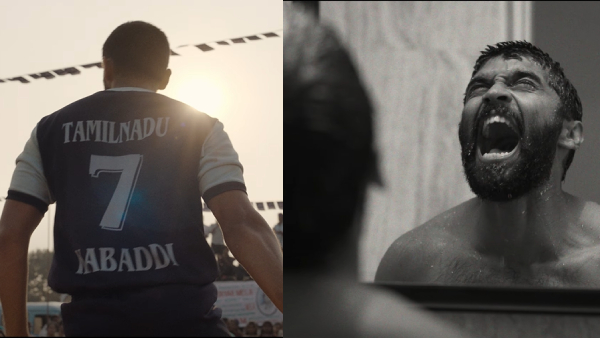
So those expecting a simple, rah-rah story of a player who fights the odds, does a few training montages set to rousing music, sheds a few tears, and finally succeeds – these audiences may need to recalibrate their expectations. We see Kittaan playing kabaddi, sure, but we also see him running – and running, and running. We see many shots of Kittaan looking at himself in a mirror, and he seems to be asking himself questions. What questions are these? As he says, “Vaazhkai-kum aasai-kum nadula irukkara kelvigal”. These are questions about the many circumstances between one’s life and one’s dream. It’s not just that Kittaan is from an oppressed community. It is also about the oppression of his desires. And that is why he keeps running: it’s a form of escape, of tiring himself out so that those questions vanish for at least a while. I was often reminded of Tony Richardson’s superb British drama, The Loneliness of the Long Distance Runner. It would make a great companion piece with Bison.
This is not to say that the film does not address issues of caste. When Kittaan is taken to an eating place, the parotta maker asks about his caste. Later, a teammate mocks the fact that Kittaan has had to “get help” to get to where he is – as though people from dominant communities make it entirely on their own. And yet, there are many people who strive for a casteless society and go out of their way to help Kittaan. This is yet another “fight” the film shows. The dialogues, sometimes, may feel too pointed, but they are necessary to establish that the responsibility for Kittaan’s success – and by extension, the breaking down of social divisions – is not just on Kittaan’s shoulders alone. This is a collective fight. In an early scene, we see a young Kittaan squeezing himself into a corner, terrified at the bloodshed he has just seen. Much later, we get an echo shot of another young man who sees bloodshed and who reacts the exact same way. Kittaan may succeed, but Mari Selvaraj also shows us the other Kittaans who need to save themselves, on their own or with help.
The supporting cast is excellent. Aruvi Madhan plays a schoolteacher who takes Kittaan under his wing. Rajisha Vijayan plays Kittaan’s supportive sister. Anupama Parameswaran plays the love interest. The first sign of love is a scene where she is at home, looking at Kittaan’s picture. It is a complicated love story, one that the film does not have time to really get into. But these gaps in the narrative are bridged by Nivas Prasanna’s scorching songs (like ‘Theekkoluthi’ in this case). They are the emotional glue holding the various bits of the film together. And the set-piece scenes work brilliantly, like the one where the Ameer character goes to visit a bedridden man. Another standout scene shows Kittaan rise from the dining table because the news he has heard has made his appetite vanish. We are talking about someone who could eat ten parottas at a time.
There are the signature Mari Selvaraj touches; like the switches from black-and-white to colour, and the use of animals and Nature to comment on the characters and their circumstances – and Ezhil Arasu’s cinematography becomes the unblinking eye that registers everything without glamourising anything. Even a “beautiful shot” like that of a man against a sun makes us feel the heat rather than the preciseness of the composition. And the camera is in love with Dhruv. You can see why he was cast. He is good in the dialogue portions, but he doesn’t have too many lines and he rarely smiles. Mari Selvaraj uses him as a brute physical presence, like the bison of the title. At the film’s opening, we see the Asian Games in a boxy frame, and at the end, the visuals of the Games fill the whole screen. It feels like something contained has been freed up, and Dhruv makes us feel every bit of this journey. Kittaan speaks not just to the oppressed but to everyone whose big dreams fill their parents with fear. This inclusivity, this resistance to dividing society into easy binaries of good and evil – this is what sets Mari Selvaraj apart.