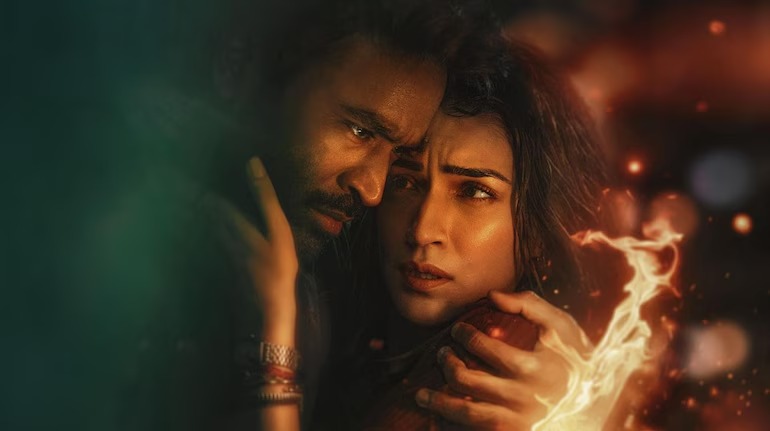
Dhanush plays an Air Force pilot who’s been hurt in love. Kriti Sanon plays a psychiatric counselor who’s responsible for that hurt. He bears the name of God. She bears the name of his salvation. Together, they take us through a drama with a lot of meat that’s not always fully cooked. That’s the short take. A longer review follows, and it may contain spoilers.
When the motion posters of Tere Ishk Mein began to appear, the title looked like it was set on fire – and there happens to be a lot of fire in Aanand L Rai’s latest outing with Dhanush. It’s there in the glowing tips of cigarettes. It’s there in the funeral pyres of Benares. It’s there in the explosions of the rockets you’d find during Diwali and in the missiles used in war. It’s there in the petrol bombs that are thrown during an event at a rich man’s house. It’s there in a backstory that has shaped the protagonist, who still carries that trauma both inside (in his psyche) and outside (on his skin, which feels like it burns constantly). He tells the girl he loves, “Tere saath hota hoon to kam jalta hoon.” In her presence, he doesn’t feel that burning sensation as much. The minute he says this, something happens that shatters his peace. The girl runs away, and as if to compensate, it rains. Even Nature feels sorry for him at this point. It wants to cool down this burning man.
Dhanush plays Shankar, aka God. Kriti plays Mukti, aka Salvation. The minute we hear these names, we know that there is only one way for this nearly three-hour story to end, which is that she will set him free. But first, back to fire. The story takes off when Mukti, as a doctoral student, presents a thesis that violence is like the appendix, and that it can be removed from a man. And Mukti feels that the rowdy-like Shankar is the ideal candidate to demonstrate this. In other words, she begins to play with fire. Shankar and Mukti are worlds apart. She is rich. She knows French. Her father is a high-ranking diplomat. She drinks wine. Shankar is a Tamilian in New Delhi, and he is an outsider not just in the city but also with the likes of Mukti. She is an excellent psychologist, but she slips up when she takes her top off and Shankar refuses the offer of sex. To her, it is just a physical thing, but like many movie-men in love, Shankar worships her purity. This should have alerted Mukti to stay away.
But her belief in her science blinds her to his very human emotions, and she continues to use him (and continues to see him) as a lab rat. She “rationalises” everything, including the way she will turn him away when he comes home and asks for her hand in marriage. But Shankar will not let go of this person who has doused his inner fire: not only has she made him a less violent man (at least for a while), she also makes him forget the trauma that still singes him. The opening stretch establishes Shankar as a fighter pilot with the Indian Air Force and when he disregards rules while flying close to a Chinese aircraft, we think he will turn out to be one of those macho-stud heroes. But this opening – where Shankar is in the heavens, so to speak – is more about how he handles the situation without violence, thanks to Mukti’s training. And the ice-cold expression in his eyes and his calm attitude will contrast with the Shankar from the past, when he was the very definition of volatile. Mukti’s experiment has been successful. A line in the title song goes: Khoon mera ishq mein sharaab ho gaya. Shankar’s blood has turned into wine due to his intoxication with Mukti. But this comes at a great cost.
I am a huge fan of the out-there conceits that Aanand L Rai picks up. They are not just out of the box – in his films, there is no box. Shankar’s love for Mukti is easy to understand. She is a mother-figure who corrects him when he steps out of line. She is the beautiful, unattainable goddess of his dreams. He is so innocent (and has probably seen so few films) that he doesn’t even think that the rich girl’s father will insult him when he asks for her hand. But the twist in this cliched situation is that the girl is standing not by Shankar’s side but behind her father. She is trying to make something clear, but Shankar does not understand hints and signs. And after this is where the out-of-the-box stuff really begins. The lab rat realises that it’s been used for an experiment – and it goes mad. The scientist tries her best to “handle” the situation, as she puts it. But then, in the heat of his fire, she begins to melt.
 v
v
Tere Ishk Mein is a gorgeous production, shot by Tushar Kanti Ray. AR Rahman’s songs are superb, and the background score keeps churning with bits from these songs as well as new cues. And for a change, the sound mixing keeps the background score in the background, without making it an assault on the ears. The songs are used beautifully. Not one of them feels out of place. A special mention to Irshad Kamil’s lyrics, which comment on the story and carry it forward. And the screenplay, by Himanshu Sharma and Neeraj Yadav, is nothing if not ambitious. The emotional war between Shankar and Mukti is set against the backdrop of an actual, physical war. I loved the fact that Mukti uses Shankar for her thesis to prove that this rowdy is a human, and she returns to his life, again, to “evaluate” him – to prove that he is human enough to go to war. At one point, Shankar and Mukti swap places. She still thinks she can save him. She is still playing God. And now, he becomes her salvation. She has to go to him to be “saved”. There are superb scenes like the one where Mukti, in her skyscraper heels, comes to Shankar’s little home. He is not ashamed about his poverty. He is not the least bit self-conscious. But she realises the gulf between them. (As an ironic counterpoint, the scene begins with one of Ilaiyaraaja’s most iconic love songs, which asks if it is possible to exist on this earth without love.)
But the film never comes together as a whole. The material is gloriously, unapologetically melodramatic – but it stays at an arm’s distance. The beats are fantastic and unique, but something about the way they have been shaped on screen results in us not really getting into the story. We stay on the outside. We see Mukti’s self-destructive nature, and we realise that it is due to Shankar the God’s curse – but this head-realisation doesn’t convert into heart-emotion. Even if we buy the somewhat improbable fact that Shankar is not going to be in touch with Mukti for a long time, even if we convince ourselves that his innocence is driving this decision, it doesn’t make this plot point easy to swallow. Similarly, Shankar’s sudden enlistment in the Air Force feels almost comical. There are times – like when the character played by Prakash Raj is humiliated – where the melodrama slips into borderline absurdity. (It feels like an homage to the scene in Asuran, where the father character played by Dhanush was humiliated in the exact same way.) As for Mukti’s choice of life partner, the man doesn’t even register in the larger scheme of things.
But all that said, I still came out of the theatre with the feeling that I had seen something where the creators had genuinely wrestled with complicated and ambitious material. No, this is not an A-for-effort kind of assessment, but an acknowledgement that sometimes, this struggle that we see on screen can itself be a reward of watching a movie. Dhanush is fantastic. But then, he has been fantastic in many films, especially under this director. (Raanjhanaa springs to mind instantly.) But Kriti Sanon is a revelation. She digs deep into a complicated part and throws herself wholeheartedly into several scenes that seem somewhat undercooked, but seem better with her in them. Like Aanand L Rai’s earlier work, there is an element of spirituality – or mysticism, if that’s your take. Tere Ishk Mein starts with a reborn Shankar and ends with Shankar reborn. It’s too bad that this desi Gothic melodrama doesn’t fully ignite, but whenever it works, it’s on fire.