As everyone knows, the story is about Rajinikanth clashing with Ramya Krishnan. As a Superstar vehicle, ‘Padayappa’ works. But the passage of time also allows us to reflect on the series of films that the star made during the 1990s.
What is the perfect Rajinikanth movie? I’m going to say Mullum Malarum, because as a piece of cinema, as a character study, as a singular testament to the man’s matchless charisma and his ability to hold the screen even while doing nothing and just being present, nothing that he did surpassed that Mahendran classic. But let’s tweak the question a bit. What is the perfect Superstar/Thalaivar movie, the movie that encapsulates the Rajinikanth whose stardom outgrew the actor-dom of Mullum Malarum? For this, the answer is probably not just a single film, but the stretch of movies he made in the 1990s, starting with Dharmadurai in 1991 and ending with Padayappa in 1999. This stretch includes not just the biggies like Annaamalai and Arunachalam and Baashha, but also underperforming films like Yejamaan and Valli, which he wrote and starred in, in a special appearance.
Why are these films most representative of Superstar? Because they extend the MGR philosophy of doing good for the people by being a good man, and adding a dash of spiritualism or even existentialism, in a form palatable to the general audience. I get the feeling that Rajinikanth wanted to show a piece of himself through these films. In Valli, he advocates that a woman who has been cheated by a man should take her revenge by killing him. And he plays a kind of philosophy-spouting commoner, who carries with him his dead wife’s sari. (Many years later, in Kadaisi Vivasayi, we’d find Vijay Sethupathi in a similar role.) In Padayappa, we get a custom that the man and woman should verbalise their agreement to get married, to ensure that they are not being pressured to do so – and by extension, we see that marriage is about what the couple wants and not what the parents want. Even if Rajinikanth is a crime lord in Baashha, he drops that lifestyle instantly, just because his father asks him to. In Padayappa, similarly, he says he will do anything his mother wants him to. In Thalapathi, he is the man who chooses loyalty over family.
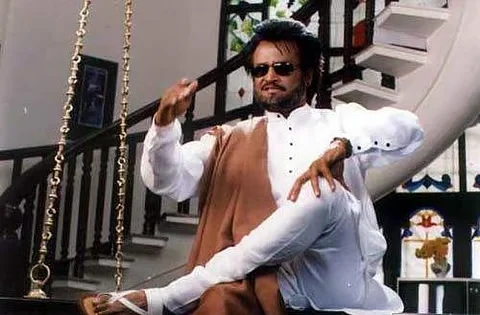
Many of these films have other elements that have not dated well – for instance, the industrialist in Mannan who, by the end, is happy to be a housewife packing a tiffinbox for her husband. And Padayappa has this “a woman should be a woman” line, implying that the docile, dhavani-wearing Soundarya is preferable to the headstrong, miniskirt-wearing Ramya Krishnan. But at the core of these films is a Rajinikanth who wishes to do good by the people by being a good man himself. Taking that MGR example further, maybe this was also the result of his political ambitions. He falls – and then he rises spectacularly. Has any star-hero of his magnitude subjected himself to a public lashing like the one in Baashha, or put his masculinity under scrutiny with the question of whether his character was capable of fathering a child, like in Yejamaan?
Even in earlier films like Nallavanukku Nallavan and Padikkadhavan, Rajinikanth played someone who was good to his family but whose family was not good to him. But in the nineties, this trait was amplified with his Superstar-dom, and we get this breed of films where the hero is strangely vulnerable, even as he tackles villains with the heroism demanded by a mainstream audience. Heck, his mother literally abandons him in Thalapathi. And Padayappa, where Rajininath plays the title character, is the pinnacle of this “genre”, if you will. All the villains are insiders. Padayappa’s father’s younger brother demands a share of property and becomes responsible for the father’s death. The antagonist, Ramya Krishnan’s Neelambari, is Padayappa’s cousin. (The lines “aatchiye avanga pakkam irukku” and the advice to use power responsibly suggest that she may be modelled after Jayalalitha, who was warring with Rajinikanth for a while.) Neelambari’s brother ruins the life of Padayappa’s sister by refusing to marry her.
And there is this constant spiritual / existential undercurrent. Padayappa’s dead father – from the afterlife – protects his wife and son in the living world. A snake protects Padayappa’s wife. And Padayappa protects everyone – even Neelambari – by being good and by not seeking revenge. If his uncle stripped him of his wealth, he saves this very uncle when the man becomes a pauper. If Valli was a kinda-sorta reworking of the 16 Vayathinile template, Padayappa is a kinda-sorta reworking of the Thevar Magan template. Here, too, we have two brothers in an emotional war, and the presence of Sivaji Ganesan anchors both films. The interval image in Padayappa is that of Padayappa and Neelambari staring at each other in giant close-up, the way Kamal Haasan and Nasser were shown in profile in Thevar Magan. But beyond these surface similarities, Padayappa is something unique in Tamil cinema: its villain is a woman in love with the hero. Neelambari is obsessed and infatuated with Padayappa.
When Enga Chinna Rasa went to Hindi and became Beta, there was a joke that the heroine’s character is so much stronger than the hero’s and the film should have been called Beti. You could make a similar case that Padayappa could have been titled Neelambari. This is a woman who has studied in the US. She has tons of money. But she falls for Padayappa because of the bravery he displays while handling a snake. She kisses him at the end of the song ‘Minsaara poove’. She gets turned on by the smell of his sweat in a cloth that he has used to wipe himself. After 18 years, she hears his voice over the phone and closes her eyes as though she has finally consummated her imaginary wedding night. Seen today, it’s amazing how little of Soundarya’s character we see in the film’s first half, which is defined and dominated by Neelambari. Even the mandatory love song between the hero and heroine – Rajinikanth and Soundarya – happens only in the second half.
That’s the uniqueness of the screenplay by director KS Ravikumar, who’s working off a story by Rajinikanth. Just look at the opening stretch. The custom regarding marriage is established, along with a flashback of how it came to be. This sequence ends with ritualistic offerings being dumped in a well. The camera captures the circular opening of this well, and there’s a match-cut to the circular vessel in which Soundarya is offering milk to a snake. The snake escapes and people in the vicinity begin to run, and they almost collide with the fancy car from which Ramya Krishnan emerges and unleashes her anger. Instantly, her nature is contrasted with that of Soundarya. Soon, Rajinikanth enters the picture, and we see the triangular image of the three people – one man, two women – who will form the romantic part of this story. And we transition to the SPB hero-intro song. You may not care about the making today, but the economy of storytelling is something else.
Like many films of those days, Padayappa is a series of breathless events and twists worthy of a hit mega-serial, but compressed into three hours. Lakshmi plays Padayappa’s mother, and she engineers a situation that’s a melodramatic masterstroke, even if her character disappears after a point. But then, many of these older films were never about conventional screenwriting. For instance, there’s a case to be made that Neelambari has been hurt by patriarchy. When her brother, played by Nasser, gets married to a woman without this woman’s explicit choice, she says that as long as women remain weak-willed, men are going to rule the world. But the rest of the time, she is more an archetype than a character, someone who stamps a flower that a maidservant plucked from her garden. There is a bit of unintentional comedy when she is asked not to wear red, because that might enrage a bull. She replies, “Maattukku pidicha colour laam ennala poda mudiyadhu.” In the theatre I was in, people burst out laughing, as much as they did for Abbas’s “What a man!”.
But the film holds up. AR Rahman’s songs hold up. Rajinikanth’s style holds up. By then, he knew exactly the pitch of performance that his audiences liked, picking from a toolkit of stylised stock expressions. Ramya Krishnan’s arrogance holds up. There’s something strangely addictive about a character that stays locked in a room watching the videotape of the man she loves getting married to someone else. And in a hero-centric industry, it’s entirely to Rajinikanth’s credit that the ending, too, belongs to Neelambari. She dies as she lived, swearing vengeance if there’s something called reincarnation. Walking out, I wished someone would make that sequel. Padayappa is very much a Rajinikanth movie, with much-mimicked trademark lines like “en vazhi thani vazhi”, but it also represents a high point of a certain kind of populist filmmaking. As the new millennium dawned, Rajinikanth’s spiritual shadings came to an end with Baba. And though he may have had bigger hits, the innocence of the films of the nineties that made him a Superstar – that would never return. The Superstar story is far from over (Jailer 2 comes out next year), but seen one way, Padayappa is the end of an era.