From making romantic fluff like Tum Bin and Aapko Pehle Bhi Kahin Dekha Hai, Anubhav Sinha has become the best social commentator of Indian cinema. Message movies, by nature, are not subtle, but Anubhav has found a middle path that balances the didactic needs of the genre with formal brilliance, whether it’s the staging or the cutting or the way the screenplay tackles the issue at hand. In Mulk, which marked this director’s rebirth as a filmmaker, the style was satisfyingly direct, like an old-school morality play. Article 15 played with gaze. The film was told from an outsider’s point of view, and when the Brahminical Ayushmann Khurrana character stepped into the swamp, it was a reminder that unless we wade into the dark recesses of our society, we cannot hope to achieve anything. After these films, we got Thappad, Anek, Bheed, and now we have Assi, which the director has co-written with Gaurav Solanki. It deals with rape, and it is Anubhav’s most formally daring film yet.
The title refers to the number of rape cases (eighty) reported per day – about one every 20 minutes. At regular intervals during Assi, the screen turns red with this fact spelt out in text – a reminder that even as this movie is going on, more rapes are being reported. The story opens with a schoolteacher (Parima, played by Kani Kusruti) being discovered by the railway tracks after being gang-raped for some two-and-a-half hours. All she has on her body are a shirt and bruises and congealed blood. An advocate named Raavi (Taapsee Pannu) takes on her case, and you think the rest of the film will be about these two women and their fight for justice: how Parima learns to live with this terrible thing that’s happened to her, and how Raavi brings the brutes to their knees in a court of law. But Anubhav Sinha does something brilliant. As compelling as that two-women story may be, it is also one that we have seen many times. So he makes a film not just about Parima’s rape but about rape itself. Instead of concentrating on two characters, he creates a three-dimensional view of the act itself – observing it through all concerned parties. The result is startling, very effective, and, narratively, very satisfying.

And now for the longer review, which may contain spoilers.
Assi may have the most gruesome depiction of rape ever seen in an Indian movie. The crime happens in the backseat of a minivan. It’s dark. We get flashes of Parima’s bashed-in face. We see a splotch of blood. We see one of the men filming the act. But most horribly, we see that it’s all a “game” to these men. As one of them gets on top of Parima, the others keep counting. Whether it’s the number of thrusts or the number of seconds, I don’t know – but it’s about whoever lasts the longest. But after this stretch, we barely see these men again. We may get a glimpse of them in court, but we don’t really single them out as characters because they are as much individuals as a collective of men that does these things. They are only one part of the whole picture. Raavi asks, “Who are these boys who grow up to be rapists?” And by way of a half-response, we get a superb scene with a superb Supriya Pathak, whose son was the driver of the minivan. This is not the expected scene about a “laadla beta” who is being pampered and protected by his privileged, adoring mother. This is about a woman who is not happy in her marriage and will not let her son’s arrest make her unhappier.
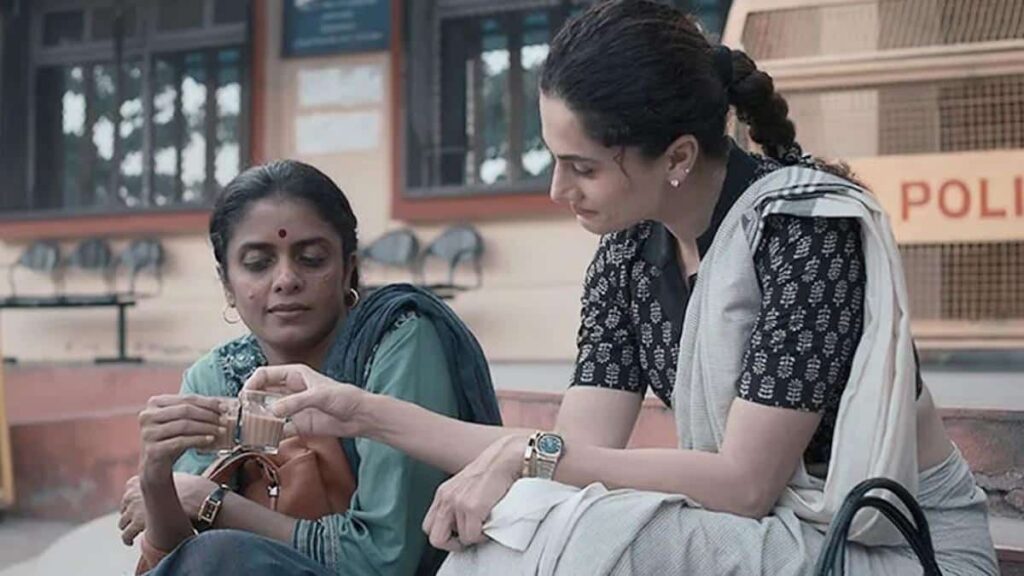
In other words, it’s all very interlinked and very complicated, and Assi lays out these links and complications and asks us to think about how our society teaches us to think about women. The trial is not just about these men who preyed on Parima. It is about a baaraat where men and women dance cheerfully to Kareena Kapoor’s item song, “Fevicol se”. Without indicting the song itself, Anubhav asks us what it means when women are objectified as “items”, even consensually so. In another scene, we realise that students that Parima has taught for over six years have formed Whatsapp groups about the rape. One of the boys jokes about the fact that he wasn’t invited. Is this just bad “hormonal” behaviour or is this boy likely to grow up to be one of those rapists Raavi wonders about? Taapsee, Kani, Revathy as the judge on the case, Seema Pahwa as the helpless headmistress in Parima’s school, Supriya Pathak – the women in the cast explode with sympathy and intensity and rage. But there’s also quiet understanding and a sense of sisterhood when the women in Parima’s neighbourhood – the very ones enjoying the baaraat with “Fevicol se” – sit with her in silence, in support, without judging her or shaming her.
The men in the cast include fine actors like Manoj Pahwa and Naseeruddin Shah, and the standouts are Mohammed Zeeshan Ayyub (who plays Parima’s empathetic husband, Vinay) and Kumud Mishra (as Kartik, some kind of government operative). Again, the links and complications are left for us to read and judge. Vinay buys his son a toy gun. Elsewhere, a vigilante is shooting rapists. This vigilante is the film’s most absurd and brilliant touch – a symbol of how unexpected the ripple effects around a crime can get. Do we wait endlessly for rapists to be “brought to justice” or do we just kill the bastards? Raavi is horrified. She views these extra-judicial killings as crimes on par with rape. But social media is thrilled. At court, we see another “vigilante”, a man who throws ink on Raavi. She’s shaken to the core. As she tells the judge a little later, it could have been acid. Many scenes in this film come in short bursts of energy and cut away quickly because that is all we need to know at that moment and life is happening elsewhere, too. It’s melodrama but with a dash of reality: call it “cinematic” vérité.
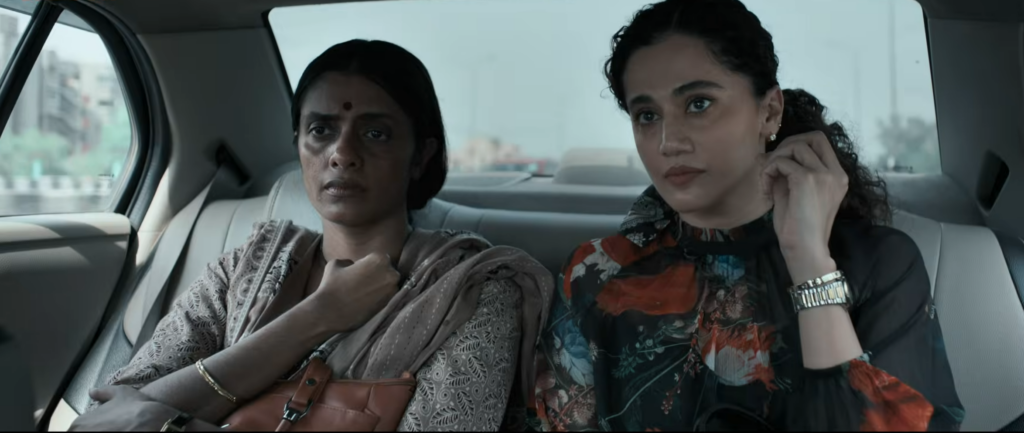 Assi is brilliantly shot by Ewan Mulligan and brilliantly edited by Amarjit Singh. A standout single shot has Raavi declaring that women are angry and can turn the world into ash, but these maximalistic words are reduced to the barest minimum of emotion because Raavi is not shouting at the man in front of her. She is muttering to herself. It’s almost as though she’s reminding herself that women have this power, while arguing a trial where everything seems to be going against women. DNA samples are botched, CCTV footage is corrupted (in another absurdist touch) by monkeys… Even women turn on women, like the sister of the rapist who lies in court for her brother’s sake. But again, she is not depicted as a “bad” person, merely someone who is all too human. We get another dimension to all this when we discover an instance of marital rape. If the film sometimes seems like it’s trying to do too much, it’s because it’s trying to unearth all possible dimensions that foster a crime like rape. You could argue that, even with all this information on screen, it’s actually too little.
In a strange way, Vinay and Kartik become the film’s beating heart. It’s obvious that we feel for Parima (because of what happened to her) and Raavi (because of the uphill task the case is proving to be). These two women are the first in the line of fire. But whenever Assi looks away from them, we see how men are impacted by the world, too. Kartik is struggling with trauma because his wife was killed by a drunk driver whose car did not have a license plate. He sighs that we live in a society where someone can drive a car with no license plate, that someone can commit a rape without leaving behind any evidence… The connection isn’t immediate, and yet it’s there. As for Vinay, he is a pillar of support to Parima and the most practical man. In a scene that occurs before the rape, he asks his little boy Dhruv to allow a little girl to get into the school bus first. When someone gives that “chalta hai” statement that Dhruv is just a child, Vinay says, “But he’ll grow up one day, no?” And after the rape, when a concerned Kartik asks Vinay why he brought Dhruv to the hospital, Vinay says he thought about leaving the boy at home. But then, all this will reach home, too. There’s no place he can hide the boy from what’s ahead. The logical conclusion to this philosophy of child-rearing occurs when children come to court to see the trial and when children stand witness to a public shooting. There is no place to hide. Now what we do when everything’s in full view is the question Assi asks.