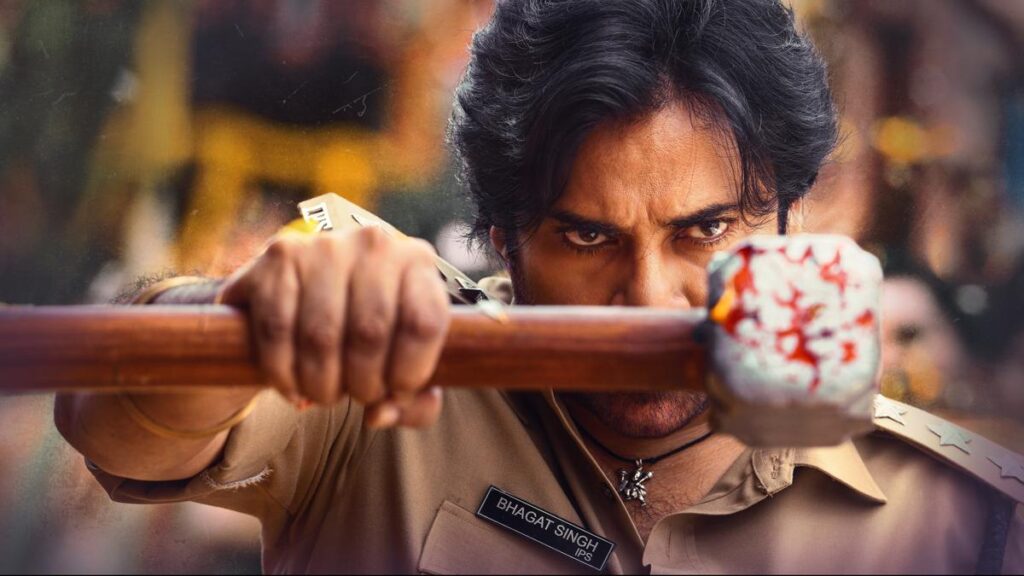
Pawan Kalyan plays a cop who has modelled himself after Bhagat Singh. He fights all kinds of injustice. He gets two heroines. He gets a villain. He gets songs and fights. He gets to deliver messages. And all of this is done without an iota of freshness. That’s the short take. A longer review follows and it may contain spoilers.
We meet the hero when he is a boy named Chinnaiah. He lives in a village by the forest, and even at this young age, he can bring down poachers who are after an elephant for its tusks. KS Ravikumar plays a kind-hearted teacher who gets Chinnaiah into school, and there, the boy beats up a man who threatens a woman. Later, the teacher asks Chinnaiah why he beat up the man. The boy says that the Bhagavad Gita teaches you to stand up against injustice. The teacher has seen Chinnaiah read about Bhagat Singh, too, and he asks the boy what he thinks about Gandhi. Chinnaiah doesn’t hesitate. He says Gandhi is fine, but it’s Bhagat Singh’s fiery ideals that he wants to follow. And that’s how he gets the name we see in the film’s title. But then, this is no surprise. The teacher should have known that he is in a mass-hero movie and if the model is Gandhi, we’d have action scenes where the villains hold up guns and the hero holds up an “ahimsa” placard in slow motion. Somehow, I just don’t see that happening.
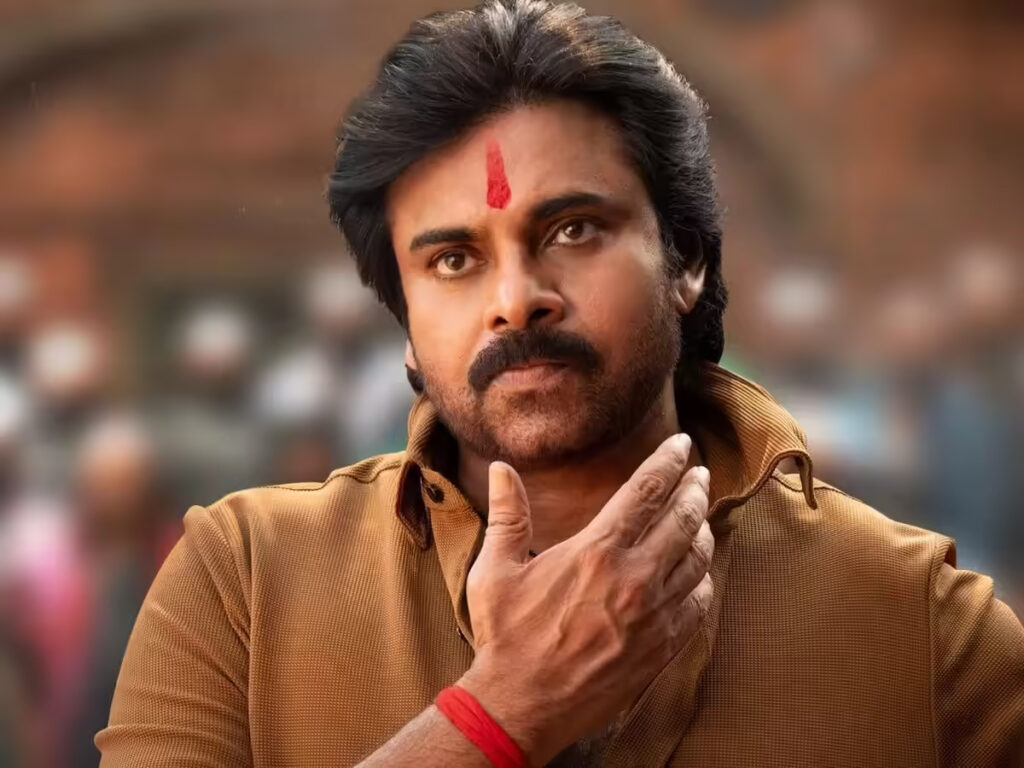
Ustaad Bhagat Singh sees the reunion of director Harish Shankar and Pawan Kalyan after Gabbar Singh, which was a remake of Dabangg. This film has shades of Theri. All of us who watch these mass-hero movies in Tamil and Telugu know what a thankless task the director has. You have to please the fans. You have to preserve the star’s image. You have to give the impression of doing something different without doing something too different. And in Pawan Kalyan’s case, there’s also the political baggage. The most we can expect in such movies is a bit of style, a bit of vision, some laughs, some good mass scenes, maybe some good songs and dances… But even with these minimal expectations, Ustaad Bhagat Singh is a massive disappointment. When the basic requirement of these films– the hero-intro scene – is so cliched, we quickly lose all hope for the rest of the running time.
At one point, Bhagat Singh – who’s a cop – finds himself having to capture the guest of a gang leader. The gang leader and the guest are seated in chairs that are above a series of steps. When Bhagat Singh shows up, the gang leader throws him this challenge: “Drag my guest down these steps if you have the guts.” Duh! At another point, the rich and spoiled son of a politician looks at Bhagat Singh and says, “What can a single man do against so many of us!” Everyone in this movie acts like they have never seen a mass movie! The first heroine is played by Raashii Khanna. The poor thing has to pretend that she actually has to play a character, and we are asked to invest in her backstory that involves a boyfriend who batted for the other team. But no one cares, not even the writer-director. The character is quickly shown her place. She is given a chance to be a part of a big dance number and then shunted out of the story. She doesn’t even get closure. One minute, she is speaking to Rao Ramesh in the middle of the forest. Then she’s gone. She is not a heroine. She is a vanishing trick.
Heroine No. 2 is played by Sreeleela. She is an RJ with a show titled “Galagala with Leela”. Fun fact: This character is wooed with a meta reference, a song from Pawan Kalyan’s Tholi Prema, which was released in 1998, three years before Sreeleela was born. No, this is not about age-appropriate heroines or whatever. I am saying that, as an audience, we don’t care. We don’t bat an eyelid. This is the kind of logical leeway we give these mass-hero films in Tamil and Telugu. And even then, even with this permission to be as illogical as possible, we get these underwhelming star vehicles. The Sreeleela character is used mainly to demonstrate what a good man Bhagat Singh is. She asks him what runs through his mind when he sees a beautiful woman on the road. He says his first thought is that she should get home safely, and hopefully she knows some kind of self-defence strategy to protect herself.
And we come to the message parts of Ustaad Bhagat Singh. There are many. There are men who are punished for a rape that’s described with Nirbhaya-level detail. There’s a possible reference to Operation Sindoor. There’s a warning about attempts to increase the Muslim population of India by smuggling in people from Bangladesh. As a counter, there’s a Ram Navami scene, and a local “rath yatra” that’s attacked by goons and then saved by the hero to the cries of “sambhavami yuge yuge”. At least in something like Dhurandhar, even if we outrage about propaganda or whatever, there’s some merit and validity because the film takes itself seriously. Ustaad Bhagat Singh is too ridiculous to even bother with! I mean, there’s a terrorist who introduces himself as “Baghdadi… pakka Jihadi.” You can only laugh!
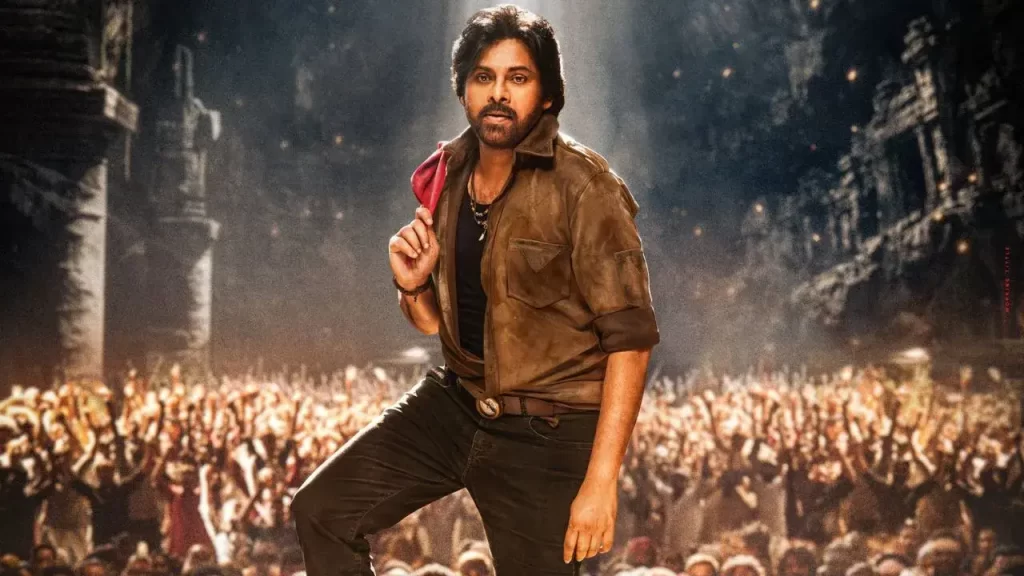
Parthiban plays a corrupt politician named Nalla Nagappa, who is told by a priest that the lines on his palm are not long enough to indicate that he will become Chief Minister. Nalla Nagappa gets angry. He breaks a coconut with his bare hands, takes a sharp chunk, and uses it like a blade to carve out an extended line on his palm. “Now will I become CM?” he yells. The petrified priest says yes. This scene is a good metaphor for these movies. The directors and the star’s fans keep threatening our lifelines if we say that we deserve more. Heck, Pawan Kalyan deserves more. He looks great. He fights well. He dances well. He tosses off lines in that casual way of his. The only thing he needs is a script that stays clear of two words: “fan service”. After all, fans have lifelines, too. And not everyone may have easy access to a broken coconut to change their fate.