If our heroes can have generically entertaining action entertainers, why not our heroines? Samantha is in good form as a woman whose strengths are those traditionally associated with a man. She cannot cook or sing, but she can kick ass with the best of them. This “fish out of water” premise is used well in an entertainer that could have used more punch, but is good enough for a casual, fun watch. That’s the quick review. A longer analysis follows, and it may contain spoilers.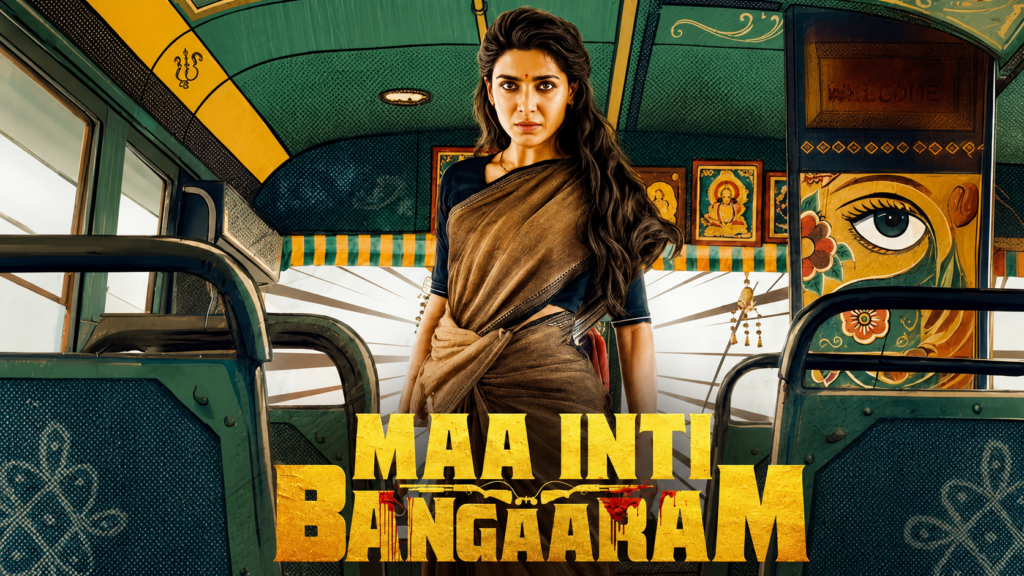
BV Nandini’s Maa Inti Bangaaram is set in the 1980s, and the film is written like a melodrama from that era. (Even today, you find shades of these movies.) There’s a large joint family. The men work. The women are homemakers. The family is traditional and religious, and follows every single ritual and custom, dressed in vibrant colours. The women gather around the tulsi plant and offer prayers. And so on. The writers are Raj Nidimoru, Vasanth Maringanti, and Prahas Boppudi. They seem to be celebrating this kind of throwback-family while also winking at it with affection. Part of the fun in this perfect star vehicle for Samantha is how her character, Swarna, will fit in. The trailer has already revealed that Swarna is an action heroine. She can kick ass. But can she prepare prawns and mutton curry the way this family wants? Does she know how to pray, and can she sing these prayers in tune?
Maa Inti Bangaaram has fun with these questions, these contradictions. At the heart of the narrative lies a serious issue. Is a woman a bangaaram – a golden daughter or wife or daughter-in-law – only if she is a perfect homemaker? What if she is a perfect fighting machine? After all, “bangaaram” is not the only way to refer to gold. You can also call gold “swarna”, which is our heroine’s name. The script has two bangaaram-s, two perfect women, who are the opposite of Swarna in every way. One is the younger daughter-in-law of the family, played by a smiling Sreemukhi. She is so perfect that she even bears the name of one of the five most virtuous women from Hindu epics: Anusuya. I wish the mini-catfights that erupt between Swarna and Anusuya had been worked into a bigger comedy track, with each one trying to be the better daughter-in-law. This is, after all, an 80s-template story, where broad comedy was an integral part of the full-course meal.
The other perfect woman is a master chef, and she is this film’s secret sauce. Manjusha Mukkavilli steals every scene she is in as Swarna’s best friend, Kiranmayi. The character is used for comedy and also drama, given that she’s the one Swarna confesses to about her past. As an orphaned woman who’s trying to find an identity, Samantha does everything right. When Swarna was a rebel-fighter in the past, it was because she needed an identity and this “cause” gave her one. And when she married a doctor named Anirudh (Diganth Manchale), it’s because he is the rare man who did not value a woman because of her identity as a cook or a singer. And when Swarna enters Anirudh’s big household, she wears bangles and a bindi and saris and assumes the identity prescribed for many women of the 1980s. Finally, when the villains return, she assumes the identity of a sari-clad saviour, a “mass” heroine, so to speak.
Gulshan Deviah plays the big villain of the piece, Karuna. This backstory, this relationship between Swarna and Karuna, is not fleshed out enough, and he remains a generic bad guy. Even when it comes to Anirudh, things remain generic. It would have been nice to see the scenes where he met Swarna and decided to marry her, not just because this would have given us a few romantic scenes but also because this relationship is based on a big lie, and its impact is not felt enough. But maybe they just wanted the men – whether Karuna or Anirudh – to be in the background as Swarna/ Samantha gets to flex in a mainstream Telugu movie. And that’s valid enough. If you overlook the fact that this is from Raj Nidimoru, Maa Inti Bangaaram is a broad, generic action/ comedy/ drama entertainer that works reasonably well. The huge action stretch in the climax is good, and the scene that follows, around the good old tulsi plant, is even better. We are left with the comforting thought that everyone is a genius in their own way, and as the saying goes, we should not expect a fish to climb a tree.