The era-defining director makes history with the first film shot entirely on IMAX cameras. He may have also made his best film yet. The story is about a warrior who wants to make his way home after the Trojan War. The actors, the writing, the making – it’s all aces. But the greatest triumph of this retelling of Homer’s poem is the way it resists easy spectacle and humanises a story of gods and men. That’s the quick review. A longer analysis follows, and it may contain spoilers.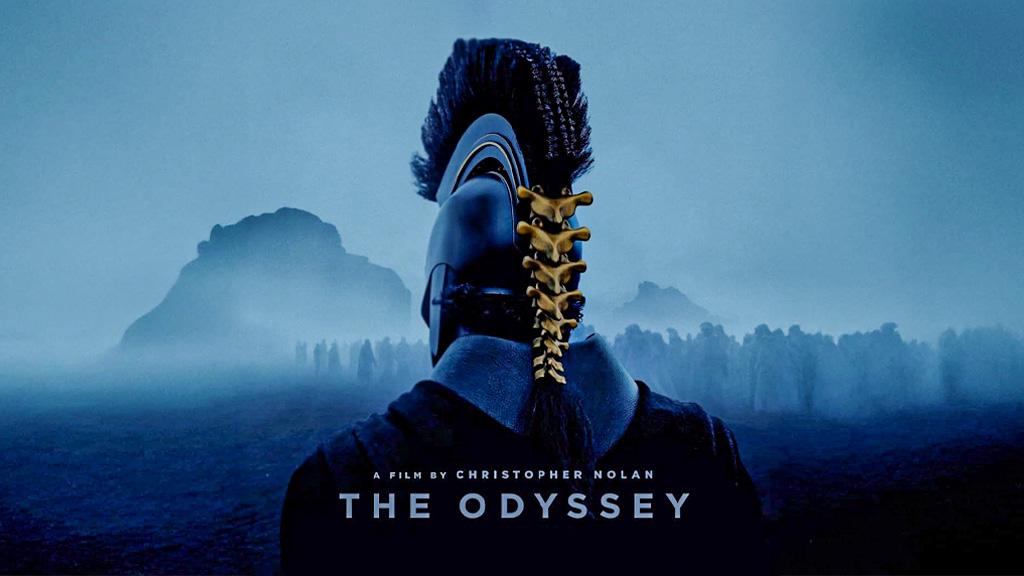
Christopher Nolan may have made his best, most beautiful film yet, and though it comes from an existing work of literature, it contains many of the auteur’s signatures. For instance, we have a protagonist who faces a huge challenge, and this challenge leads him to mind-boggling situations, and at the end, there’s no real triumph – there’s only the acknowledgement of the very human cost of setting out on this adventure. Homer’s poem, like Nolan’s work, is also a non-linear narrative that plays with time. It is the story of a warrior named Odysseus, played by Matt Damon. Odysseus was a hero of the Trojan War, and now he just wants to go back home to his wife and son in Ithaca. But before getting to Odysseus, The Odyssey begins with the son and the wife. Only after a while do we meet Odysseus as a character (and not as a memory from someone else’s story), and he is already on his way back home. But his journey is stalled because he is trapped on an island by a nymph named Calypso. And then we go back and forth in time, unravelling the rest of the story.
Before we get to the review, let’s begin with the controversies – like the language used in this gorgeous IMAX movie. In older films that came from epics or ancient history, the English language was structured the way they spoke in British poems and plays. Even an actor as quintessentially American as Marlon Brando had to adopt a British accent to play Mark Anthony in Julius Caesar. And the lines in those films had a touch of philosophy and poetry. In Cleopatra, for instance, a character wonders, “Why are the eyes of a statue always without life!” But in Nolan’s world, the language is blunt and direct and refreshingly unpolished. After the Trojan War, Odysseus tells his men, “Ten years on this fucking beach… let’s go home!” And that’s exactly what he might have said had his story been written by him and not by Homer. After all, Odysseus was just a regular guy, not a poet like Homer. In Nolan’s retelling, even the gods are “regular guys”.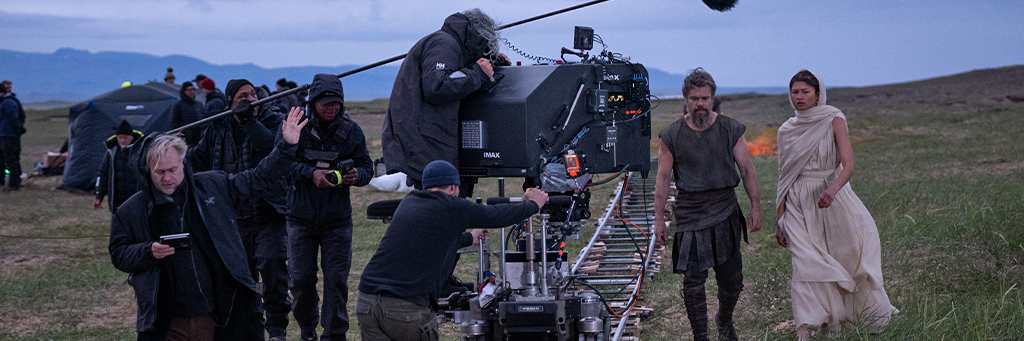
The other major controversy has been about the mixed-race casting – but when you see The Odyssey, you see that it is not just some woke, inclusive, politically motivated decision. Yes, maybe that did dictate some of the casting. And yes, it is a bit odd at first to see, for example, the very Indian-looking Himesh Patel being called Eurylochus – but you get over it quickly because there is a reason that is easily explained. And the reason is that there is no one bard telling this story. Parts of the Trojan War story are narrated by a king named Menelaus. A part of Odysseus’s story is narrated by Calypso. At points, Odysseus himself becomes a narrator. In other words, there is no one omniscient bard or narrator, whose “voice” needs to be maintained. There are many “bards” in this movie, and with each of their oral retellings, it is entirely probable that one of the listeners imagines that Helen of Troy looks like Lupita Nyong’o.
Perhaps I am saying that The Odyssey is an epic that I loved so much that I want to defend it – but let’s get on with the review. The thing about popular, canonised literature – whether Homer or Valmiki or Shakespeare – is that they become a part of common cultural memory. Their plots and structures and characters become archetypes. So even if you haven’t read the original text of The Odyssey, you’re likely to have encountered it in some shape or form. The one-line of The Odyssey is that it is about the struggles faced by a great warrior to get back to his home after a great war. But you may have seen the same one-line in, say, The Gladiator. The wife of Odysseus, the beautiful Penelope, is waiting for her husband to return. But she is being pressured to marry again, because everyone around her thinks Odysseus is dead and the kingdom needs a king. Penelope issues a challenge. She will marry the man who strings a mighty bow and shoots an arrow through a difficult target. This is essentially a swayamwar-like situation that can be found in our own epics and myths. And Nolan himself has addressed the plot point of what a long separation can do to a relationship in Interstellar.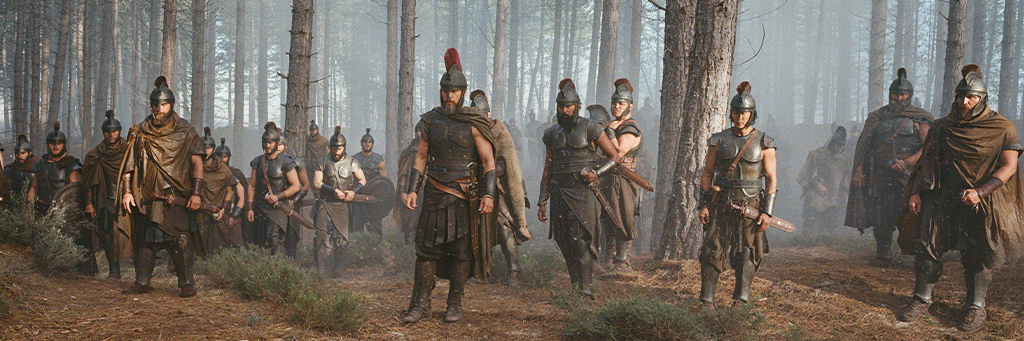
So faced with these familiarities, a filmmaker can do one of two things. The first is to be overly reverential to the source material, and risk being called repetitive or derivative. Nolan takes the second approach. He is respectful to Homer, but he is not reverential. One of the challenges faced by Odysseus is to navigate his ship around a giant whirlpool. Another challenge, which comes soon after, is a monster. After years of bleeding-edge visual effects, even the most wonderful of movie wizards cannot summon up the awe that people sitting around a fire felt while hearing about these adventures from their bards. So Nolan doesn’t put the spotlight on the whirlpool or on the monster. Instead, he does something brilliant. He retains a sense of these fantastical elements, in the sense that we see the whirlpool and the monster as though through the corner of the eye. But his real focus is on the resulting human drama. His real focus is what happens to Odysseus and his men as a consequence of navigating this whirlpool, and what’s the cost of evading the monster.
Matt Damon plays Odysseus not as a swashbuckling king and soldier, but with the world-weariness of a warrior who has discovered that war is futile. He is like Emperor Ashoka after the Kalinga War. He is a deeply traumatised man. Anne Hathaway plays Penelope by bringing out the patience and sorrow and undying love inside a woman who just wants to be left alone to wait, instead of having other men crowding around her to decide her destiny. Tom Holland plays Telemachus, the son of Odysseus and Penelope, and he portrays the impetuousness and immaturity of a man-child who grew up without knowing a father and is desperate to be seen as a man, a future king. These actors are brilliant – as is almost all the casting. Samantha Morton is especially marvellous as the witch Circe, who is humanised as a woman who is tired of men who keep looting and raping and behaving like pigs – and that’s why she turns Odysseus’s soldiers into pigs. The small bit of flirting she does with Odyusseus, with a put-on coyness, is the kind of acting touch only a great actor can give. It also serves as a hint that Circe and Odysseus became lovers, which is a plot point Nolan removes from his retelling.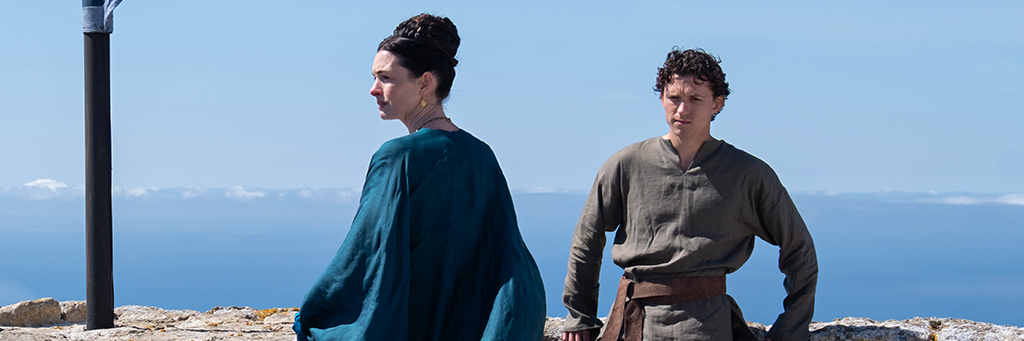
Nolan also removes the council of gods, and some of the trials of Odysseus – like the episode with the Sirens – are given less screen time than the others. All of these turn out to be wise choices in a film that opens with this text: “a time of apparent magic”. The key word in this adaptation, for me, is “apparent”. It has two meanings. It suggests something that is real or true but may not be so. It also suggests something that is readily visible, very clear. Whichever meaning we take, whether we take The Odyssey as a story about readily visible magical happenings or as a story of things that seem like magic but are not really so, it supports Nolan’s vision of not making the fantastical elements stand out.
The set pieces are not “spectacular”. They are not singled out as “wow” moments. The Cyclops looks like a child’s drawing of a human, a Picasso human with skewed facial features. It’s not a vengeful monster. It’s almost pathetic. It just wants to mind its own business. When Circe turns men into pigs, Nolan makes it a body-horror moment – but not the gross-out kind. She looks like a veterinarian who is calmly tending to animals. It would have been so easy to make a gorgeous set piece out of the episode with the Sirens, but, again, Nolan resists the temptation. We see them at a distance, through mist. We hear their song, which doesn’t sound like a melody but instead, as Odysseus says, like the sound of “all the promises he has not kept”. These fantastical episodes are stripped of grandeur and wonder and glamour. They are humanised. They are integrated into the narrative and into the incredibly organic visual palette of cinematographer Hoyte van Hoytema, which deserves its own separate review.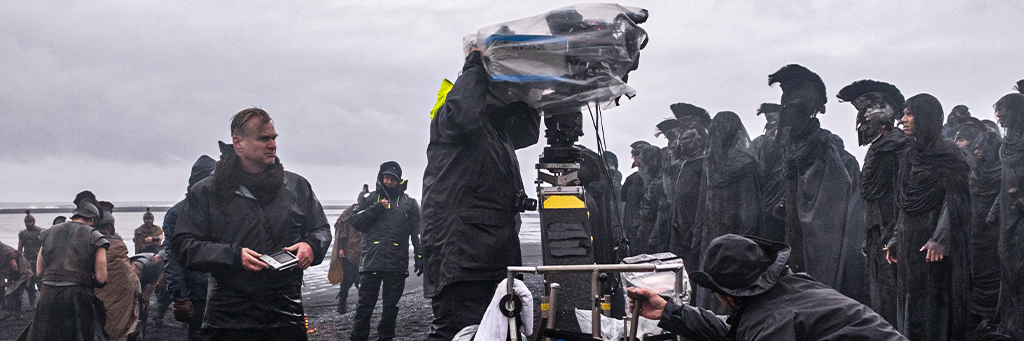
If there’s a sense of “otherness”, of something not quite earthbound, it comes from composer Ludwig Göransson, who uses magically odd percussion sounds and big male choruses that sometimes keep building in volume and pace like the music from 2001: A Space Odyssey when the apes find the monolith. I think I was under a speaker in the IMAX theatre I was in, and many times it felt like I was in the midst of an ancient tribal ritual. And it’s the human episodes that are crafted as set pieces. When Odysseus and his men face a storm, we feel as though we are in the middle of a ship that’s being torn apart by the fury of nature (or by unseen gods). When Odysseus has his big one-versus-many face-off with Penelope’s suitors at the end, we see what it’s like to fight off men several years younger. This is not about awe-inducing choreography, like in the Hong Kong action movies. This is about chaos, with just enough clarity to see what’s happening to whom.
The film keeps cross-cutting between the events in Ithaca and what’s happening to Odysseus, who’s tossed around from one place to another, one danger to another. If Odysseus is battling to get back home, Penelope is battling to keep her suitors at bay because she still loves Odysseus. And around Penelope, Nolan writes two of the softest, most emotional scenes he has written. One is the quietly sensual stretch that takes place before Odysseus leaves for the Trojan War. He wants Penelope to take a husband if he dies. She wants him to come back. It’s a very emotional scene, but it is staged like a matter-of-fact conversation between a couple making an important household decision. There is no melodrama. Another wonderfully written scene is the one where Penelope is emotionally manipulated by Antinous, one of her suitors played by Robert Pattinson with cockiness and authority.
And yet, the man is not an all-out villain. He worshipped Odysseus as a young boy and was hurt when he was not taken to war. Again, he is humanised. Charlize Theron plays Calypso with tenderness. Yes, she has imprisoned Odysseus, but she is also kind and she loves this man and has enough humanity inside her divinity to understand that he really belongs to Penelope. The only actor who seems a bit off is Zendaya, who plays the goddess Athena, but again, the character is developed with care. This is the goddess of wisdom and warfare, and having a young actor like Zendaya in the part makes Athena more “human”. It’s as though she is capable of making mistakes as much as Odysseus is, and she is also made to look like a human, keeping pace with Odysseus as he walks or weeping for Odysseus as he talks about his regrets. She doesn’t “appear” out of nowhere, and even when she leaves, she doesn’t “disappear” with a flashy visual effect. The camera turns to Athena, it turns to Odysseus, and when it turns back to where she was, she is no longer there. It’s simple. It’s wonderful. We are free to imagine whether she was really there or whether she was a hallucination or whether she was the mind-voice of Odysseus.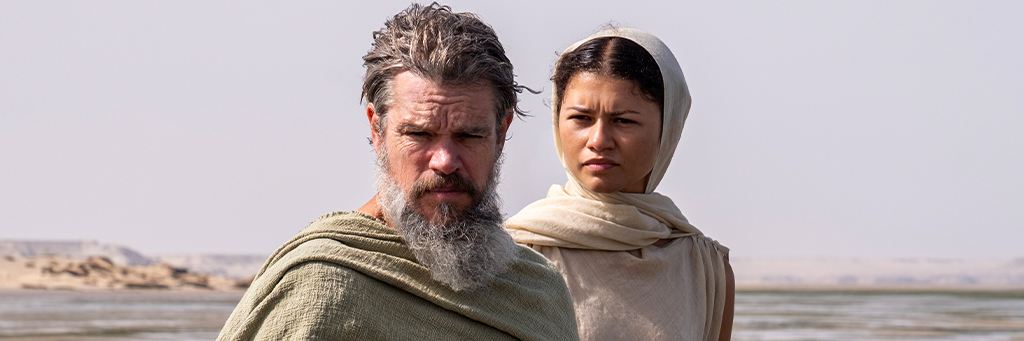
If I have used the word “human” about a hundred times in this review, it’s because that’s the defining characteristic of this movie – and surprisingly so for an adaptation of a mythical story that begs to be made in a splashy, larger-than-life style. The camera sometimes goes so close to the actors that we see the lines on their faces, the sag under their eyes, the spots on their skin. They are all humanised. Even Helen gets a scene where she asks Odysseus to apologise to Penelope for causing the war. At that moment, she is not the famous face that launched a thousand ships but just a woman who regrets the pain and sorrow she has caused another woman. Even the episode of the Trojan Horse is humanised. It is not a brilliant military strategy but also something that betrays a loyal soldier’s trust in Odysseus. (This character is played by Elliot Page.) We also realise that we have not thought about what it must have been like inside the Horse, with all the men cramped up against one another, wallowing in piss and shit.
The most human of all is Odysseus. He may have been a hero during the war, but now, he is a flawed man. He is an autocrat with his men. He says vain things like “I defy the Gods”. Despite knowing the dangers, he says that he wants to be the first man to hear the Sirens sing. But at the same time, he is like Oppenheimer. He comes to realise the cost of what he has done with his war and the Trojan Horse. He regrets breaking the trust between humans. He feels responsible for the collapse of all that was good about civilization. Are there any flaws in this film? I was so immersed, so overwhelmed that I could hardly see any. Even the time-tricks that Nolan likes to play are seamlessly woven in, with expertly placed flashbacks that vary in duration. When Antinous says he has seen Odysseus hunt, we get a quick flash cut of that visual from the past. A little later, a bigger stretch of this hunt plays out. Elsewhere, we see two dimensions of the same time period, like when a scene plays out outside the Trojan Horse, and later, we see the same scene from inside the Horse.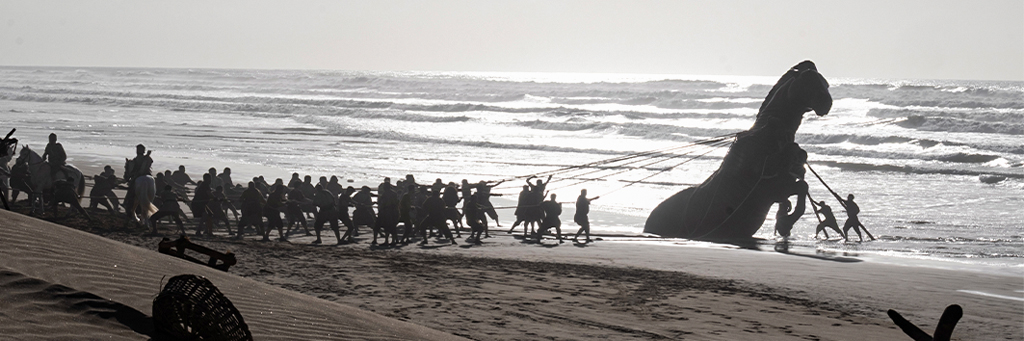
Jennifer Lame’s editing is stunningly in sync with Nolan’s writing. Though this is an episodic story, it doesn’t feel episodic. It just flows. The film does not look like a checklist of adventures. It is not “first this happened, then this other thing happened, and then they faced this third thing…”. Each adventure swirls around the central narrative in a most organic manner. Nolan’s writing can sometimes feel too geometrical in its precision and too emphatic in trying to make its points, but again, here, it all just flows. At one point, Odysseus is told that, after all the control he has tried to exert, he has to give up this control and take a leap of faith and just flow with the tide in order to get back home. I felt the same about Christopher Nolan here. For the first time in a while, he seems to have set himself free and crafted a film that doesn’t look calculated or designed to within an inch of its life. I am happy he got all those awards for Oppenheimer, but The Odyssey is the film for which he truly deserves those Oscars. The film genuinely finds a new way to read an old text, the way experimental theatre does – only, we get to see the proscenium in IMAX size. The Odyssey is art made by an artist operating at the highest level. It demonstrates the magic of cinema while remaining – yes – thoroughly human.