Akhil Akkineni shows he can be a mainstream leading man. He plays the title character, an orphan who grows up to be a big part of the family feuds in a village. Bhagyashri Borse is the love interest. The supporting characters have interesting and intriguing shades, and there are enough twists and masala-flavoured surprises to make the movie a decent watch. That’s the quick review. A longer analysis follows, and it may contain spoilers.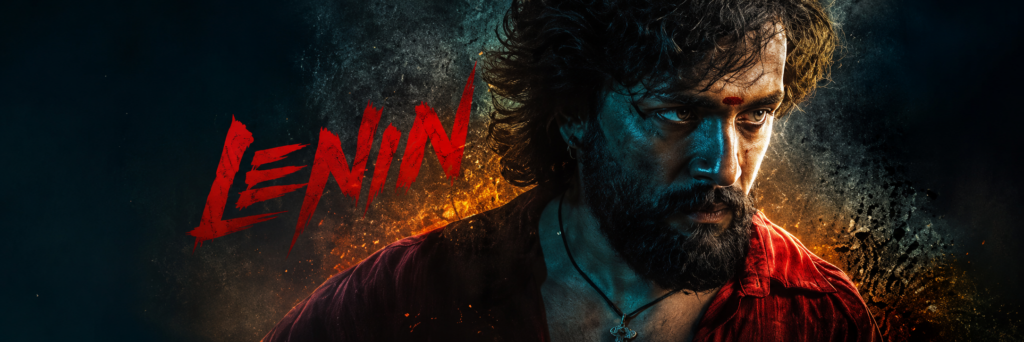
For the first time, Akhil Akkineni looks comfortable in commercial cinema. He looks like he belongs. Yes, his face has been given an artificial tan to make him blend into the rural setting of Lenin, but he looks relaxed. There are no nerves. Sometimes, the pressure of being a star kid is so great that they are pushed into cinema before they know the ins and outs of it. There’s only the pressure to be a star, like the father, like the grandfather. In Lenin, Akhil handles that pressure pretty well. He sings and dances with conviction, he fights well, he does the romance bits nicely, he delivers the big dialogues with flavour – he finally looks like he is owning the necessary “artificialities” of commercial cinema. He plays an orphan named Lenin. He walks into a village and is kinda-sorta adopted by the character played by Eswari Rao, a widow who presides over an 18-day festival called Bharatam Mitta, which has its roots in the Mahabharata.
These 18 days are meant to mirror the 18 days of the Kurukshetra war, and Lenin comes off like Karna, a nobody who becomes an important man because he is taken in by an important family, but then finds himself having to fight his own kin. There’s a Shakuni-like character who likes to gamble. There’s a woman who says that her love for her son blinded her, like in the case of Gandhari. The 18-day festival is dedicated to Draupadi, and we find an equivalent in Bharathi, played by Bhagyashri Borse whose midriff is given a tad too much prominence. (Haven’t we crossed those days?) But the actress is solid. In a satisfying masala-cinema touch, her relationship with Lenin begins and ends with blood. The writer-director Murali Kishor Abburu knows his way around this genre. He knows he is working with a basic revenge template, but the Mahabharata-based tweaks keep things mostly interesting.
A big part of the enjoyment of these films comes from whether there’s enough cleverness to counter the clichés. I thought there was. There’s something interesting going on with Lenin’s friend / brother figure Vasanth, played by Pramod Panju. There’s something interesting going on with the drunkard named Ethirajulu, played by Sivaji. There’s something interesting going on with Lenin’s reappearance in the village, after a stretch in jail. The film is not perfect, but it does show that no other industry has the utter belief and commitment to masala cinema as the Telugu film industry. It is this unapologetic conviction that makes the most far-fetched contrivances work, like the truth about Lenin at the end. We buy into this without hesitation because this plot point is the result of a particularly brutal act of betrayal, and we now want to see justice being served. There’s even a ghost. But I, for one, was not rolling my eyes. This is the film’s pitch. It works.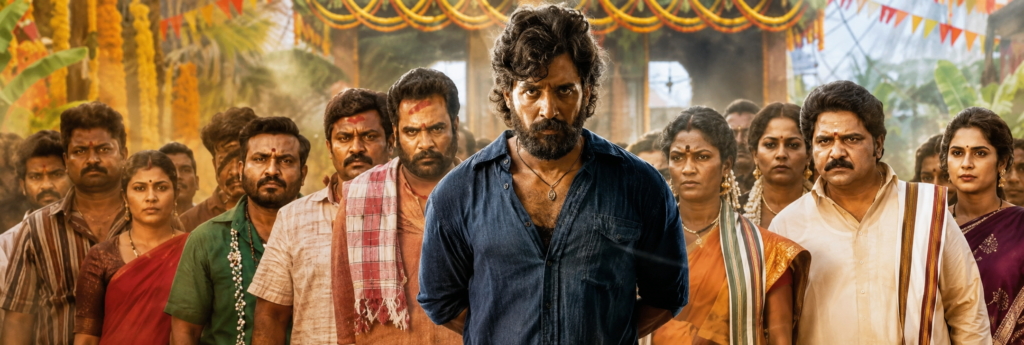
What doesn’t work so much is the love story between Lenin and Bharathi. I liked that she’s the bolder one. She gambles with men. She speaks up about being in love with Lenin, when Lenin feels awkward to declare his love for her. Even the role she plays on stage at the festival is that of Duryodhana. But there are too many songs. Thaman’s tunes are nice, but the romance could have used less choreography and more scenes that actually built the relationship between this couple, which is the film’s core. There are also some bits of lazy writing, where big secrets are conveniently overheard. Some characters are abandoned (like Eswari Rao, after a point), and many characters are hardly developed. One of Lenin’s friends is killed. We don’t feel anything because we’ve barely spent time with the man. But the big things work, and the big picture works – mainly because every little happening is developed with seriousness. That’s the key to making watchable masala movies. As much as the film is a showcase for Akhil, it is also a showcase for a certain kind of larger-than-life cinema. I was reasonably satisfied.