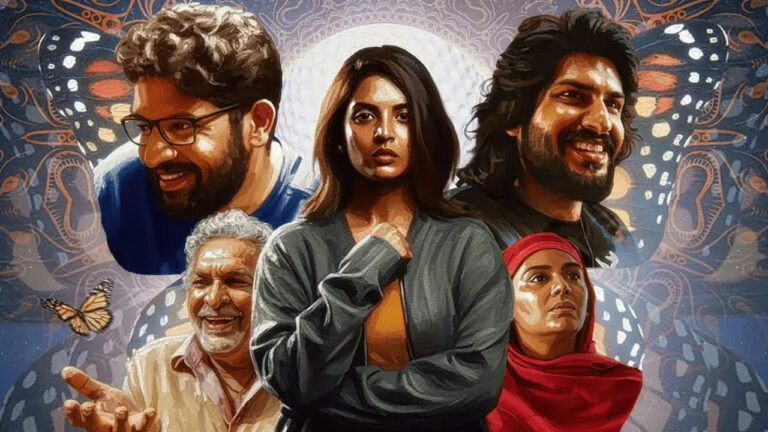
The film, however, is not about the protagonist’s condition. It is about his dream. It is a warm underdog fantasy woven around a bunch of likeable characters. The rest of this review may contain spoilers.
In Thalavara, Arjun Ashokan plays Jyothish. He has an older friend named Shyam, who is called “oldie” by their group of friends. In an early scene, Shyam comes by after dyeing his hair, eliminating the streaks of grey. It’s a casual scene in this apparently casual movie. Because if we dig a little deeper, we will see that Jyothish cannot do something similar for the condition that he has, the condition that has given him his nickname. He has vitiligo, and apart from using filters on his phone, there’s nothing he can do to eliminate the patches where his skin has lost its pigmentation. The pleasant surprise in Akhil Anilkumar’s film (which he co-wrote with Appu Aslam) is that it does not use this premise to become a noble, well-meaning weepie. It has a message, sure, but this is not the usual melodrama about a man who has to learn to accept himself. The film, instead, plays out like a warm fairy tale of an underdog with a near-impossible dream.
Jyothish dreams of becoming an actor. He has the genes of his movie-crazy father, played by an amusing Ashokan. The man is so movie-crazy that he cannot resist watching a clip even when his daughter goes missing. Thalavara is filled with asides like this. Devadarshini is very good as Jyothish’s grumpy mother, and she does not want her son to turn into another version of her husband. So for her sake, Jyothish attempts to go abroad for higher studies, and he runs into a travel agent named Sandhya (Revathy Sarma). As it turns out, this is more an opportunity for a meet-cute than a serious career move. An earlier version of this meet-cute has happened in the supermarket Jyothish works in. The romance track works beautifully, and Revathy Sarma is spectacular. She plays the girlfriend as a combination of motivational coach and guardian angel.
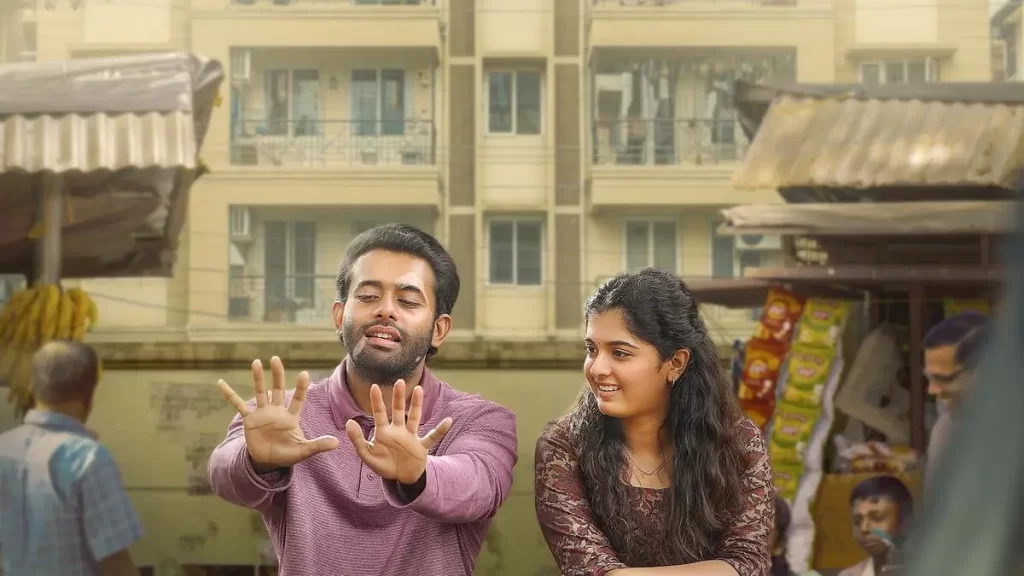
Thalavara means lines of fate, or destiny, and the film plays like something Ashwath Marimuthu might have made. Its emotional logic is stronger than its “logical” logic. If you wonder how a man who is a little self-conscious before a camera can nurture dreams of becoming an actor, this is not the movie for you. But if you buy the logic of this particular scene, that acting is less about looks than performance, then the film will leave with a smile. I loved the fact that the director did not give in to his social-messaging impulses and make a movie that is all spinach. There are takeaways, but there’s a tasty sugar coating that makes this more of a movie than a morals-dispensing machine. The film is not about vitiligo. It is about what happens around a man who happens to have vitiligo.
The overly melodramatic bits do not work. There’s one involving Jyothish being insulted at a film set. There’s another where Jyothish faces a producer who’s a bully. There’s yet another where Jyothish faces another actor who wants the same part. But this latter bit leads to a scene set in a hospital, with one of those rousing moments I did not see coming. The way Jyothish and his friends fight and make up, the way Jyothish’s mother makes her peace with his ambition, the way an unexpected death is followed by an unexpected bonding scene between a brother and sister, the way destiny plays a part in Jyothish going to Thrissur for an audition, the way Jyothish’s family brings up his condition only when really, really triggered – all of this works wonderfully. The writing of the scene where Jyothish finds out that his sister is pregnant – especially – is all kinds of joy.
Arjun Ashokan is moving and convincing, and his sincerity fills in the gaps in the story that the screenplay doesn’t. Thalavara requires you to do a bit of emotional connecting-the-dots, and I think this will be quite easy if you buy into these characters. Like I said, it’s a bit of a fantasy, but with just enough reality to root it in a recognisable world. The good people win. The bad guys are punished. And we are left with a reminder about the unpredictability of life, which is what some people call destiny. One moment, you could be cracking a joke. The next moment, you could have a heart attack. What matters is whether you lived the life you wanted to, the life that you chose. The scene illustrating this made me tear up a bit. Maybe it doesn’t happen enough in real life. But that is why we need these stories on screen, right?