Though the central characters are teenagers, this lightly melancholic story is not your average “teen movie”. It’s about three sets of fathers and sons in “those innocent days”. The rest of this review may contain spoilers.
Satyajit Sharma plays the father of a schoolgoer named Anurag (Aryan Singh Rana), and I think many of us may see shades of our father in this man. He lives with his wife and children in Chandigarh. He wants his son to get into a good college in Delhi, and worries that the boy may be slacking off. So he tells Anurag, “No friends, no girls, no TV.” Like many fathers of a certain generation – this film is set in the early 2000s – his concern and worry come out as borderline-tyranny. His wife says that he could have said the same things with love, but the man replies, “[My son] may hate me now but he will thank me one day.” Maybe this is why a teacher tells her students that they should get their report cards signed by their fathers, and not their mothers. Spare the rod, spoil the child. At one point, while Anurag slouches at his study desk, his father literally shoves a rod down the back of his shirt, so that he will sit up straight.
Ghich Pich is a beautifully realised story about three sets of fathers and sons. The other two narrative threads are about Anurag’s classmates and besties, Gaurav (Shhivam Kakar) and Gurpreet (Kabir Nanda). Gurpreet belongs to a Sikh family, and he wants to cut his hair. His father says his name means someone who loves the Guru. How can he even think of this sacrilege? Gaurav, meanwhile, discovers that his father is in an extramarital relationship. He is devastated, and it’s worse when he realises that his mother has made her peace with it. The director Ankur Singla does not judge her, nor does he paint her as “progressive” or whatever. Every person is different. Every family is different. The performances are uniformly excellent, and what could have been drama (or even melodrama) becomes a sort of slice-of-life narrative. Like Gaurav does in one scene, we could be peeking into these homes through the windows.
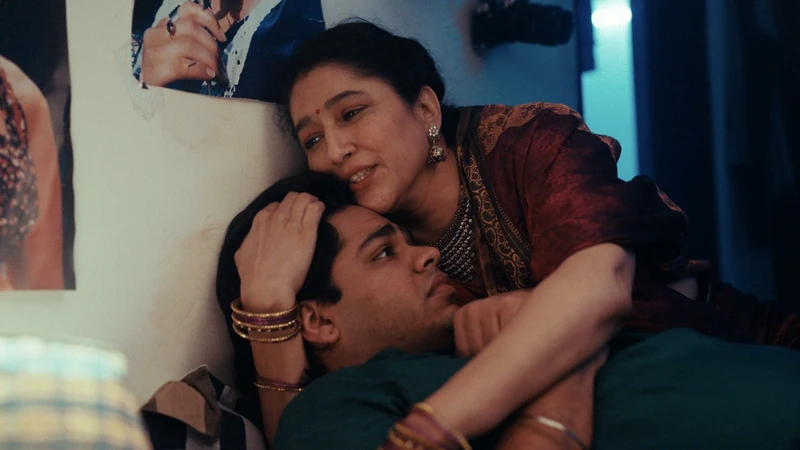
This lived-in feel is the film’s biggest achievement, and it’s enhanced by the handheld cinematography and a colour scheme that looks like what photographs used to look like in the age of film-roll cameras. Even the “typical” scenes – like Gaurav annoying his teacher, or Gurpreet falling for someone who loves the Head Boy – carry a light touch of melancholy. Anurag advises Gurpreet that he’d better let that girl go, because he is lacking in all the criteria that girls look for (money, looks, etc.). “Sometimes, we just have to accept that others are better than us.” Another welcome atypical choice Ghich Pich makes is to sidestep the hormonal issues that are so easy to write into a story about teenage boys. I loved that Gurpreet’s idea of romance with that girl is to treat her like a princess. He is horrified when his friends ask if he’ll kiss her.
As time flies, the period that each generation considers “those innocent days” keeps changing. In this story, we get a reference to Chandrachur Singh, making pizza on a tawa, love letters written in blood, and a very touching use of an Internet search. One of the sweetest scenes in the film occurs when the three boys set out in Anurag’s father’s car, and find themselves face to face with another car. One of them has to back up so that the other can pass. The male driver of the other car shouts at the boys. The boys shout back. Then the woman sitting next to the man gets down and requests the boys to let them pass. The macho aggression melts in a moment. All the boys can talk about is how pretty she is. Ghich Pich is filled with such wonderful observational moments.
How do we look at the closing stretch? Of the three father-son stories, two seem to end happily and the third one seems like something’s gone wrong. But then, a character smiles and we see their point of view. Life in a small town can be stifling. Getting away can feel like you’ve suddenly sprouted a pair of wings. I was reminded of Udaan. The others are doomed to live the same lives their parents lived, though they might not think of this as doom. Every person is different. Every family is different. From one point of view, an affair is a violation of everything that a family is supposed to be according to society’s dictionary. But someone else may see this as one of the many “adjustments” a man and a woman have to do in order to build a home. Ghich Pich is the most empathetic movie I have seen in a while.