The film is about a number of characters in a number of relationship conflicts. Some are treated seriously, some are treated comically, and there’s definitely a vision – but there’s no emotional connection. The rest of this review may contain spoilers.
There are many characters and many relationship stories in Anurag Basu’s spiritual sequel to Life in a Metro – and there are two flavours of storytelling. The first type is where angst is treated like angst, like in the track with Ali Fazal and Fatima Sana Shaikh, who play Akash and Shruti. They are married. He is a software developer, but he wants to be a musician. He says things like the guitar in his hand has been replaced by a keyboard. Can he not come home after work and pick up that guitar again? No. He is one of those all-or-nothing artistic types. It’s either being a full-time musician or being a full-time developer. At one point, Akash’s very, very understanding boss asks him to take a month off and see if this music thing works, and if it doesn’t he can come back. But Akash says that a safety net kills the drive, and this quickly kills any sympathy we may have for this character.
The second type of storytelling here is more interesting, at least in theory – where angst is played like farce. We find this in the track with Pankaj Tripathi and Konkona Sen Sharma, who play Monty and Kajol. They are a long-married couple. She says (in her mind-voice), “Dar lagta hai ki agar nazar takrayein to ek doosre ko kehne ke liye kuch nahin rahega.” But when infidelity comes in through a dating app, the very serious situation becomes very funny. Both actors are wonderful. They totally get this pitch, which is also found in the track with the former schoolmates played by Neena Gupta and Anupam Kher. Anurag Basu attempts something really audacious here. Remember those Hrishikesh Mukherji comedies where people were always role-playing, pretending to be someone else? Now imagine this jokey, over-the-top tonality inside a full-blown father-daughter melodrama! That’s what’s happening here.
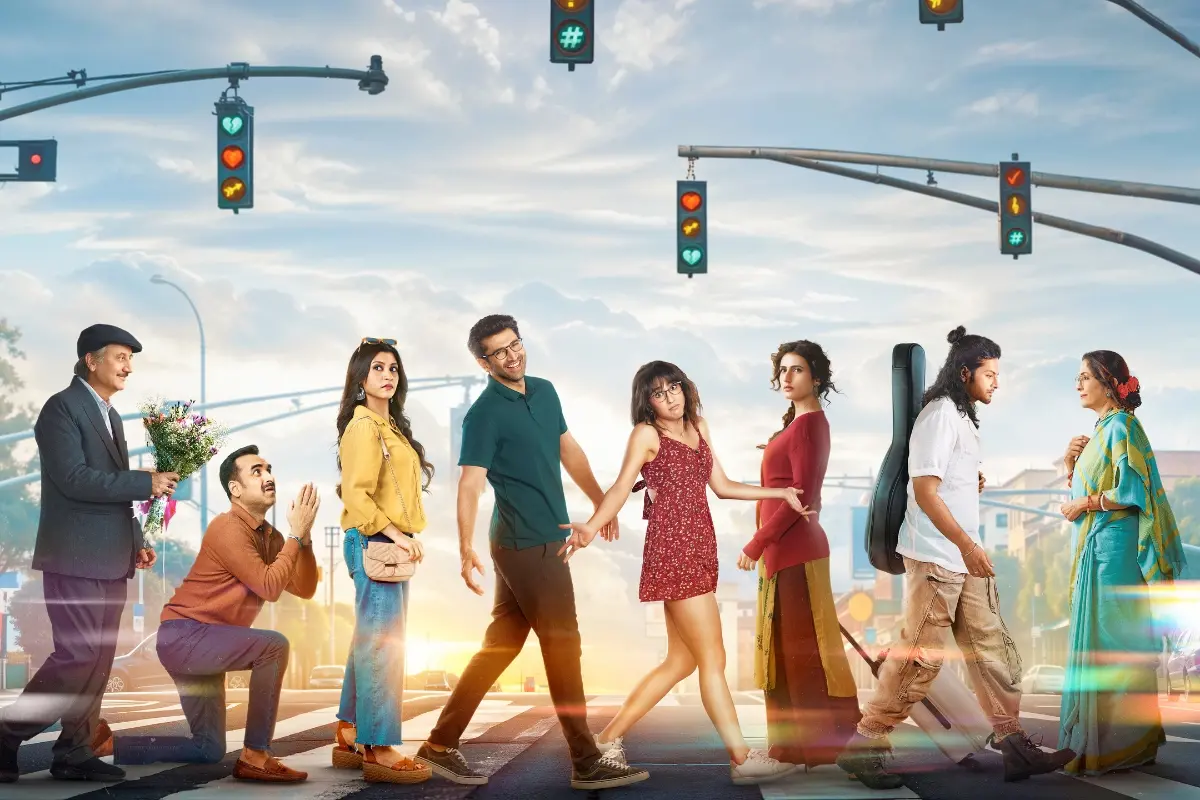
For a while, there is a delicious oddness about Metro… In Dino. Slowly, we find how the characters come together, either in the “angst played like drama” way or in the “angst played as comedy” way. The weakest track is the one with Aditya Roy Kapur and Sara Ali Khan. He can’t stick with one partner for long. She needs to grow a spine, so that people don’t keep taking advantage of her. The way these arcs play out is very obvious, and the flat performances don’t help. But the bigger issue with the film is that it never amounts to being more than an interesting and ambitious experiment. The situations are too generic, too predictable. There’s a lovely line where a housewife describes herself as the equivalent of a “jeb mein rumaal”, like a handkerchief in a pocket, an unremarkable item of utility that’s remembered only when needed. The writing is filled with asides like this. But there’s nothing much around these lines. We don’t feel the pain of infidelity. We don’t feel the pain of failing at one’s passion and being called a loser by your wife. Everything is resolved a little too smoothly, and the non-stop score makes it all look like a harmless music video.
And then we have Pritam’s songs, which are good on screen but don’t have much variation: they all sound like easy-listening pop-rock. But more than the songs, it’s the way they are used. Sometimes, we see Pritam and his band on screen, performing these songs like a Greek chorus as the film’s characters go about their business. Sometimes, the characters talk and sing to the camera. And sometimes, there’s a full-on Hollywood musical vibe, like when men wearing suits at an office burst into song and dance. Again, full points for ambition, but this non-stop music (either as a score or as songs) keeps cutting into what we are supposed to feel for these characters. I ended up feeling nothing. I felt I was watching something pleasant and distracting, but nothing that really cut deep.
The one character that registers is a teenager confused about her sexuality. In the midst of the Technicolor whimsy of the other tracks, there’s a blunt, no-fuss honesty about this story, and the kids are wonderful. And the filmmaking, throughout, is superb. The warm cinematography is by Abhishek Basu and Anurag Basu, and I found myself wondering about the amount of footage they shot in order to weave this tapestry of interconnecting lives. Even the writing is fantastic in terms of form, if you overlook the predictable content – and the film would not exist without the very intricate editing of Bodhaditya Banerjee and Satish Gowda. But with all this, Metro… In Dino says very little that you don’t already know, and I wished they had made this an OTT series where every character had had more space to breathe and not just be a set of bullet points. Experimental filmmaking is necessary to break the monotony, but not at the cost of old-fashioned values like emotional connect. Otherwise, it’s just the filmmakers having fun, not the audience.