This is the story of a writer who confronts not just his characters, but also his own biases and prejudices. The inventively made film doesn’t preach, but it leaves you thinking. The rest of this review may contain spoilers.
On the surface, Mayakoothu is the story of a writer of serialised novels. His name is Vasan, and he is played by Nagarajan Kannan. Delhi Ganesh plays his publisher and editor. He says that writing is a dying art, as no one reads anymore. He is running this publishing company on behalf of the owner, who is keeping the company going only because his father is the founder. After the father dies, the son will shut down the publishing house, and in effect shut down the career of writers like Vasan. Even Vasan’s wife is not a reader. She watches television serials, and she wishes he’d write those instead. Vasan keeps pouring out his frustrations to a sculptor – that is, another creator. The man becomes both an advisor and a sort of conscience. One of the things this sculptor says is that everything we create has an impact. In other words, the stories that Vasan writes – they are more than just strings of words meant to entertain his readers.
What exactly are these stories? So first, let’s look at the three serialised novels that Vasan is writing at the moment. One is about a gangster named Dhanapal. He has murdered 49 people, and now he has learnt that there is an undercover cop in his gang. This is the point up to where the last installment of this story has stopped: that is, Dhanapal has to figure out who the mole is. The second story is about Selvi, who works as a domestic help. She is married to a carpenter who likes to drink, and they are struggling to pay their son’s school fees. The third story Vasan is writing is about a farmer’s daughter who wants to become a doctor. But to achieve her goal, she needs to clear a difficult entrance exam. Can she do this on her own, without expensive coaching?
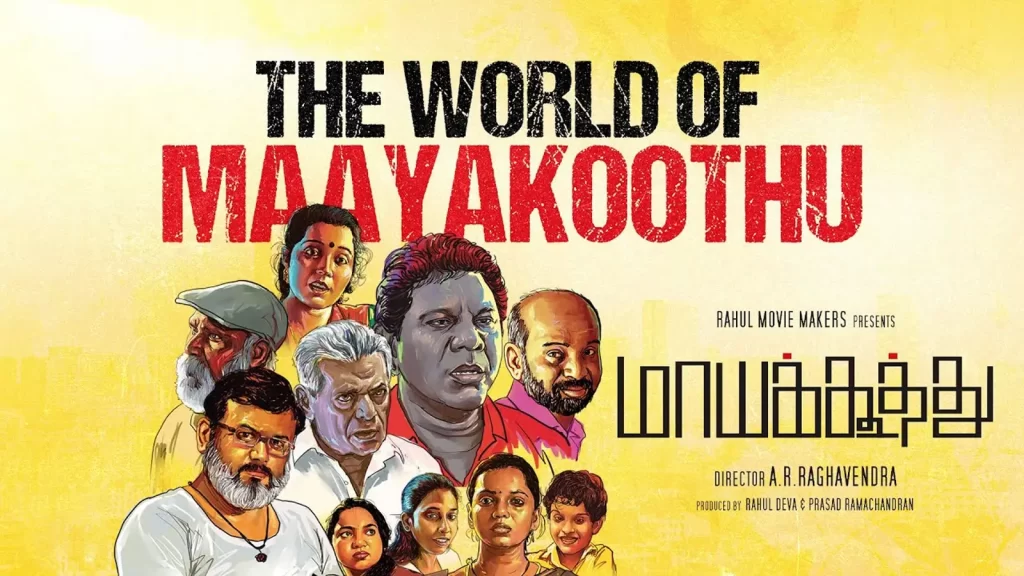
All these stories come to us in the form of episodes that keep cutting into one another. We see the characters in each story played by actors. The first sign that this is not your usual hyperlink movie is when Vasan gets a call from a disappointed reader, who asks why Vasan has given the farmer’s daughter access to pesticide. Is it because her parents are asking her to drop her dream, and is this plot point a sign that she will end her life? If yes, isn’t that a pessimistic view of existence? Shouldn’t her fate be decided by her efforts, and not by the author’s whims and fancies. Vasan does not understand this argument. After all, he is the creator of this world and its characters. Does he not have the right to decide their destiny? A little later, Selvi pays Vasan a visit. It feels like an extension of his imagination. She is a character that he dreamed up and she does live in his head, after all. So isn’t it natural that she’d almost feel like a flesh-and-blood person to him?
A writer who begins to interact with his characters as though they are real people: this is where the inventiveness of the screenplay begins to really bloom. Vasan’s editor jokes that his situation looks like something from a Nolan movie. But perhaps that’s not the right reference. Nolan’s brilliance lies in external conflict, and the name that came to my mind more readily is Charlie Kaufman, the creator of mind-bending internal journeys like Being John Malkovich. And the film that came to mind is Who Framed Roger Rabbit?, which is set in a Hollywood where cartoons coexist with humans. In Mayakoothu, the creator coexists with his creations, his characters – and they challenge his prejudices and biases. Why shouldn’t a farmer’s daughter become a doctor? Why should a domestic help’s husband always be a drunkard? Why are henchmen always named Mari, Kabali, or Kaali – as opposed to, say, Chandrasekhar? Why are lower-income people like auto drivers depicted as pimps or thieves?
The lack of a budget shows in Mayakoothu, but the film – which runs less than two hours – overcomes this limitation through its inventiveness. It manages to make us think without being preachy, which is more than what we can say about most movies that set out to change society with well-meaning messages. Maybe the God in the heavens has created a world that’s unequal, but the creator named Vasan can change things through his narrative choices. He can deliver optimism. He can deliver justice. The necessary political exposition and philosophising are nicely done. (The director, AR Raghavendra wrote the film with M Srinivasan). In real life, Vasan is surprised that an auto driver can read, but he does not have to carry this mindset into his writing. If he wishes, he can choose to be a responsible creator who is not just shaped by his circumstances but is open to learning from those lower down the social ladder. The film left me thinking about the power we wield in our respective professions, and whether we use that power wisely. That is one hell of a takeaway.