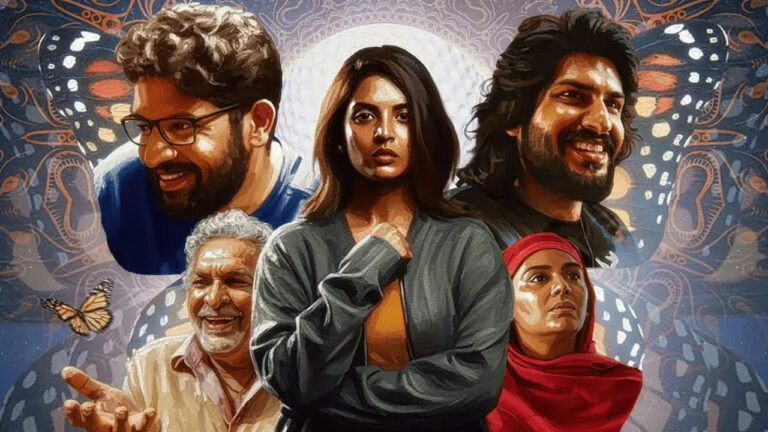
This stunningly shot first feature features newcomers, and this eliminates the distance between real and make-believe. Their feelings and yearnings become our own.
Director Avinash Prakash has been my show producer ever since I “went digital”, and I have heard many of the incidents – traumatic and otherwise – narrated in this partly autobiographical story, set in Ooty. His biggest achievement in Naangal is to bring to life the word at the centre of the film’s being: “hiraeth”. It refers to a certain kind of homesickness, sometimes for a home you never knew existed. For us, most of the private lives of other people are that way. We don’t know these people existed, and yet, on a movie screen, their feelings and yearnings become ours: partly because some of human experience is shared by everyone, and partly because the part that is not shared, the part that is specific to others, comforts us that we are not alone. In Anna Karenina, Tolstoy wrote this about adults: “All happy families are alike; each unhappy family is unhappy in its own way.” Naangal transposes this sentiment to a story about children.
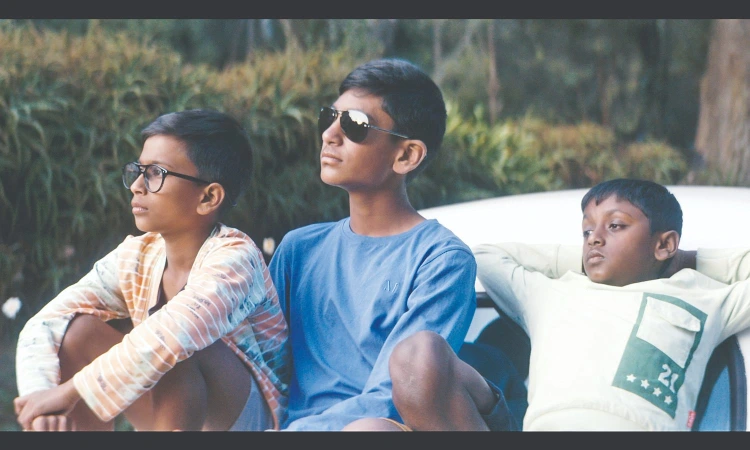
The film is set largely in the 1990s, and the opening stretch shows the three brothers – Karthik, Gautam, Dhruv (Mithun V, Nithin D, Rithik M) – being kids. They play with soap bubbles and take pleasure in tormenting one of them who’s afraid of the dark. But between these “fun” episodes of buying comics and watching movies and playing with their dog Kathy (Roxy), there’s a strain of adult responsibility that peeks through. They have a list of things to buy for the household: vegetables and so forth. Isn’t there a grown-up around? Who is doing the cooking and cleaning? Who is making sure these children are going to school or that their homework is being done?
The answer is revealed in a dramatic flash of thunder and lightning, when we meet the father, Rajkumar (Abdul Rafe). The (partial) reveal of the man is in black-and white. Other portions of the film play in colour. The Ooty light is soft and it allows Avinash (he shot the film, and also wrote and edited it) to capture some of the most indelible “ordinary” images in recent memory. Naangal is not a spectacle, but the ordinariness, the next-door-ness of its events give the constant sense of major drama. And a lot of this drama comes from the unpredictability of Rajkumar. Is he a good parent? No. Is he a bad parent? Again, no. He is just a failed parent, someone who loves his children and also lashes out at them with utter cruelty, depending on how life has treated him that day.
He is a failed husband, too, as Padma (Prarthana Srikaanth) will attest to. Somewhere between these two adults and their three children, we get an epic story of small things – though to the people these things are happening to, it’s as monumental as a volcanic eruption or a nuclear explosion. It’s just that there are no special effects. I have seen different cuts of Naangal over the past few months, including a four-hour-eighteen-minute version that played at the Jio MAMI Mumbai Film Festival, in 2023. What we have now in theatres is a roughly two-and-a-half hour version. Every single time, in every single version, I felt my childhood come alive, dysfunction and all.
Given the first-time nature of these actors, there are some stretches that stick out. But as Naangal goes along, it pulls you in. The actors slowly fit in, and several sequences are standouts – like the one between Rajkumar and Padma by the fireplace, or the one with Rajkumar and the boys in a restaurant, or the one where the boys’ grandfather apologises to Karthik. There is a scene where two young boys have rolled up pieces of paper for a “message in a bottle” scenario. Their father is at a distance, walking with their older brother, and seeing him, these two kids drop to their knees to hide from his line of sight. But he finds them eventually, and they all start talking, and the evening light turns to twilight, and the scene becomes a living-breathing photograph.
Other times, we get a scene that is a living-breathing nightmare. Take the stretch where one of the kids is cleaning the floor. The scene is shot entirely from the eye level of the crouched child, who is gathering cigarette butts and other bits of dirt. The father appears, seen only up to his knees. Not a word is spoken. He casually runs his finger against a corner, and the finger comes off grimed with dust. He taps the point of his shoe at a few places, indicating that there’s more dust. He leaves. The child begins to clean with renewed intensity. In the father’s mind, he is probably instilling “discipline”. But the child is a wreck. What is it about some men that they behave this way? Why do they get married in the first place? And yet, the lives of Gautam, Karthik, and Dhruv would be poorer without this man’s shadow looming over them. That’s the strange push-pull of bad parents: you hate them… until you find out that you love them, too. You want their embrace, their approval. This complex and delicate web of emotions is spun along by Ved Shanker Sugavanam’s complex and delicate music. Every contributor to Naangal ensures that we leave the film with a heart filled with feeling, with the reassurance that well-narrated fiction can make someone else’ nostalgia become our own.