
There are times I look into a mirror and I don’t know the person staring back at me. In my mind, I’m still the guy who giggles whenever someone sighs about life and says… “it’s hard”. My algorithms know all about my fondness for shit and fart jokes. I don’t take myself seriously. I think reasonably young-ly. I run from giving (and taking) advice. And yet, I am also the guy who gets asked to dye his beard because I work in a “visual medium” and you don’t want people to think you are “old”. (This happens more often than you’d think!) And if that’s how it is with me, I wonder how it must be with handsome, chiseled-look movie stars as they pass through the decades. Tom Courtenay was one of the youthful faces who embodied the British “new wave” in films like The Loneliness of the Long Distance Runner and Billy Liar. He was about 25 then. He will turn 89 soon, and was probably a year younger when he shot for Queen at Sea, one of the best films at this edition of the Berlinale.
I haven’t seen Courtenay in a movie since 45 Years, which was released in 2015. (He’s been active though. His filmography shows quite a few entries since then, but I have not seen those films.) 45 Years, too, was an autumnal story, about a man who’s about to celebrate his 45th wedding anniversary. When an actor is always in the news – or even filmmakers like Martin Scorsese or Steven Spielberg – the age factor doesn’t seem to be that much of an issue, because we see them like we’d see family, and the extra grey hair or the extra wrinkles are not instantly noticeable. But when you see an actor after ten years, and when your primary memories of that actor are from their prime, you feel like an NRI who’s returned to India after a long time, and you’re the one saying shushed-voice things like “they’ve gotten more frail”. That was the reaction I had to Tom Courtenay in Queen at Sea.
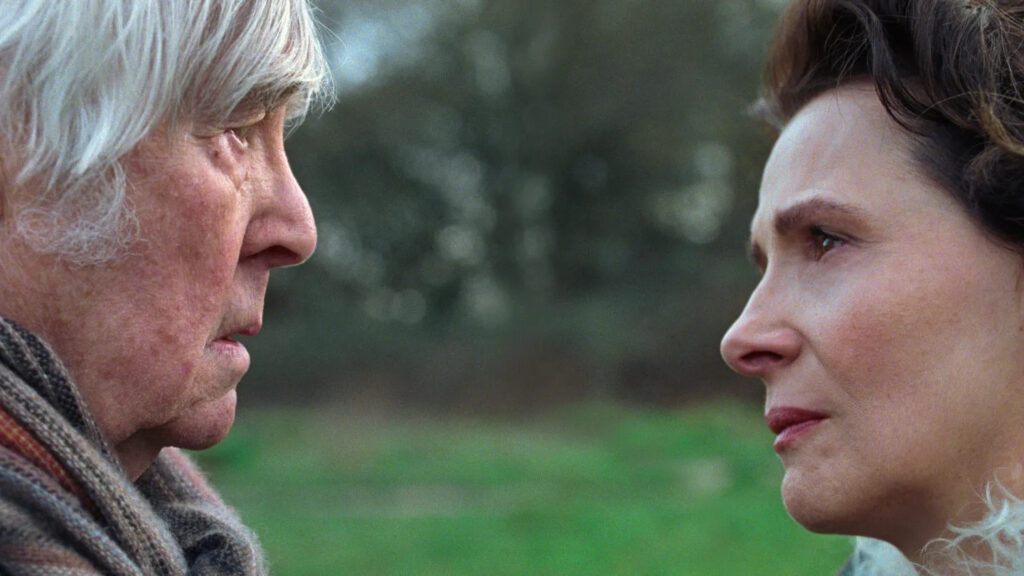 The film, directed by Lance Hammer, follows the structure of Michael Haneke’s intimate epic about old age, Amour. There, we had Jean-Louis Trintignant and Emmanuelle Riva playing a couple in their eighties. The wife has a medical condition, and the husband cares for her. The daughter, played by Isabelle Huppert, wants her mother to go to a care facility, but her father won’t agree. In Queen at Sea, Tom Courtenay plays Martin. Anna Calder-Marshall plays Leslie, who has a medical condition. And Juliette Binoche is their daughter, Amanda, who wants Leslie to go to a care facility, while Martin resists, insisting on taking care of his wife all by himself. When I watched Amour, I was a decade younger, my parents were a decade younger, and the emotional hit wasn’t quite the punch in the gut. I was very moved, but in the empathetic way that we respond to well-crafted characters in any kind of well-told story. But now, with me and my parents thirteen years older (Amour was released in late 2012), the connect with a geriatric story is so much more immediate. I was gutted. If you’d asked me what I felt about the film as I walked out of the theatre, I’d have said it’s shattering. I’d probably have also said I never want to see it again.
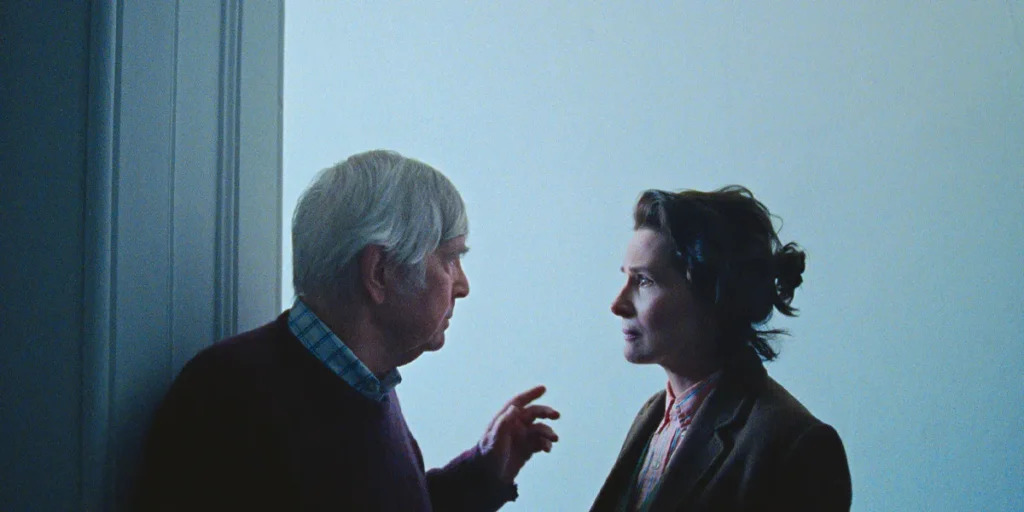 Queen at Sea opens when Martin is having sex with Leslie. A man is having sex with his wife. What’s the problem, right? But the wife has dementia – that’s the problem. Amanda is frustrated and she calls the cops. She has warned Martin about this many times, but he refuses to listen. Amanda says that Leslie cannot consent to sex, because her mind is not quite there. Martin sees it differently. Is consent always worded? Even if Leslie cannot say “Yes Martin, I would like to have sex, I agree to have sex with you,” there are things she does that tell Martin that she wants sex. Because after a point, intimacy doesn’t need to be initiated with words. We see Leslie sliding her hands down Martin’s pants. Her blue eyes may be frighteningly zoned-out, but her hands know what they are doing and what she wants. How can Amanda be aware of these signals between Leslie and Martin? And even if she has power of attorney over Leslie’s care, does she have the moral authority to invade a marriage?
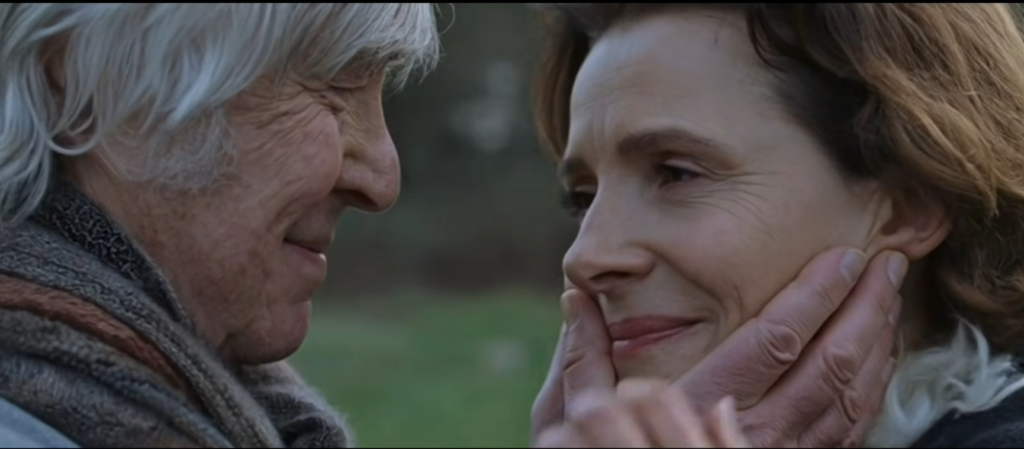 Queen at Sea is filled with difficult choices, because Martin himself is one of those stubborn old men who thinks he can take care of his wife (they live alone, Amanda keeps visiting) – but what if he cannot realise that he needs, at the very least, a nurse? What if he keeps insisting that he knows what’s best, but cannot see that age has hit him, too, and he’s not the Martin he once was? The director makes a brilliant – but also cruel – choice in sliding in a subplot about Amanda’s young daughter. It’s brilliant because it’s a contrast to the main story. This young girl is at the prime of her youth. She’s just discovering love and sex. And so forth. It’s cruel because the contrast keeps reminding us about how much at the end of their lives Martin and Leslie are. You look into the mirror and see a grey beard – that’s one thing. You walk out of your house and see a teenager whose moustache is just sprouting – that’s an entirely different thing.
Because so many of the critics who attend film festivals are middle-aged or more, Queen at Sea hit us quite hard. The film also made me think about the situation in India. At least in this particular cinematic universe – set in the UK – care facilities are actually a thing, with trained caregivers, cameras in corridors, and so on. Back home in India, even if you have the money, it’s usually difficult to find good spaces for the elderly. Yes, we may want our parents around us till the end (their end, our end, whichever comes first) – but if the situation is such that their situation cannot be “managed” (like with Leslie and her dementia), what do we do? Cinema is so personal, that way. Provided we have the empathy, we can always “identify with” all kinds of stories: about Gen X, about older people, about animals, about aliens. But some of these stories hit home because you are just at that point in life. When I saw Ordinary People as a teenager, I saw myself in the traumatised young boy who needs therapy because he is unable to talk to many people. Today, I saw myself in Amanda. The positive side? At least you know you are not the only one in this situation! Amanda is me, too.