
The geek in me peeked out for a second when I heard the title of Australian (and Aboriginal) director Warwick Thornton’s new movie. It’s Wolfram… and instantly, my mind went back to the periodic table. Wolfram is another name for Tungsten (symbol W, atomic number 74). It is with great shame that I’m recalling those days as a front-bencher, always getting good marks in Chemistry and thinking that Chemical Engineering (which I would go on to do) would be more of the same. Instead, I got stuck with blood-curdling things like thermodynamics and distillation towers. Now that I have been rescued from those horrors, I’ll get back on track with Wolfram. The director’s awesome story is ready-made for a Hollywood biopic. His first appearance at the Berlinale was when he showed his short films. “I actually started believing in myself by getting into Berlin,” he said in an interview. And now, he’s back here with a film that’s competing for the festival’s top prize, the Golden Bear. How’s that for a full circle!
Wolfram is set in the Australian Outback, and it shows those vast expanses exactly as I imagined it. The Outback inside my head comes from Colleen McCollough’s The Thorn Birds, which has this passage. “Life seemed mostly flies and dust. There had not been any rain in a long time, even a sprinkle to settle the dust and drown the flies; for the less rain, the more flies, the more dust. Every ceiling was festooned with long, lazily spinning helixes of sticky flypaper, black with bodies within a day of being tacked up. Nothing could be left uncovered for a moment without becoming either an orgy or a graveyard for the flies, and tiny speckles of fly dirt dewed the furniture, the walls, the Gillanbone General Store calendar.” Every frame of Wolfram is festooned with flies. The scenery is gorgeous, but the air is filled with flies, which don’t seem to bother the locals. They’re probably used to it. They are insiders, and that’s the feel you get when you watch this Western-model movie – that it’s been made by and with insiders.
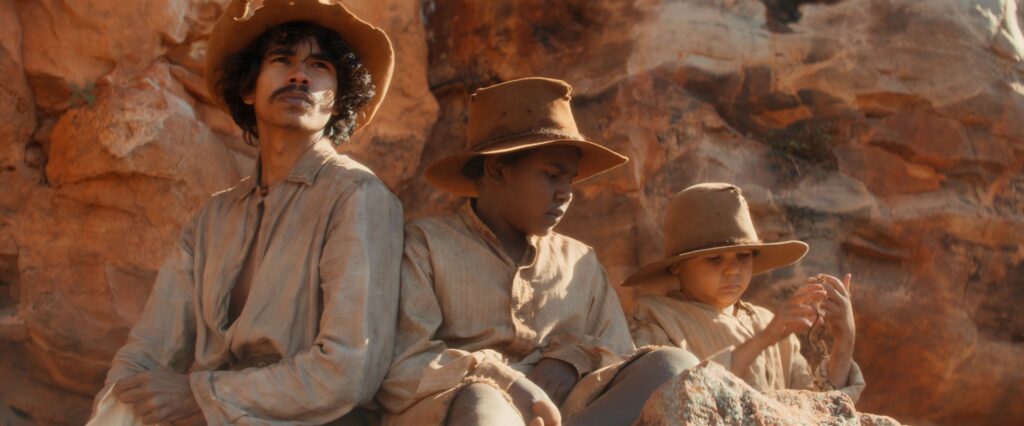 The spare story is set in the 1930s. Two children – child labourers – escape from a Tungsten-mining camp and are pursued by two outlaws on horseback. The kids want to go back to their mother… But all this is redundant. I was just caught up in the landscapes and the harshly sunlit scenery. And also the wonderful cultural details. The (Aboriginal) mother leaves a trail for the kids. She has nothing except her physical self, so she cuts bits of her hair and weaves them into shapes and puts them out on bushes and fences. There are also cruel cultural details, like the fact that Aboriginal children found without parents became the “property” of the finder. A window into a strange and beautiful folk culture – that’s the USP of Wolfram, and that’s the USP of Soumsoum: The Night of the Stars, whose local idiom is filled with delicious lines like “A piece of wood left in the river can never become a crocodile” and “A promise is like spit… Once you put it out, you can’t take it back.”
Soumsoum, directed by Mahamat-Saleh Haroun, is also in the Competition section, and I think this is the first film I’ve seen that’s set in Chad. But the stunning scenery apart (this is a movie that demands the big screen and eats up every inch of it), the village where the story unfolds is as unforgivingly patriarchal as most such villages are. The protagonist is a seventeen-year-old schoolgirl named Kellou, who has supernatural powers that she can’t yet comprehend. She can see what others see in the visible world, and she can also see beyond. At one point, she reveals a fact about her father that stuns him, because he thought it was something no one else knew but him. Like anyone who’s different in any way, Kellou is troubled – and the village begins to view her as a troublemaker. The only person who can help Kellou is someone who is like her, a middle-aged woman named Aya. A strange bond is forged between these two women, and their journey makes us realise that “all living things are connected to each other.”
 If there was an award for the sweetest film of the festival, it would go to The Loneliest Man in Town, directed by Tizza Covi and Rainer Frimmel. Al Cook is a musician whose home in Vienna is filled with memorabilia from the Elvis era, and the blues guitarists even earlier. The building is being torn down. All the tenants have moved out. And now, Al has to vacate. Part of the film is about losing the possessions that have come to define a life. That VCR with those video cassettes containing recordings, the books, the vintage posters that are now collectors’ items – Al has to let go of it all because he plans to move to another country. He plans to move to a southern part of the US, where the blues was born. Meanwhile, he runs into a woman he used to date. She’s a Beatles fan. When every movie wants to pound you into submission with sensation, The Loneliest Man in Town drifts along like a blues song playing on a gramophone in the neighbour’s house. It’s irresistible. You can’t help jiving along.