Dhanush plays a man who returns to his village after a stint abroad, and he wants to continue his father’s modest food business. He also wants to continue the tradition of goodness that his father instilled in him, and this becomes difficult when Arun Vijay begins to do bad things. The concept is solid, but the writing isn’t. The rest of this review may contain spoilers.
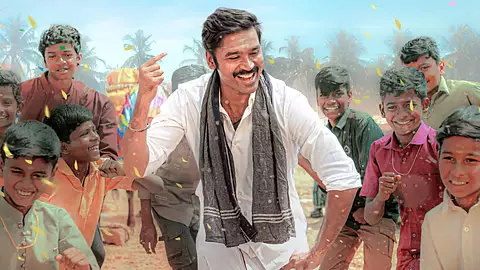
Idli Kadai is Dhanush’s fourth film as director, and the guiding spirit of the story is a good-hearted man named Sivanesan (Rajkiran). He owns a small eating joint whose specialty is the idli he makes. He wakes up early, bathes and prays and looks as though he is going to a temple rather than to prepare food. And he believes in doing things the old-fashioned way. After examining an electric grinder, he says that the quality of the batter is not as good as what he makes by hand. After examining an option to open franchises in nearby towns, he turns the option down because he cannot be physically present in every outlet. Dhanush plays Sivanesan’s son, Murugan. Like many youngsters, he wants a better life. But Sivanesan says that a better life isn’t just a car or a bungalow, but also the clean air and the clean streams of their village. Murugan is frustrated. He takes off to Bangkok.
When circumstances force Murugan to return, I thought we were in for an idealistic story like Swades, where a man gives up the “better life” he has abroad for the simple pleasures of his homeland. And the first half does play out this way. But pre-interval, there’s an interesting genre shift. A villain enters the village in the form of a millionaire named Ashwin (Arun Vijay). There’s a backstory. Back in Bangkok, Murugan was supposed to marry Ashwin’s sister Meera (Shalini Panday). Murugan’s return to his village ends up canceling this marriage, and Ashwin wants revenge. And the second half turns into a more philosophical zone. Murugan wants to live the life that his father did, following the principles of ahimsa, or non-violence. But can such goodness be pursued when there is so much evil, in the form of Ashwin? Or to put it in commercial-cinema terms, can a hero afford not to show “heroism” when the villain blatantly displays “villainism”?
These interesting concepts are not translated into a convincing movie. The first half is too simplistic, and there’s way too much melodrama, amplified by GV Prakash’s non-stop score. It might have helped to show how Meera fell for Murugan. Their pairing is barely convincing. The other pairing, of Murugan and the Nithya Menen character in the village, is also very sketchily written. Sathyaraj plays the father of Meera and Ashwin. It is a good part. He is a man who loves his son so much that he overlooks everything the son does. But after a point, you wonder how far Ashwin will have to go into the path of evil before his father says enough is enough! In Raayan, Dhanush’s most focused film as director, he shaped generic archetypes into characters that felt lived-in. Here, it all stays at the generic level – even the performances. They are solid, but there’s nothing new.
The bigger issue is that Idli Kadai goes for easy sentimentality. We are told that it is better to come back home to our families instead of living away from them, but we don’t see the other side. It is this sacrifice that makes our children get a better education, a “better life” than we did. The screenplay tries a bit of “magical realism”, if you will, in the spirit of movies from Devar Films. Animals and birds become spirits and saviours. When Murugan is in Bangkok and something bad is about to happen back in his village, he says he feels weird – as though feeling the event telepathically. There’s also visual melodrama in the fight where Ashwin is in shoes and Murugan walks barefooted. Scene for scene, the ideas are certainly there, but they don’t come together in an organic manner.
Several aspects needed to be better established, like how Murugan is accepted by the village and becomes as beloved as his father, or whether Murugan had adjusted to life abroad in a way that might make a return to village-life difficult, or why the character played by Samuthirakani (a second villain) was even needed. The latter brings about a fight that breaks Murugan’s ahimsa principle, and confuses Murugan’s arc about a man who wants to be like his father. A moment involving the corrupt cop played by Parthiban hits the sentimental sweet spot. It’s exactly the kind of scene that showcases the power of goodness, but without overselling it. I also liked the way Ashwin kept going at Murugan, hoping that the man would break. Because how can you really fight a man who won’t fight back? With more focus on characterisation and the central themes, Idli Kadai could have been that rare mainstream film that redefines what it means to be a hero. What we get, instead, is a pale shadow.