
The writer and director of ‘Kishkindha Kaandam’ reunite for another mystery story, about a missing man. The clever writing and beautiful filmmaking makes the film well worth it, even if you wish that some more explanations had been given. That’s the short take. A longer review follows, and it may contain spoilers.
Director Dinjith Ayyathan and writer Bahul Ramesh’s last big-screen outing was the superb Kishkindha Kaandam, whose inciting incident was that a man’s gun goes missing. In the duo’s follow-up, Eko, a man himself goes missing. In search of this man, various people – from former friends to policemen in plainclothes – trek up to a house on a hilly estate. This is the home of Kuriachan (Saurabh Sachdeva). His Malaysian wife, called Mlaathi Chettathi (Biana Momin), lives there with a caretaker named Peeyos (Sandeep Pradeep). But Kuriachan is untraceable. Instead of the man, these searchers keep running into his well-trained dogs. Kuriachan is a breeder, and his dogs do a great job of keeping people away. If monkeys were the drivers of the subtext in Kishkindha Kaandam, the subtext of Eko is driven by these dogs. You can train them, and they will be loyal to you. But what are you training these dogs for – to protect someone or to imprison them? In fact, the same question can be applied to the animals, too. The first dog we see in Eko is in a cage, and later, it is chained to a post. Is this a pet… or a prisoner?

Who holds the leash of the narrative? Who is in control? That is the question throughout Eko. At first, we think it is Kuriachan, who seems to have all these people running around in circles. Then, we think that maybe Peeyos is in control, because there’s a development that makes it appear that he has a dark secret. And what about Mlaathi Chettathi? Is she the docile old woman who needs caretaking, or does she have secrets of her own? Not all these questions are fully answered because this writing-directing team does not believe in spoon-feeding the audience. They are making a mystery movie, and even the characters and their motives are sometimes mysteries. The ending is clear – at least to an extent. But elsewhere, you desperately want to know more, but they are not telling. Why do so many people want Kuriachan? What are his crimes? Does his wife really know Malaysian black magic? What is that pulp fiction-type bit about death by dynamite? Just like the characters in the movie seek answers about Kuriachan, we seek answers about these characters themselves.
Some of these mysteries are explained. For instance, Kuriachan keeps sending letters from wherever he is in the Kerala-Karnataka border. Eventually, we find out how. We also find out what happened to Mlaathi Chettathi’s ex-husband. (This narrative thread contains a bigger point, that age has nothing to do with love.) But what about the nude magazines that Peeyos has and the soft-porn stories that he writes? What about the Naxals and their connection with Kuriachan? Why do we need the scene where Mlaathi Chettathi’s son demands a share of property? What about the misogynistic line that talks about controlling female sexuality, the line that says that women in heat and dogs in heat should be caged! Eko opens with a visual of these words: “The journey is not the destination.” It appears to be an indicator that the journey we follow as the film unfolds, the journey that makes us think certain things about Kuriachan, is not the destination. And this destination makes us realise that, all along, we were following someone else’s story.
As a film, I did not find Eko as brilliant as Kishkindha Kaandam. There’s mystery, and then there’s too much mystery. Not wanting to spoon-feed the audience is fine, but there are times we feel the writing is at the other extreme, where it stubbornly withholds information that might have made the movie better. Even with its unspoken and unsaid things, Kishkindha Kaandam had father-son scenes that led to a shattering climax that blended text and subtext beautifully. Here, the text and subtext don’t come together as organically – and for that to happen, I think we needed more information about the interpersonal relationships between Kuriachan and Mlaathi Chettathi, Kuriachan and Peeyos, Kuriachan and the friend-character played by Vineeth, and so on. Eko is a film that works as a puzzle that you enjoy solving in the head, but it doesn’t get into the heart the way Kishkindha Kaadam did. Perhaps a second viewing will make Eko more enjoyable, as opposed to being just a very intelligently constructed slow-burn mystery. Maybe that second viewing will make us feel less frustrated that so much is hidden from us. Maybe that second viewing will convince us that the scene with a snake isn’t overkill with animal imagery.
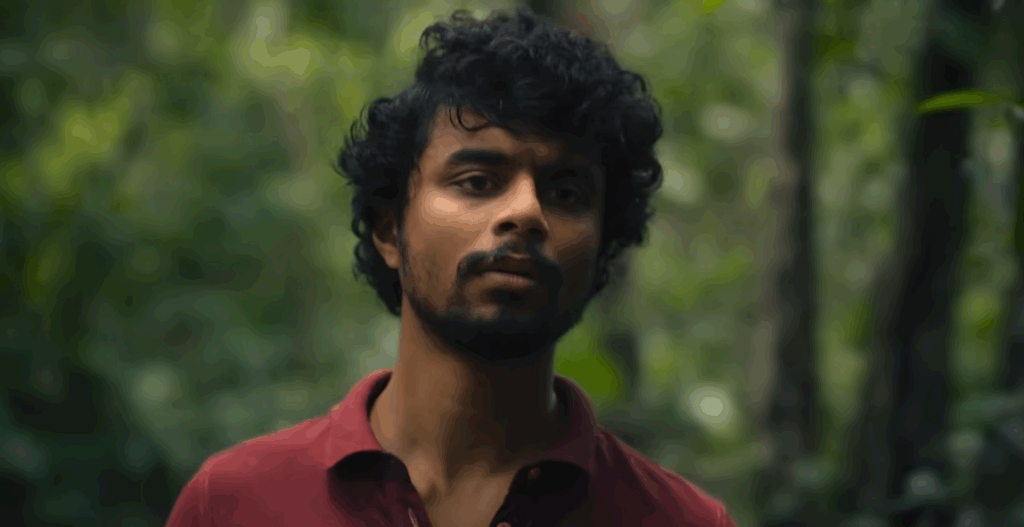
If I seem to be making excuses for the film (and maybe I am), it’s because even as is, Eko is well worth watching. Like in Kishkindha Kaandam, Bahul Ramesh is also the cinematographer, and the frames are often wide and filled with green. We feel as though we are in a jungle where the dog is the apex predator – or at least, the person who controls the dog is the apex predator. Kuriachan uses dogs like a don would use his henchmen. We use the word “psycho” to mean someone who is not within the definition of what we think is normal behaviour. Everyone in Eko is a psycho in some way, and my favourite psycho is the most loyal of Kuriachan’s dogs. I can’t say more. Go watch Eko and make up your mind after you unscramble it after the viewing. And meanwhile, a huge shout-out for Sandeep Pradeep’s magnificent performance, easily one of the best of the year. Eko has a huge cast, with Narain, Vineeth, Ashokan, and Mujeeb Majeed’s score, which is practically a supporting actor. But Sandeep towers over everything and everyone. Whether he has a bright future is not going to be a mystery.