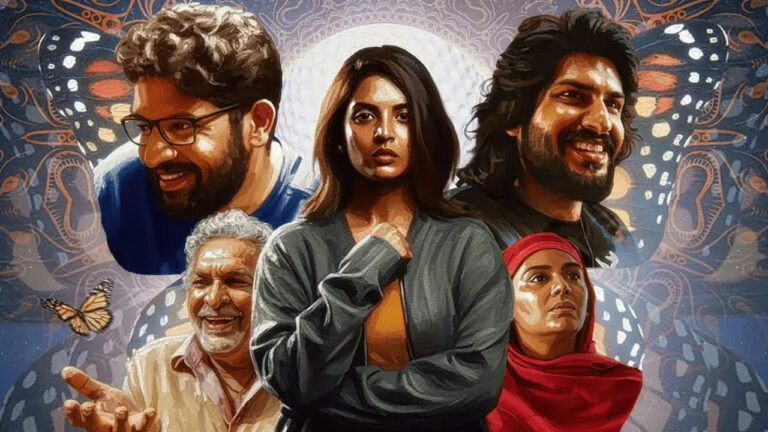
A working woman from Mumbai goes to Pune to be with her mother, who has a terminal illness. There, she meets her resentful sister, who’s become the caregiver. While the story weaves around these women and their complex relationship, there’s also a dark family secret at the centre of it all. The result is an exquisitely acted and directed story with minimal melodrama and maximal emotional effectiveness. That’s the short take. A longer review follows, and it may have spoilers.
Tighee opens with a beautiful wide shot of two women on one side of the screen, a man on the other side – and they are on a beach. Between them, we see an expanse of sea. By the end of the film, we realise that this is really a gulf that’s as vast as the ocean and cannot be bridged. One of these women becomes the first character we see in Jeejivisha Kale’s feature. She is Swati (Neha Pendse), who works in a Mumbai-based tech company named Gaia. That name comes from the ancient Greeks’ notion of Mother Earth, and Tighee is about motherhood. Swati’s creepy, touchy-feely, predatory boss points out that her hair has strands of silver, and she should go to the salon. Swati does not have the time. At home, she pulls out the strands with one quick, brutal tug. If only you could do the same with the ties that bind us to others! If only we could be like dogs, which are not bound to any single blood relation and can be happy around anyone who shows them attention!
At least, that’s what Hemalata (Bharati Achrekar) says to the pup in her arms. Hemalata is Swati’s mother. She has a terminal illness and she lives in Pune, with her younger daughter Sarika (Sonalee Kulkarni). There’s been a rift between Swati and her mother, and when Swati hears about her mother’s condition and turns up after years, Sarika isn’t happy. Like many siblings who are stuck in the role of a caregiver, she is resentful of Swati for not being around. “I have my own problems”, she screams. And she has no one to share them with. Even at this young age, Sarika has acquired the traits of the “crotchety old lady” in the neighbourhood, the kind who screams at children for setting off firecrackers. Even looks-wise, Sarika is differentiated from Swati, who wears pretty clothes and pretty makeup and looks conventionally pretty. Sarika, on the other hand, has a face that’s scrubbed clean, as though she couldn’t be bothered. Or maybe, after all the taking-care the mother needs, it’s just that she doesn’t have the time and bandwidth to take care of herself.
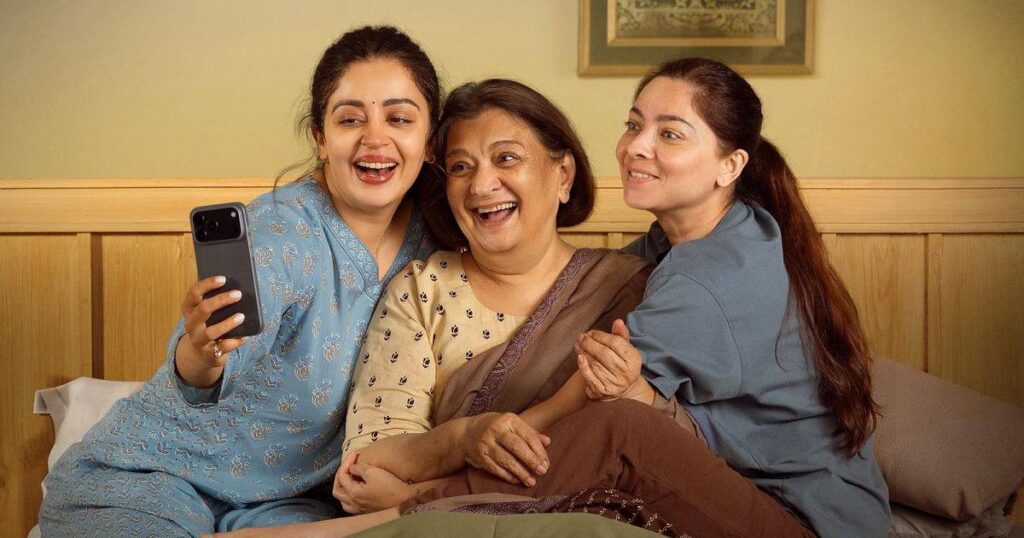
But there’s a story behind Sarika and those firecrackers. It’s something that happened on a Diwali night long ago, and there’s a family secret that involves a dead father. Or is he really dead? We get the answer at the end, and it’s very emotional, but Tighee is not a “mystery” as such. It uses this “mystery”, if you will, to talk about the complexity of most relationships. Take Swati’s husband, Malhar (Pushkaraj Chirputkar). He is tangential to this tale, but no less important in showing us how fragile we all are in relationships. The man had dreams of opening a business but the pandemic cut him off at the knees, and now he’s dependent on Swati’s salary. At one point, he visits Swati in Pune, spends time with her mother, and while leaving, he tells Swati he needs some money. She GPays him instantly, but he’s guilt-stricken and he wants her to know that it isn’t just the money that brought him here. He did want to check on his wife. Both things can be true at the same time. You can need something from someone, and also want to do something for their emotional well-being.
As far as the events that unfold on screen, there’s not much in Tighee that you won’t have seen in dysfunctional family dramas down the years. But the film – written by Prajakt Deshmukh and Nikhil Mahajan – works wonderfully because the actors are wonderful. Bharti Achrekar alternates marvellously between the difficult, stubborn woman Hemalata is seen as, and the vulnerable human who is nearing the end of her road. Neha Pendse is utterly convincing as the outsider who slowly becomes an insider again, quivering with insecurities, and Sonalee Kulkarni is brilliant as someone who is angry at the world but is bound by a sense of duty as well as the fact that the things she wants to do haven’t really panned out. We sometimes become martyrs because – even with all the hardness that martyrdom entails – it makes it “easier” to blame your failures on your situation. As her colleague and only friend, Nipun Dharmadhikari has a lovely little role as a calm man in the presence of three stormy women.

The truth in these performances is matched by the truth in the storytelling. There are no easy attempts to win our sympathy. When the big reveal happens at the end, it is not because the film has to get over but because Hemalata has seen something happen to Swati and she does not want to keep the secret inside her anymore. The music elsewhere is plucked strings and gentle piano runs, and it’s only at the end that we get the big rush of violins – and the emotion feels totally earned. Tighee is also a beautifully staged film, with evocative camerawork and super-smooth (and at times, very sharp) editing. So much of Tighee works so well that the minor imperfections begin to look like the minor flaws we see in otherwise good people. And at a time when our screens are so filled with audience-pandering, it’s wonderful to watch a movie that takes its time to breathe. The effect is healing – not just for the characters on screen but also for the audience. Richly satisfying resolutions in the movies are sometimes just what we need when they are not as easily obtainable in real life.