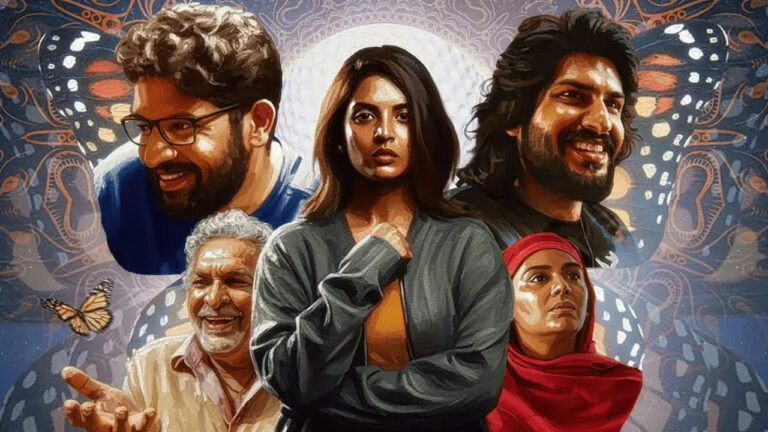
Mammootty and Vinayakan play killer and cop in a story that takes a while to take off. The writing could have been better at times, but post-interval, things begin to fall into place with surgical precision, and the final stretch is terrific. That’s the short take. A longer review follows and it may contain spoilers.
It’s the end of the year, and absolutely nothing has changed in cinema – which is my way of saying that Malayalam movies continue to push the bar. We’ll get to the story of Kalamkaval in a bit, but let’s first talk about the casting. You have a fair-skinned, good-looking man like Mammootty and you have a dark-skinned actor like Vinayakan. The instant temptation would be to have Mammootty play the good guy and Vinayakan play the bad guy. But no. In Jithin K Jose’s debut film, Mammootty plays a serial killer and Vinayakan is the cop on the case. It makes sense. If you were to look for an actor for a role that requires him to seduce a series of women, who better to cast than Mammootty! I mean, which woman can resist him! In the first few minutes of the film, this character smoothly lies to his wife, smoothly talks to a woman he has been seeing on the side, smoothly smokes a cigarette after making love to her in a lodge, and then smoothly kills her. We should be appalled. Instead, we want to applaud. This is not just performance. This is also social service. The next time any of us faces an ageist remark, all we need to do is point to Mammootty and say that age is just a number. As terrific as he is on screen, he makes us feel better off screen.
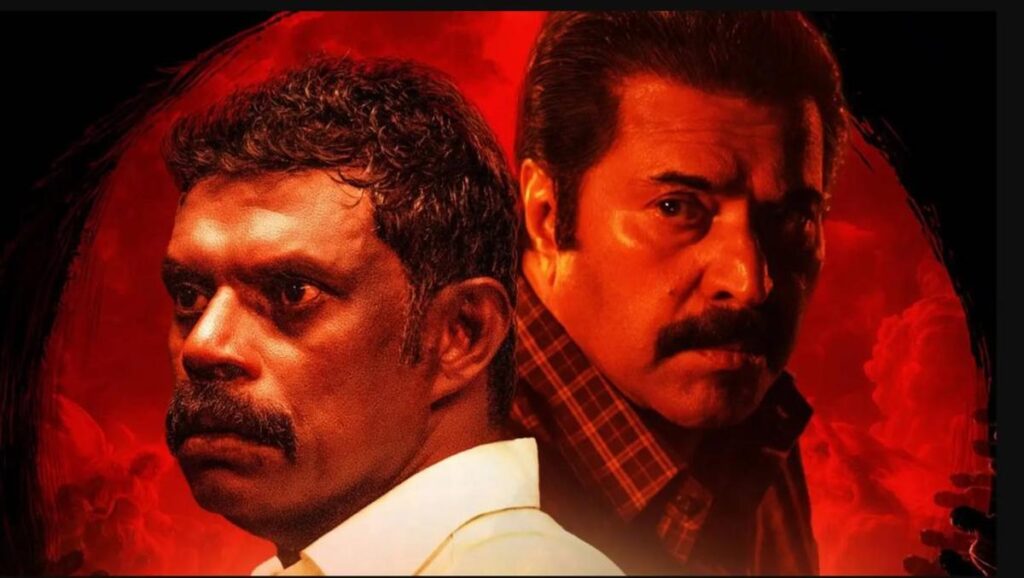
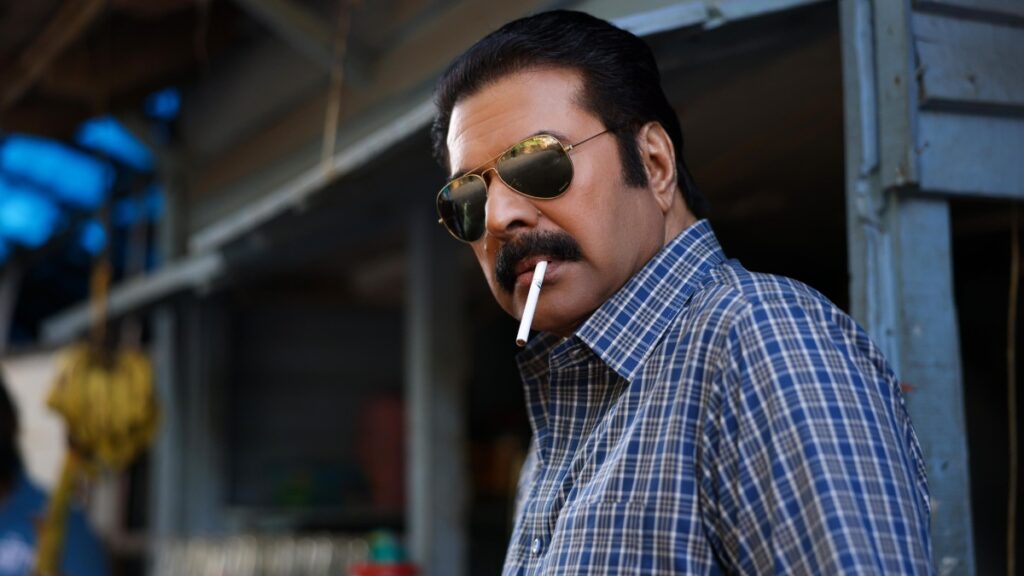
Kalamkaval is basically a fun, pulpy, B-movie – unlike, say, Vidheyan and Munnariyippu, to name two of my favourite films where Mammootty has played villainous characters. But here he’s a relentless ladykiller, and just seeing him stand still, smoking a cigarette at a roadside shop while eyeing a potential victim is a masterclass in acting. His lips curve into a smile that’s first seductive and then sinister. The change in the smile is just a fraction, but the change in mood is a thousandfold. Vinayakan is equally good as the diligent cop who just won’t give up. He has a look throughout that suggests that whatever time it takes, he will get his man. This is a look of perseverance and persistence. Even in the one scene he is shown with his family, he is arm-wrestling with his daughter. It’s a matter of who wins. But the scene carries an undertone. When this daughter grows up, she might be in danger from the likes of the man he is chasing.
The most beautiful aspect of Kalamkaval is its suggestion that there are many women looking for… something else. They could be single women looking for storybook love, even if it’s an older man. Or it could be married women who lead unsatisfied lives. One of the film’s most indelible images comes when we see a woman waiting on a bed. She waits and she waits. It’s a very sad visual. Of course, this is not the main point of the movie. But it’s there, and it keeps you caring that the killer gets caught even as the fan inside you may want Mammootty to somehow escape. Kalamkaval does not make any excuses for the man. There is no tortured childhood, and his stepmother did not beat him – or even if these things happened, we are not told about them. The man is a psychopath, plain and simple. He is addicted to killing, and the Vinayakan character gets a great monologue about rats to explain how killing can get addictive.
But I must confess that the first half did not impress me much. Yes, the actors are great but the screenplay suffers from the need to have a big interval moment. So until then, there is a lot of repetition about the killer and his various victims. There is a nice technique used where the entire process from initial sighting to final killing is played out through various women instead of just one woman, but it still looks too easy. There is no tension on the killer side of things. Most movies about killers – unless written by Bahul Ramesh – are about one of many things. They are about who the killer is, or what his motives are, or how he gets caught. Here, the identity is revealed right away and there is no motive as such, so the only mechanism of suspense and tension the film has is the fact whether he gets caught or not, and how.
Fortunately, this portion (which plays out mainly in the second half) works solidly, and the last half-hour is terrific. It’s a wonderful demonstration of misdirection, thanks to a screenplay that relies on short scenes that keep crossing over from killer to cop, cop to killer. There is some concession to “mass” elements by staging a fight scene, when you’d think an entire squadron of policemen would be involved – but the final blow is delivered by someone you don’t expect and it adds an element of poetic justice. In this last stretch, everything becomes better – the cinematography, the tension, the staging. And when we get a reveal, it’s a grand theatre moment that makes you glad you are watching this movie with many other people who are experiencing the same high as you, at that exact same moment. Kalamkaval is not perfect, but it doesn’t need to be. The two leading men and the final stretch more than get the job done.