The film takes a long time to find its feet. But once the real story gets going, there’s a fable-like Amar Chitra Katha feel that works well. The rest of this review may contain spoilers.
Pawan Kalyan’s new film comes with a long title: Hari Hara Veera Mallu – Part 1: Sword vs Spirit: Battle for Dharma. It’s a Chosen One story set in the 17th century, and it’s an interesting attempt to mix history and mythology. The history bit kicks in when Aurangzeb (Bobby Deol) reimposes the Jiziya Tax on non-Muslims who refuse to convert. Referring to Hindus, he says that as long as their religion is alive, Indian culture will never die. The mythology comes in with Veera Mallu. At first, he looks like a Robin Hood-like outlaw, someone who steals from the rich and gives to the poor. But slowly, he reveals mysterious powers, like an ability to control wild animals by communicating with them. Part 1 ends when Veera Mallu faces Aurangzeb, setting up the clash that will presumably be narrated in the sequel.
The first half is not very promising. There is a lot of flab. Why do we need to see Aurangzeb behead his brother and so forth? Why not start with him announcing the Jiziya Tax, which is the oppression that underlines the story? But then, to establish the character of Veera Mallu, we get a series of smaller oppressions by smaller rulers down south, diwan-s and the like. They make their citizens dig for diamonds, and give better food to those who find the rocks. Or else, they make these villagers fight mountain-like wrestlers in order to get their share of grain. “God will send a saviour,” says an oppressed father to his son, and sure enough, Baby Veera Mallu lands up at the doorstep of a temple, swept along a river as though guided by a divine force. The frames (Gnana Shekar, Manoj Paramahamsa) are colourful, and MM Keeravani’s big score adds power to the proceedings – but the events themselves are generic and dull. There’s a nice bit where Veera Mallu asks his people to raise their heads and see the diwan’s face, as opposed to earlier, when their heads were always lowered and they could only see his feet. But for the longest time, there seems to be nothing at stake.
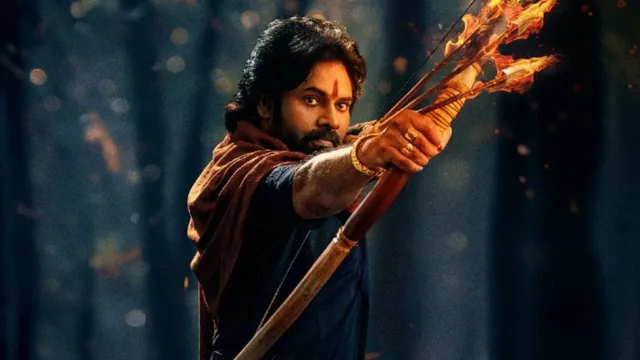
It’s just one long fight sequence after another to set up the protagonist, and there’s no danger, nothing to make us care. More time is wasted with the Nidhhi Agerwal character, who looks like a love interest and then springs a surprise. But none of this is written convincingly. Pawan Kalyan handles his star duties with flair (though there are times he seems bored and appears to be going through the motions), and his agile presence somehow takes us to the interval block, which is where the real story begins. This is where the journey to meet Aurangzeb is set up, when Veera Mallu is asked to steal the Kohinoor diamond that sits on top of the Mughal emperor’s Peacock Throne. Veera Mallu forms a gang, and the second half gets going, and then the film becomes much better.
The post-interval portions whole-heartedly embrace the history-meets-mythology aesthetic, and a masala-filled Amar Chitra Katha flavour kicks in. We get a landslide, a tornado, and even a pack of wolves. The songs (like ‘Maata vinaali’) fit better, and the action is also nicer. A set piece where Veera Mallu takes on a whole bunch of Mughal soldiers is beautifully done. Instead of going wide, the camera stays fairly close – and the compressed frames look like action paintings. There are mentions of Hindu rituals like a Varuna yagna to bring rains, but these rains also bring relief to a drought-stricken village filled with Muslims. Only Aurangzeb and his men are shown as bad guys. I wish the king had been given more to do, but maybe that’s what Part 2 is all about. And I really hope they go all-out with the comic-book fantasy feel. For now, we are left with a half-decent set-up, and in a season of disappointing movies with big stars, that feels like an actual achievement.