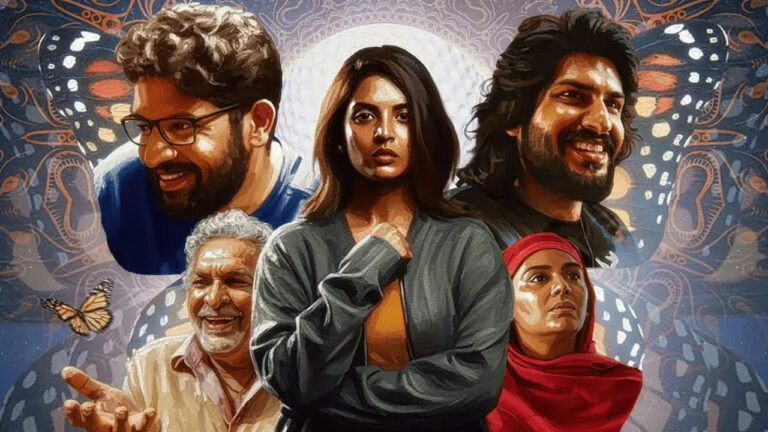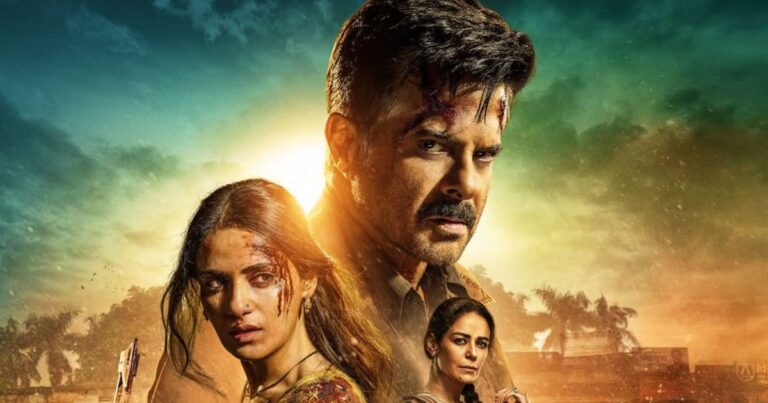
In terms of story, the film is a traditional hero-versus-villain narrative. But the screenplay detours, the suspense about what Mirai is, along with the genuine, child-like sense of joy and invention, makes the film a satisfying watch, especially on the big screen. Manchu Manoj and Teja Sajja give solid performances, and they are surrounded by top-notch technical values. A longer review follows, and it may contain spoilers.
After the Kalinga war, King Ashoka repents the bloodshed he has unleashed. He splits his powers into nine parts, contained in nine books that will be protected by nine warriors. One of these powers is immortality, which is why these holy books have been coveted down the years by Alexander, Hitler, and so on. So we get an Indiana Jones flavour to a desi story about good versus evil. The latter is represented by Mahabir Lama, played with authority and menace by Manchu Manoj. As a film culture, we suffer from a lack of actors who look convincing as villains. Manchu Manoj not only has the build and the looks, he is also enough of an actor to convey badness with minimal words. I loved that he can forge himself a sword that can become invisible at will. This is the kind of wide-eyed stuff we go to the movies for.
Karthik Gattamneni’s Mirai doesn’t exactly shatter the ‘Chosen One’ template, but there’s cleanness in the storytelling and a genuine sense of joy and invention. Watch Ritika Nayak as a mind reader, capable of bending other people’s synapses to her will. Watch Jayaram as the sage Agastya in the modern day, and you’ll know what I mean. He says that Mahabir Lama is so evil that no power born in Kaliyuga can tackle him, especially now that he’s got his hands on quite a few of the nine holy books that King Ashoka left behind. The sage mentions something called “Mirai”, and we keep waiting to know what it is. And when it’s partially revealed, with a creature from another yuga, the moment is spectacular. This is a gorgeous-looking film, with lots of colour. The cinematography, the music, the production design, the action, and the visual effects are all aces.
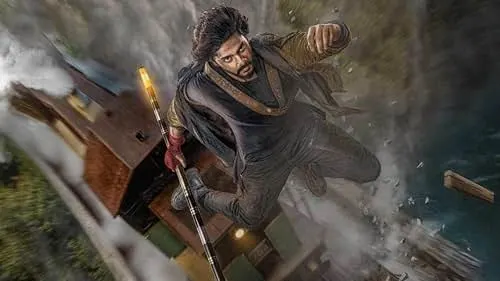
Teja Sajja plays Vedha, an orphan who has to be convinced that he is one who needs to take on Mahabir Lamba. The film, thankfully, does not give Vedha a love angle, and after being established with a comic action stretch, he gets going on his journey across the world. Teja looks the way he did in Hanu-Man. He’s thin, he looks innocent – he’s the visual opposite of Manchu Manoj. I liked that Vedha is never fully in control at any point. Unlike Mahabir Lamba, he figures things out at the last minute, and he needs the help of others. There’s a great bit of writing where Vedha steals a car and discovers something about himself. And this sense of discovery is an ongoing process. It’s refreshing to see a hero who’s vulnerable (emotionally and physically), and yet decisive about what he needs to do.
Some of the clichés are tiring – but Mirai keeps throwing other things by way of compensation. We get sounds being used as weapons. We get a superb backstory stretch for the villain, who was ostracised as a child. Shriya Saran plays Vedha’s mother, and we get a lovely echo moment where the son mimics his mother’s sacrifice in order to conquer Mahabir Lamba. The mother-son emotion isn’t overused. There’s just enough to make us feel for Vedha, that his mother is so near and yet so far. I wish some of the stakes had had a greater sense of danger, but Mirai is designed for the child inside us, and at least my inner child was quite satisfied. The film is old-fashioned in the best sense of the word, and when we get the full reveal of what Mirai really is, it’s a goosefleshy scene. We seem to be having a bit of a moment in terms of superhero movies that reference our own myths and legends and beliefs, and Mirai is a solid addition to this genre.