A young man in prison thinks back about his life and his love and his obsession with sex. The result is a drama that’s uneven, but never uninteresting. That’s the short take. A longer review follows, and it may contain spoilers.
A sadistic jailer in Cuddalore prison gets stabbed in the throat. That’s the big incident that opens Maayabimbum, but it’s not what you think. It’s not an act of revenge. It is not premeditated. It is not an escape attempt. So what is it, really? That is a question you keep asking throughout the duration of KJ Surendar’s debut feature – and this delayed gratification is the film’s USP. So what is Maayabimbum, really? Is it a prison drama that tells us why Jeeva (Akash Prabhu) ended up here? Is it a story about Jeeva and his friends, who always keep objectifying women as sex objects? Or is this going to turn out to be the story of Sumathi (Janaki), the nurse who seems to have a crush on Jeeva and who (according to his friends) is someone he can easily have sex with? The film keeps us guessing…
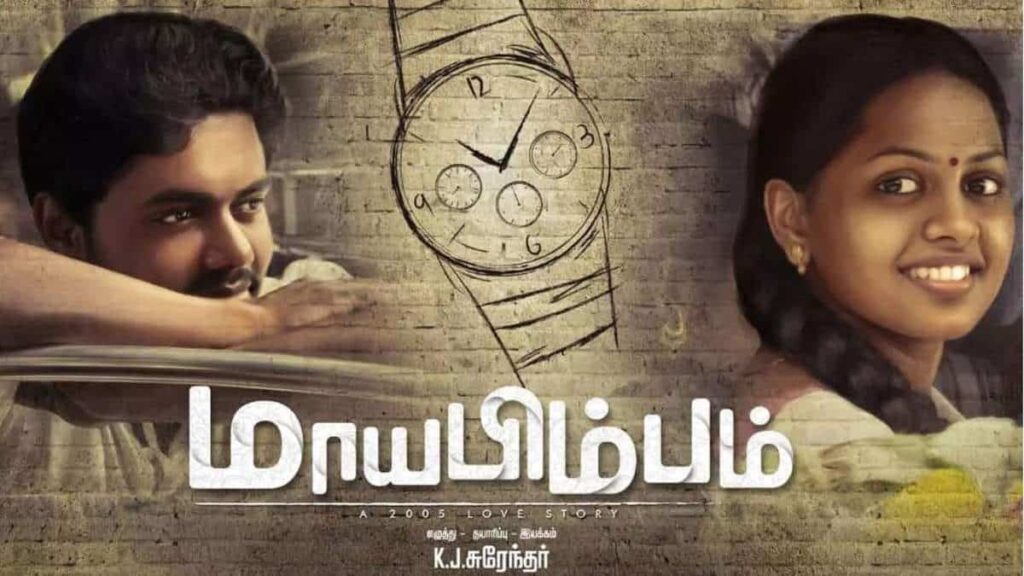
And it keeps us fooled. Till the film’s big design begins to reveal itself, I thought the long flashback with Jeeva and his friends was just one of those filler-things we see in our movies because they have to pad up the time until the interval twist. One of these friends is a die-hard womaniser, and he even gets a song about this, along with an amusing bit about how he can measure the “current” level when a woman is nearby. This is an indication of the level of interest in the woman, but these men do not realise that this “interest” could be romantic and not necessarily sexual. They talk so much about the sex part of relationships that they fail to recognise the love part even when it’s staring at them in the face. This is what the title refers to, the fact that perceptions can sometimes be an illusion.
There’s a lot that could have been better in Maayabimbum. Jeeva’s loving family is a tad too loving, and could have used a touch of dysfunctionality. Surendar turns out to be a better storyteller than filmmaker. He needed better actors, a slightly bigger budget – maybe these could have brought down the occasional levels of amateurishness. But Surendar certainly writes well, and after a point, I was involved enough with the film to view it like one of those YouTube movies put together by an enthusiastic bunch of newcomers. Because the reveals are solid. We see that nice guys can be sex-obsessed assholes, too. We see how trauma about a parent shapes a woman’s view of life. We see that parents seldom know who their children are. We see a diary having entries after a certain point, suggesting that the early parts of the writer’s life were not worth writing about.

Even though the acting quality needed to be better, it’s refreshing to see normal-looking people on screen. At many points, I was reminded of morbid romantic melodramas like Sethu – and it says something about our current state of filmmaking that even a flawed effort like this film has more intrigue value, watchability value than many of the bigger and polished films out there. The scenes are logically constructed and they keep building. There’s a scene early on where a chronically ill patient is considered a pain to the people looking after him. This offhand remark gets a payoff at the end, and there are many writing choices like this. Maayabimbum is the rare film that doesn’t have an explosive interval point. There’s just the sadness on someone’s face, the feeling of being cheated yet again by life. Sometimes, these small, human touches are enough to make you keep watching. I’d be interested in seeing what Surendar does next, hopefully with better resources. He seems to be a voice worth watching out for.