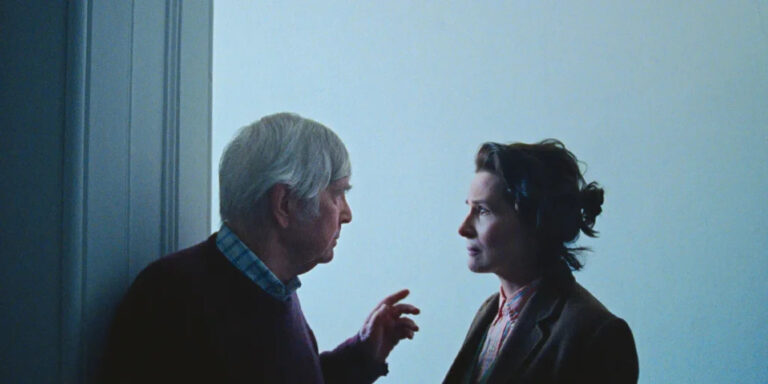

If you have seen Aavasavyuham, you know what “a Krishand movie” is like. That film spoke about eco-issues that are all-too-real, but the treatment was surreal. The result was a “thriller mockumentary”, a brilliant subversion of form and content. Krishand’s new film – Masthishka Maranam: A Frankenbiting of Simon’s Memories, set in Kochi, in 2046 – is a cyberpunk thriller, a sci-fi creation set in a computer-driven consumer culture, where even memories are for sale. What starts as the story of a grieving father slowly evolves into a wholly original, Orwellian murder mystery made from the DNA of films like Matrix and Apocalypse Now and Minority Report. (I know. It’s a lot to process.) The entire cast is brilliantly in sync with the wild material and the wilder filmmaking, and Rajisha Vijayan stands out in the role of a lifetime. I’m still reeling from the sensory overload and putting things together in my head, but I can safely say this. Masthishka Maranam is one hell of a trip.
And now for the longer review, which may contain spoilers.
The city is in chaos. Black markets are thriving. This is a world in which consumerism is everywhere, and the small irony is that it looks like we (in the present day) are already halfway there. Companies take photographs from a person’s social media accounts or from other places online, and they use these photographs to create personalised ads. For instance, you could have put up your grandmother’s picture in an obituary notice, and some company could use her likeness to sell you a product. It’s the height of personalised service. You can even buy and insert yourself into someone else’s memories. Let’s say you feel like a vacation in Kodaikanal. You don’t have to actually go. You can buy the memory of someone else’s Kodaikanal vacation and replace them with you, and have a great time. And this gives rise to one of the film’s many existential questions: If we buy someone else’s memory, is it still their memory or is it now ours (because it’s our brain that’s now processing and experiencing these thoughts)?
 It’s scarier when it comes to sex. If a woman’s memory of a sexual encounter makes its way into the black market, and if men insert themselves (pun fully intended) into this memory, is it rape? Because the woman has not consented to having sex with this particular person! This woman is an actress named Frida (Rajisha Vijayan). In this eyeball-grabbing culture, where everything she does is news, she is a contradiction of sorts. On the one hand, she has no issues about performing an item number where she bites on green chillies and thrusts her hips and cleavage into the camera. On the other hand, she rejects an “Oscar award” because it is shaped like a man. When everything is a “statement”, is anything or anyone real? Isn’t everything just a performance? The film is fantastically edited, and the scenes / memories smash into one another like electrons in a particle accelerator. It’s inevitable that it takes us a while to settle down with the “story”, because so much is happening.
The story opens cold. Bimal (Niranj Maniyanpilla Raju) is in his bathtub, playing some sort of VR game. It looks like a war game, with people killing and people getting killed. Later, we realise that this man has lost his daughter to an illness, and he is trying to numb his pain by entering the memories of people who have had near-death experiences. The daughter is another signifier of the rampant consumerism in this version of Kochi. Bimal and his wife could have had a genetically modified child with no possibility of illnesses, but they chose to have her the old-fashioned way. Why? Because they could not afford the new-fashioned way. The wife, however, has moved on. She has somehow managed to get the money for a surgery that has removed the most painful memories of their daughter. So she can look at the little girl’s pictures without feeling tragic amounts of emotion.
 You think this “story” will play out with Bimal learning how to overcome his issues, but that story would be too linear for such a premise. This is a movie about memories, and memories aren’t sequential or even logical. They can strike us from anywhere… One minute, you can be with a corpse in a room with red floral wallpaper, and the next minute, you can be discussing a “sex tape”-like memory with your karate instructor. The brilliance in the writing is that it is not random. There is the sense of a story that adds up – just not in the conventional way where cause precedes effect. There are murders, a Ninja warrior, a syndicate that controls Malayalam cinema, an ethics teacher whose life is not exactly ethical – and because of Bimal’s expertise in game-playing (that is, inserting himself into memories and becoming someone else), he ends up doing detective work for the police.
So yes, even though the narrative does not directly point to Bimal’s salvation, he overcomes his grief because he has had no time to think about his daughter. He is already so numbed with police custody and court cases that his grief needs no further “numbing”. An ordinary message movie would say: “Keep your mind occupied. That is the best way to move on.” Krishand doesn’t say it. He shows it. There’s more consumerism in store, for even the murder trial is sold to sponsors and the witnesses are asked to perform Bigg Boss-style for a large number of viewers. So it makes sense that the prison where suspects are held is shown as a glass cage. Whether with memories (which remain inside) or events (happening outside), there is no hiding. Masthishka Maranam is a fantastic and fantastical film that doesn’t feel like science-“fiction”. It feels like a reality we are all too close to.