The story is about a young boy from Imphal who runs away from home in search of his missing father. So yes, this film can be seen as a charming adventure story with lots of laughs. But it is also a drama that speaks sad, hard truths about how the world keeps finding ways to separate us as insiders and outsiders. That’s the short take. A longer review follows, and it may contain spoilers.
Lakshmipriya Devi’s Boong is the first Indian film to win a BAFTA, for Best Children’s & Family Film – and it is a very interesting mix of flavours and tonalities. On the surface, it’s an example of that genre called “Boy’s Own adventure”, where a plucky hero undergoes a series of dangers during a mission. Our hero, here, is a little boy (Gugun Kipgen) who lives in Imphal. His name is Brojendro, and he’s called Boong. The adventure he embarks on is to find his father, who hasn’t been home in a while. Boong lives with his mother Mandakini (Bala Hijam, who’s wonderful at conveying silent strength). Boong lies to her and – armed with his trusted weapon, a catapult – sets out on his journey, which includes broad comedy like travelling with a corpse and pranking one’s best friend by sticking a “donkey” poster on the seat of the best friend’s pants.
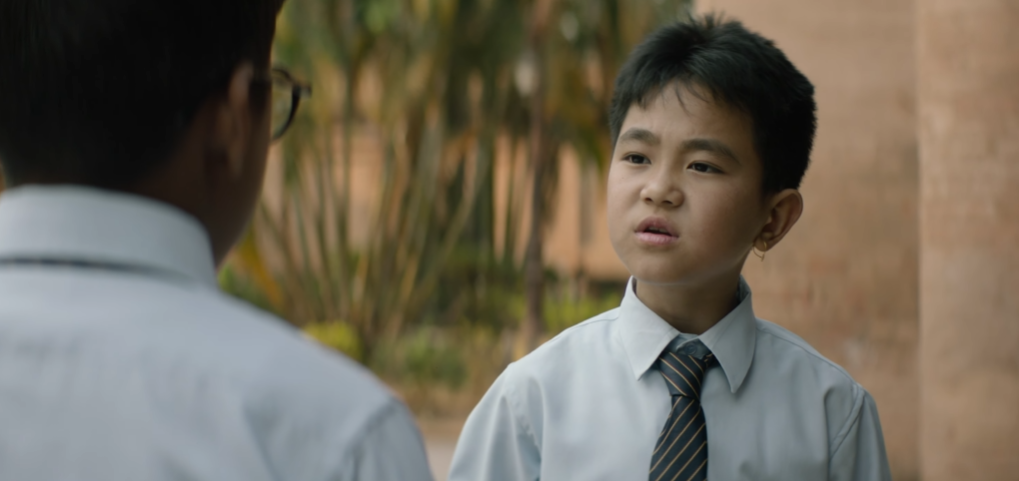
But before we categorise Boong as a simple “Children’s & Family Film”, the way the BAFTA committee did, let’s look at this best friend. He is a Marwari boy named Raju Agarwal (Angom Sanamatum), and his father owns a yarn shop. We are used to stories from the rest of India about narrow-eyed people from the North-East being mocked and insulted as “Chinky” – but here, Raju is the one who’s mocked as an outsider. His family may have been in Imphal for generations, but as a Manipuri girl in class notes, Raju has big, round eyes. It’s some sort of reverse racism. We see a region filled with Sardars and Tamilians (did we really need the background of the “Lungi Dance” song, though?), and a rebel group that seeks to liberate Manipur from India classifies all of them as “outsiders”. In a scene, we get a glimpse of this graffiti on a wall: “Outsiders go back!”
Hindi cinema is banned. We get a scene where people are watching PK, which is about an alien, the ultimate “outsider” – and this audience is watching the movie in secret. As someone says, Mary Kom can’t watch her own biopic in Manipur. And so we have a film centered around a boy and his charm and his innocence, but also a film that is very adult about the many realities of the region. A trans-dancer sings these words: “If you throw me into the river, I will come out holding a fish / If you throw me into the fire, I will come out holding a lit cigarette.” It is a survival anthem, and it could apply to anyone – say, Boong’s mother, who runs a handloom business. The fact that her husband has gone missing (he won’t return her calls) has not discouraged her. She has found a way to carry on. She is a practical woman who encourages Boong’s wish to study in an English-medium school. She reasons that he won’t grow in a place where he isn’t happy.
So she understands why Boong runs away to search for his father. She knows the boy isn’t happy without his father. And later, when Boong calls from wherever he is, Mandakini doesn’t scream at him, she doesn’t scold him. She probably knew that this day was coming, when her assurances would no longer be enough and when Boong would seek his own answers. Boong, then, is also about the strength of women who find ways to survive. One of the narrative threads is about how Mandakini finds her only friend in Raju’s father, an “outsider”. She has no use for the small-minded locals who surround her. (Naturally, they are outraged by her behaviour.) And she has no use for the artificial borders constructed around her, between insiders and outsiders, between married women and men who are not their husbands.
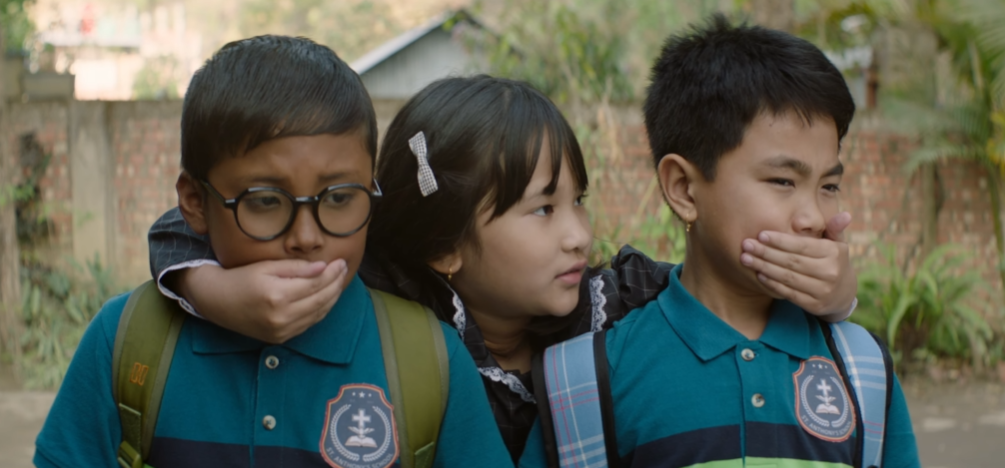
Boong is, finally, a story about borders and the lines that divide us. The place that Boong and Raju travel to – that’s on the border of India and Myanmar. The trans-performer – in the eyes of society, she exists on the line dividing “male” and “female”. The Madonna song played with the Manipuri version of the dhol – that’s at the intersection of Western pop and Indian music. The most heartbreaking scene in the movie has a compound wall dividing Boong and characters who live on the other side. Boong opens with a card that says “To love, friendships and peace in Manipur…” In essence, it is a story that wishes that these borders did not exist. The music is a little too eager to nudge our emotions, but that apart, the director has made a complex film that seems utterly simple. Boong is a charmer that makes you smile a lot and then sends you home with a heavy heart.