The concept is solid: a man keeps trying to avoid death, and death keeps coming at him in every direction. But despite strong filmmaking, the narrative remains emotionally aloof. The rest of this review may contain spoilers.
Mani Ratnam and Kamal Haasan have repeatedly stressed that their reunion after Nayakan has nothing to do with that earlier film. They are right. There are a few images, a few touches that reminded me of Nayakan. Trisha (named Indrani) plays a version of the girl who is “saved” from a life of sex work. Silambarasan (as Amaran) plays a version of a boy who thinks his father has been killed by his mentor; he’s essentially a more ferocious variation on the boy who kept saying “baba mar gaya”. Plus, as a lost little boy, we see Amaran in an oversized shirt (like in Nayakan), as he loses his father and is “adopted” by another father. Kamal Haasan is named Sakthivel, as is his grandson. The idealistic cop played by Nasser in Nayakan finds a kind of reflection in the idealistic cop played by Ashok Selvan; only, this cop is after bad guys across the board. He’s not just after criminals but also the crooks in the government.
But here’s the thematic difference. Nayakan was an examination of good and bad, whether being oppressed meant that you could take the law into your own hands, even if it was to help your fellow-oppressed. The philosophy at the core was direct, and the questions it raised were emotionally affecting. Thug Life, on the other hand, is more abstract. It’s the story of a man who constantly battles with death – he even battles with his own death, at a point when he is betrayed. Sakthivel’s opening monologue talks about Yama, the god of death, and both literally and figuratively (i.e., in the form of loss), this film is filled with death: the death of a brother, the death of a mother (stated but not shown), the death of a lover, the death of a son, the death of an innocent father in a shootout, the death of a wife’s memory, the death of trust…
But while all of this seems like a good idea, it does not translate easily on screen, and what we are left with is an underwhelming mix of action and drama. This could have been the story of a man who made a decision on behalf of his brother’s daughter, a decision that ended in tragedy. This could have been the story of a bar dancer used by (or kept in a golden cage by) two different men. This could have been the story of a brother and sister who are reunited by the man responsible for their separation at a young age: the very man who used the little boy as a shield against his death. (Sakthivel, in this scene, is an opportunistic coward.) This could have been the story of two brothers, one of whom seeks the other one’s power. This could have even been the story of a gangster who is torn between the love for his wife and the lust for his much-younger girlfriend (and this is something I would have really, really liked to see from Mani Ratnam).
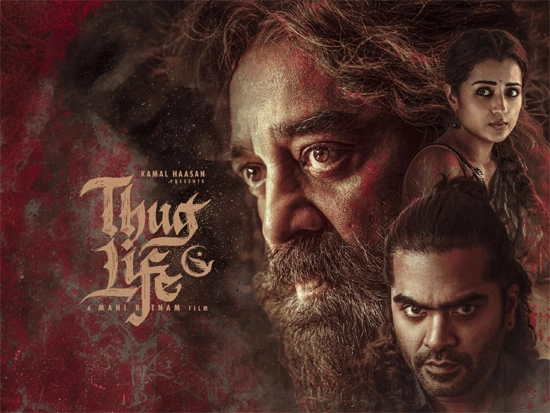
Thug Life tries to be all these stories and in all the jumping between tracks, it quickly loses narrative tension. The “Mani Ratnam” signatures do exist. There’s a superbly compressed stretch that – in short-story fashion – shows us the series of events that leads to a young woman’s suicide. (Her ultra-conservative father is a big reason for this decision.) Indrani’s introduction stretch is a beauty. Her past is interwoven with her present, and the pace transforms what could have been melodrama into something playful and sexy. And though one part of me was devastated that AR Rahman’s absolutely outstanding soundtrack was not used in full, the way the songs like ‘Sugar Baby’ and ‘Jingucha’ weave in and out of the music video-staging and simultaneous narrative happenings is breathtaking. Editor Sreekar Prasad, cinematographer Ravi K Chandran, the team that found the locations, and especially production designer Sharmishta Roy – everyone pitches in strongly. But the film remains emotionally aloof.
The gangsterism is very generic, filled with very generic action and very generic lines about the business. We hear the Joju George character comment that Amaran has made the business flourish, but it remains a line – we don’t get a sense of this flourishing actually happening. There’s a nice line where Sakthivel talks about Delhi being cursed with sons wanting to overthrow their fathers – but again, this tossed-off line doesn’t pierce the heart like a well-staged dramatic scene would. And because of the time spent on this gangster stuff, the drama, which is far more interesting, suffers. Sakthivel gets a daughter, whose marriage-related subplot could have been axed from the movie and we would have missed nothing. There is a puzzling scene with transwomen that seems to have no beginning or end. There’s the hint of a brilliant stretch between Sakthivel and Amaran in a hospital, but the drama ends almost before it can begin. Why does Amaran believe what he’s told about Sakthivel, so quickly? Wouldn’t he want to confront the man with whatever he has learned? Wouldn’t he want to know if this is indeed true? Are the two characters close at all?
Post Iruvar, Mani Ratnam has been moving away from “stating” the obvious and instead visualising it. It worked beautifully in the Ponniyin Selvan films. But here, this technique takes away the emotional glue that binds us to these characters. What kind of gangsters are these? What is their business? What is the deal Amaran makes without consulting Sakthivel? Instead of concrete insights, we get Kamal Haasan-style abstractions that remain interesting as concepts, but they don’t help the narrative much. The name “Amaran” suggests immortality, but I don’t know if the film would have played any differently had the character been called… say, Kumaran. There’s a bizarre segue to Himalayan territory that seems to exist to bring in a martial arts flavour into the movie, but again, all this could have happened anywhere. Two brothers, at different points, fall from a height as they prepare to meet their death, but this echo adds nothing to our emotional response to these characters. When Indrani moves in with another man (and becomes an alcoholic), we feel nothing for her. With many of the conflicts in Thug Life, my response was simply… “Why should I care?”
If nothing else, Thug Life makes you wonder about how much action a dramatic film can hold and how much drama an action film should have. I am not a fan of Chekka Chivantha Vaanam, but there was a clarity in that narrative: it was about three brothers who wanted their father’s throne. It was action over drama. In Thug Life, you think the second half will do something similar. I thought the film would explode into a revenge story filled with guns and knives and devious plotting, but now, the emotional drama keeps getting in the way, with meandering, borderline-surreal scenes like the one with Sakthivel and his wife on a beach. As a piece of staging, there’s not a single lazy frame (and some of the surrealism works wonderfully, at least as visuals). But there’s nothing inside the image that makes its way into us, nothing that makes us invested in these scenes.
Kamal Haasan, Silambarasan and Trisha do what is required, without fuss. Among the supporting cast, Vadivukkarasi makes the strongest impression – first with a sarcasm-filled monologue (this brought back memories of her brilliant work in Mudhal Mariyadhai), and then with a dramatic bit in a church. This is the kind of sharp acting and writing where a character is fleshed out in just a few strokes. Otherwise, there are too many characters and very few of them register impactfully. Joju George, Aishwarya Lekshmi, Bagavathi Perumal, Nasser, Mahesh Manjrekar, Ashok Selvan, Abhirami – all of them are stuffed into generic parts. Rajshri Deshpande barely gets a line of dialogue. One gets the feeling that, in this Delhi-based gangster drama, Mani Ratnam was less interested in the gangsters than in the drama. It’s very poetic to start a film with a warrior standing in a field of grass and end with the same man in a different kind of field: he is now a different man. But the emotional through line doesn’t take us from this Point A to this Point B.
So, okay. It’s just a movie, not the end of civilization as we know it – but after Retro and Thug Life, I am beginning to believe that our auteurs, our filmmakers with a unique voice, should not make movies with stars. One reason is simply that, when we go to these films, Karthik Subbaraj is the star, Mani Ratnam is the star. But when they invite star-actors (or actor-stars) into their universe, they seem to get pulled into a different orbit, which involves bigger business stakes and bigger fan bases and so on and so forth. And a dark drama like Thug Life – one with no “heroes”, as such – ends up with a hero-worship song like ‘Vinveli nayaka’! The entire tonality of the film gets thrown off. The same song makes so much more of an impact when a bit of it is used as an instrumental undercurrent in a scene where Sakthivel attempts to pacify his angry wife. In other words, this is a big song that plays better in a smaller moment. I am sure Mani Ratnam will bounce back, and I am sure Kamal Haasan will bounce back – but hopefully in their own independent ventures.