Jiiva plays a panchayat head who has to be a proper politician when a wedding and a death threaten to erupt into trouble. The film’s strength is its low-key nature and its tonal consistency. It works because it does exactly what it sets out to do. That’s the short take. A longer review follows, and it may contain spoilers.
Nithish Sahadev’s Thalaivar Thambi Thalaimaiyil (TTT) opens with a voiceover that compares life abroad to life in India. It’s actually a man on a loudspeaker. He says that if the people abroad live a good life, that is their thalai-ezhuthu, or destiny. And if we lead a sorry life, that is our thalai-ezhuthu. In other words, we are like this only, and soon enough we are in an eccentric scene that can happen only in India. It involves a man who doesn’t seem to be mentally well. He is in danger, and while half the village is panicking about what to do, one man in white walks in calmly and defuses the danger. He is the panchayat head Jeeva, and he’s played by Jiiva in one of his most understated performances. TTT is a dry comedy mixed with low-key drama, and Jiiva gets that pitch just right. He doesn’t try to make us laugh. He doesn’t lecture us. He knows that the humour is in the situations, and he just needs to drive the drama forward. And that he does.
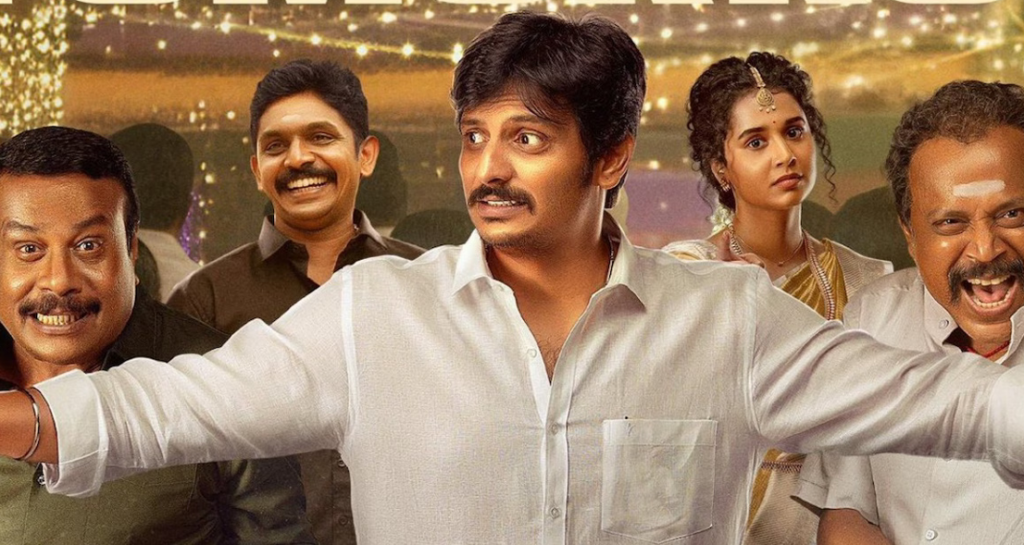
So this first big scene establishes that Jeeva can calmly handle tricky situations. In other words, he is a solid politician. But soon, he is stuck in a trickier situation that keeps accelerating in ways that even he finds difficult to solve. If that first scene was centered on a man who was a little off, mentally, the rest of the film is about two families that are clinically sane but behave as though they are even more mentally off. Thambi Ramaiah and Ilavarasu are neighbours at war. (Both of them, like Jiiva, play it straight.) There was a tragedy that drove them apart. And now, they are strangely united by destiny. Just as the daughter of one of them is about to get married, the father of the other one dies. So both families are united by the desire to perform a ceremony at the same time.
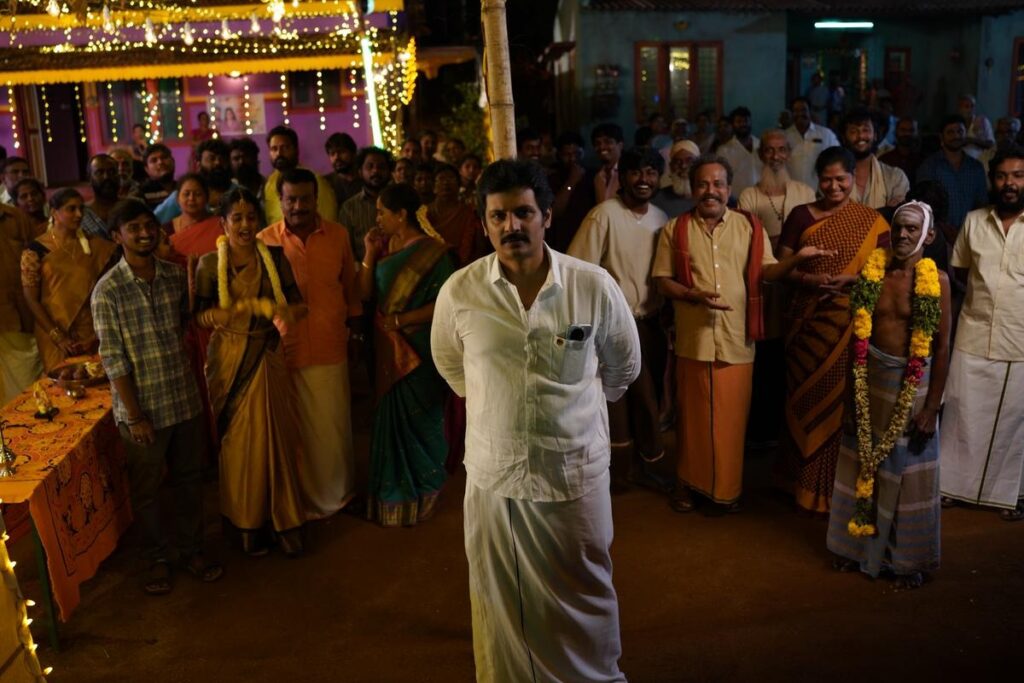
And this time, Jeeva’s challenge is to ensure that he appeases both these enemies with a solution that offends no one. In other words, his skills as a politician are put to the ultimate test. Nithish throws in everything but the proverbial kitchen sink. We get bombs, and a whole bunch of eccentric characters. We get the payoff to the opening image of a clothesline in Jeeva’s house, where all the clothes were spotless white. (He is a politician, after all.) We get a Sooryavamsam song, and a man who loves the bride in a one-sided manner. We get a long-unmarried groom whose name, Kanniappan, is rather sadly shortened to Kanni. We get some solid writing by the director and co-writers Sanjo Joseph and Anurag OB, and some solid music by Vishnu Vijay. What we don’t get are needless duets, heroism, fights, or melodrama. The film holds on to its tone and its madcap mission with impressive precision. The opening speech is repeated at the end, about the people abroad leading a better life than us. And that’s the unsaid “message”, so to speak. Things will get better if we stop gossiping and mind our own business. That all of this is accomplished within a couple of hours is a Pongal bonus.