A sixty-ish man takes care of his ninety-ish mother. That’s seemingly the story of this feature. But it’s really about time standing still when we are lost in unending daily rituals. That’s the short take. A longer review follows, and it may contain spoilers.
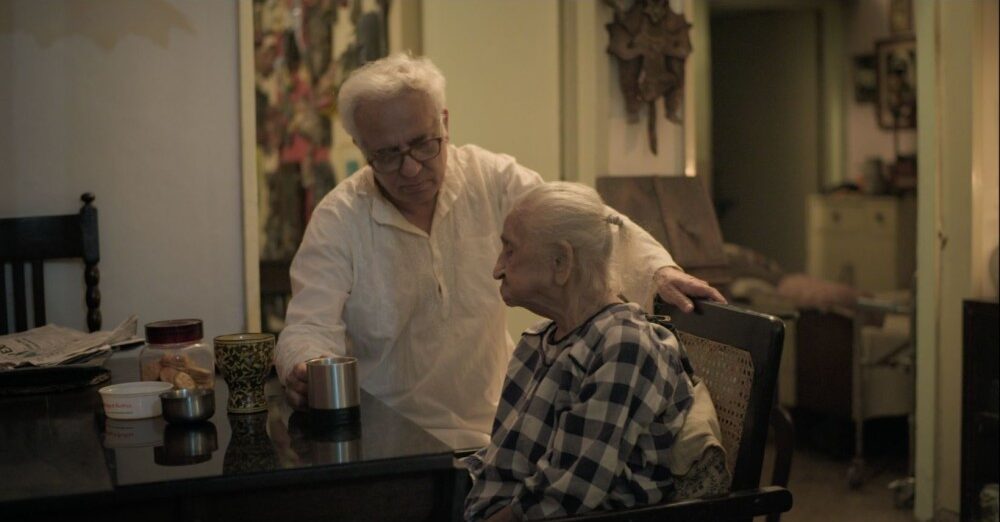
The first fifteen or so minutes of Prabhash Chandra’s Alaav (also called Hearth and Home) lay out the style of what’s to come. For about five minutes, we see a sixty-ish man (Bhaveen Gossain) doing his riyaaz. The camera, which is always static, is in an adjacent room, and we see Bhaveen through the connecting doorway. It’s a frame within a frame. And then, for about ten minutes, or perhaps even more, we see Bhaveen putting his ninety-something mother (Savitri Gossain) on a bed and feeding her. He sits on the other side of the bed, eating from a plate while also making sure his mother eats. She coughs. He gets up and gets water. Time stands still and we are reduced to a meditative, trance-like state, where everything becomes a ritual: eating, taking out dentures, reading, wiping the floor, boiling some water, or even enabling a bowel movement. The house becomes a silent spectator, holding these two individuals and their daily lives.
Alaav is the very definition of what used to be called an art film, and the predecessor that springs instantly to mind is Jeanne Dielman, Chantal Akerman’s 1975 anti-epic about daily rituals. Alfred Hitchcock said that drama was life with the dull bits cut out. Chantal Akerman, on the other hand, asked why we have this “hierarchy of images”, and why a kiss or a car crash is more deserving of screen space than the daily grind of a housewife. Why not show three minutes of someone peeling potatoes? Or, to borrow Hitchcock’s words, why should life’s dull bits not be included in a movie? The boredom and frustration the viewer feels is the boredom and frustration the characters feel. And yes, time is also a character. When Bhaveen folds a bedsheet, over some two minutes, we hear the ticking of a wall clock. This is as much filmmaking as it is modern art – or postmodern art, which demolishes what we know and accept as filmmaking.
The cinematographer of this two-hour feature is the remarkable Vikas Urs, who has become the go-to guy for modern Indian art cinema. The static shots show a man imprisoned by his decision to be a caregiver. The camera “traps” Bhaveen. And because the camera doesn’t move, our eyes are free to roam all over the frames. If you wonder why there is no nurse or why Bhaveen did not admit his mother in a hospice, you are not going to get any answers. But even without these questions, other things are revealed. You see the paintings and brass artifacts and the carpets and the coloured glass bottles by the window sill – and you sense an artistic sensibility in Bhaveen. You see him talking to his mother as though she were a child, and you sense the deep love he has for her. You see him asking his mother who he is. At first, it feels like a game. Will this mother who seems to have lost all her faculties remember that this man is her son? But when the same question (“Main kaun hoon?”) is repeated later, you sense that perhaps Bhaveen has lost his identity. Yes, he practices and teaches music, but essentially, he is a 24×7 caregiver. Alaav is a documentation of his life, and also a crystal ball that shows us how our lives may be when we end up in Bhaveen’s position. Alaav says it’s not going to be pretty.