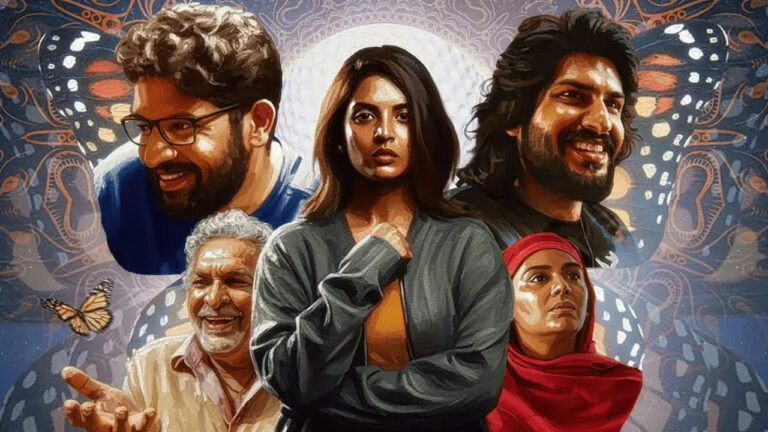
Rashmika Mandanna plays a recessive college-goer who is bullied into love by a toxic alpha male. Her emancipation forms the rest of this film, which has its heart in the right place. But the characters are too one-note to make a real impact. That’s the short take. A longer review follows, and it may contain spoilers.
The very title, The Girlfriend, tells us a lot about Bhooma, the college-going character played by Rashmika Mandanna. The title defines her through her relationship with her partner. In other words, she is not her own person. She is her father’s daughter. She is Harshitha’s and Vinay’s friend. And she is Vikram’s girlfriend. (Dheekshith Shetty plays the boyfriend with suitable swag and swagger.) When we first see Bhooma, she is carrying a big suitcase up the stairs. It’s the first day of college and she does not know anyone. Harshitha sees her and asks if she wants help. Bhooma just looks at her. She doesn’t say yes. She doesn’t say no. But when Harshitha comes forward to help, Bhooma smiles gratefully. She needed help, but she could not bring herself to ask for it. She needed someone else to make the first move. So it is with Vikram. He makes the first move. He calls her to his hostel room and he kisses her and then announces to everyone that he has kissed her. By default, without doing anything from her side, Bhooma becomes… the girlfriend.
Rashmika is superbly withdrawn as Bhooma, who has been shaped by her tyrannical and manipulative father to have no mind of her own. She tells her English professor that she wants to write in order to escape to another world and that she is too scared that she is not good enough – and this hesitant quality defines her. Even the decision to place her head on Vikram’s shoulder during a movie takes an eternity. So far, so good. But then the screenplay “touches” begin to show. Her professor asks her to read Virginia Woolf’s A Room of One’s Own, which emphasises the patriarchal obstacles women face in the pursuit of intellectual and artistic pursuits. And we learn that Bhooma was named after Bhooma Devi, the goddess of earth, because the elders felt she was destined for a life of struggle. And when Vikram proves to be as dominating and manipulative as her father and she feels like the walls are closing in, we get an effect where the bathroom walls literally move closer to Bhooma and close her in.
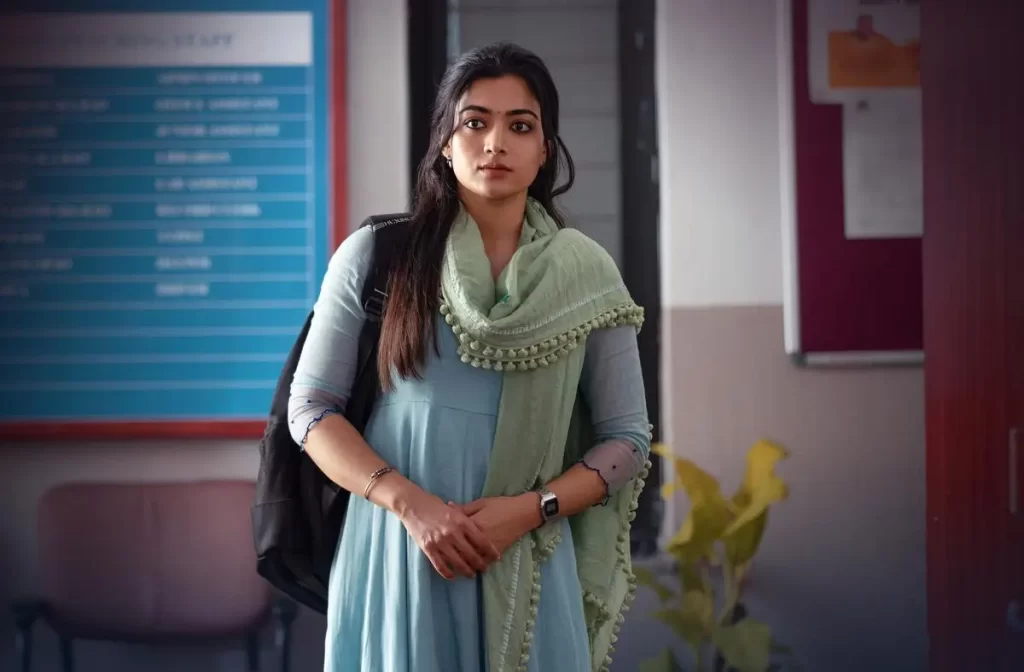
That is the problem with The Girlfriend. It is a very literal movie. It paints its characters in such broad strokes that it becomes too easy to separate the good guys from the bad guys. Vikram is a one-note patriarch in the making. He treats his mother like a cooking-cleaning robot, and that is what he wants from Bhooma. There is not one redeeming quality in the man. For instance, is he tender with Bhooma after their lovemaking? Do those moments of intimacy give Bhooma the feeling of being wanted as a person, a feeling her one-note patriarch of a father never gave her? We never get to see, and we never get to know. Yes, the whole point of the film is how difficult it is for someone like Bhooma to break free from someone like Vikram and say that she is now her own person and not someone’s girlfriend. But the utter lack of nuance makes it very hard to stick around for two-plus hours, knowing full well how the ending is going to turn out. Bhooma has been seen throughout with dupatta-s that are wrapped so closely around her throat that they are visually choking her. At the end, we guess that there will be no dupatta as Bhooma declares her freedom. And so it is.
Rahul Ravindran made a beautifully understated debut with Chi La Sow, so it’s hard to understand the constant over-emphasis in this film. When Bhooma meets Vikram’s mother, it is made clear that she is worried this woman is who she might turn into. But in addition, we get a visual of Bhooma draped in the same saree that the mother is wearing, as she gazes into a mirror that seems to have been positioned for this explicit purpose. In The Great Indian Kitchen, we had a mother-in-law who cared for the heroine, and the protagonist’s world was filled with many characters. Here, we just keep seeing Bhooma and Vikram in various variations of “this is not right” situations, and the film itself becomes one-note. Apart from that book by Virigina Woolf, we see another one, and it’s Raold Dahl’s Matilda – again, a story about a young girl who finds freedom.
I wish the Harshitha character had been given more screen space, as a sounding board if nothing else. The one character that does make an impression is Durga, played by Anu Emmanuel. She plays a part in Bhooma’s emancipation, and she is a strong woman: don’t miss the name, Durga. But she is also a flirt, and she tries to have Vikram for herself – in short, she is somewhat complex, and this makes her interesting. She feels like a real person. Her short-lived sisterhood with Bhooma is the film’s best part. Bhooma realises the value of Durga’s advice much later, and you really feel for her when she begs Vikram to go away. “I don’t love you. I am not happy in this relationship,” she says. But moments like these are few and far between. When Bhooma is slut-shamed, everyone in the college laughs at her. Not one woman offers sympathy, because that’s how the audience can feel extra-sorry for Bhooma. Had it not been so emphatically one-note, we could have seen The Girlfriend for what it wants to be: a strong statement about how difficult it can be to extricate yourself from a toxic relationship. But all we are left with is a film that shows us what it could have been.