Pranav Mohanlal plays a spoilt rich brat who’s home alone. Soon, this home turns into a haunted house. But there’s a twist, and the protagonist decides to get to the bottom of it. Scares and atmosphere and all, ‘Diés Iraé’ is a solid theatre watch, but the writing doesn’t do justice to the themes. That’s the short take. A longer review follows, and it may contain spoilers. I mean, it does contain spoilers! You have been warned.
With his last two films, Rahul Sadasivan has established himself as a unique voice, and his latest outing, too, is unique in its design – in the sense that this, too, is not just a “horror movie”. Diés Iraé has Pranav Mohanlal as Rohan. He is an architect, but he has inherited his father’s business and his father’s riches. Other architects would probably call him a “nepo kid”. Rohan lives in an enormous, very posh bungalow. He is alone at present because his parents have gone abroad to be with his pregnant sister. But Rohan comes across as a pretty self-absorbed guy, and he isn’t upset about being alone. The first time we see him, he is making out with someone at one of his house parties, overflowing with booze and spliffs and other assorted joys. He plays football. He plays the drums. He knows the words to rock songs. Rohan is Westernised to a fault.
So like in Bhoothakaalam and Bramayugam, there is something going on underneath the horror-movie surface. On one level, Diés Iraé is a coming-of-age story. It is about Rohan’s arc from getting annoyed that his father is calling him to Rohan voluntarily calling his mother. It is about this Westernised guy getting in touch with “Indian” emotions. This is a story about the relationship between parents and children, and the extent to which parents will go to ensure the happiness of their children. By the end, Rohan is a much nicer, more caring person than he was at the beginning. On another level, Diés Iraé is a story of yearning. What if we love someone who does not love us back, or worse, does not even know that we exist? What if we did not know what to do other than stalking the person, and hoping that this person will notice us? Peel away the jump scares and the presentation of a horror movie, and we see that Rahul Sadasivan has once again used genre tropes to dive into bigger themes.
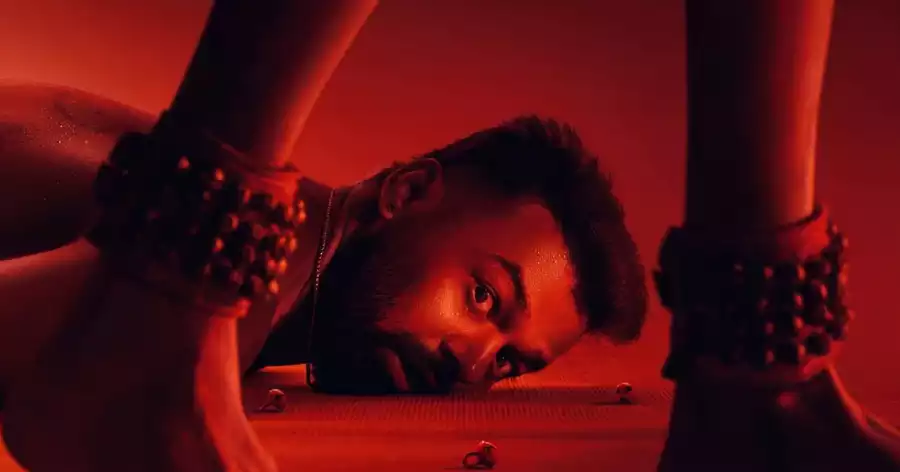
The story gets going when Rohan learns that a classmate has died by suicide. We learn that this woman was a dancer, and someone Rohan has had a fling with, but she took the whole thing seriously and wanted to marry him, and he stopped taking her calls – and in the hands of a lesser filmmaker, Diés Iraé would be a film about a ghost taking revenge on the man who used and discarded her. Or to put it differently, a man who ghosted a woman ends up being harassed by her ghost. But this plot point turns out to be a superb case of misdirection. The structure of the film, too, is fascinating. The first half is your classic haunted-house story. Rohan lives alone. He senses things. He hears things. And soon, an unseen force is dragging him across the floor – with a force you expect from a wrestler rather than a dancer. I was happy that there’s a reason Rohan does not move out. Unlike the usual horror movie where we yell at the characters to get the F out and check into a hotel, Diés Iraé has Rohan say that this harassment will continue even if he moves, and he has to solve this issue if he wants peace.
And post-interval, the film transforms into a kind of buddy-cop detective thriller. Rohan takes the help of a contractor named Madhu (Jibin Gopinath), whose father was a priest familiar with rites and rituals. Again, we see the theme of parents and children. If Madhu’s father seems to have given him the gift of sensing the paranormal, Madhu tends lovingly to his ailing mother. Rohan and Madhu go about making enquiries that will help them figure out what’s happening, and this leads them to characters like Elsamma, played by a scene-stealing Jaya Kurup. This is one of those roles made to grab attention, and she makes every second count. In general, the performances are all solid, and serve the film well. As always in Rahul’s films, the behind-the-scenes departments are all aces, from Shehnad Jalal’s cinematography to Jothish Shankar’s production design to Shafique Mohammed Ali’s editing to the sound work by Jayadevan Chakkadath and MR Rajakrishnan. You know that click when you snap a hair clip back into place? You will never hear that click the same way again.
But the screenplay doesn’t match up. Diés Iraé runs just about two hours, and I would have happily given thirty extra minutes of my time to see things being better fleshed out. I’d have liked a better reason for Madhu to say yes to helping Rohan. The connection between the title (which has to do with Judgement Day) and the story is very weak and looks forced. I wanted to know the reason behind the girl’s suicide, the reason for the pointed close-up of her claw-like hand, and the reason her brother is attacked at a later point. Given the film’s themes, the girl’s parents aren’t used much. I’d have liked the parent-child theme extended to this household, too. A horror set piece at Madhu’s house looks as random and gimmicky as the so-called twist at the end. And instead of the “criminal” confessing to the crime in one huge and chunky monologue, I’d have liked this reveal to have come out in bits, as the investigation goes on.
We can do a lot of guesswork for some of these answers, and some of you may say that not knowing some things is its own kind of satisfaction – because we cannot possibly have the answers to everything that happened in the girl’s past. But that makes Diés Iraé less satisfying than Rahul’s other work. As a theatrical spectacle, it is a solid watch (even if the first half looks like a lot of time is wasted to get to the interval twist). But given the film’s themes and ambitions, the results aren’t enough. The film remains at a surface level. It doesn’t sink into you emotionally the way a Bhoothakaalam does. It doesn’t leave you with a sense of dread. It doesn’t haunt you. You watch it, enjoy the scares and the suspense, and then forget about it. In other words, Diés Iraé is a decent-enough horror movie, but as a Rahul Sadasivan film, it falls short.