The new film adds bits of outtakes, most importantly a stretch that gives thakur his much-needed catharsis. But even otherwise, even with its minor flaws, ‘Sholay’ remains insanely watchable after fifty years. The writing is tops, yes, but so is the direction. The big-screen experience of the film is still something else.
Sholay is a big movie with a big cast and if there’s one shot that shows why it belongs on the big screen, this is it. The ‘Mehbooba’ number plays out in Gabbar Singh’s lair. Jai and Veeru blow up the freshly arrived stocks of ammunition in the bandit camp, thus weakening them. Jai is wounded, and the two of them ride their horses back to the thakur’s haveli. Radha – the widow – sees the horses from the window in her room upstairs. She sees Jai clutching a blood-stained arm, and instinctively, she begins to run. She has developed feelings for him, and her heart tells her to run. She runs to the end of the first floor, she runs down the first flight of stairs, then she runs down the second flight of stairs, and runs all the way to the main entrance, which is where she sees the thakur, her father-in-law, and suddenly she remembers who she is. The heart gives way to the head. She remembers that she is a widow in white. She pulls her sari up to cover her head. And the big screen takes us closer to her as a person. As we take in the size of the haveli, through that tracking camera, we realise what it must be like for her to be in that huge space all alone, the only woman. Before the arrival of Jai and Veeru, the only others around are a manservant and a thakur who cannot think beyond his Gabbar Singh obsession. But when Radha stops at that entrance, the thakur is shaken out of his monomania, if only for a second. He’s stunned by her action, her impulsiveness, and his expression suggests that he’s suddenly realised that there are other people in the household too, living people who have unfulfilled needs while he’s going about avenging the dead. It’s a big moment, with big emotions — and it plays out better than ever on the big screen.
When we talk about great films, we usually talk about the dramas, the Guru Dutt movies, the Benegal movies, the Satyajit Ray movies. We don’t talk about “commercial” action movies. And on a superficial level, that’s what Sholay is – a “curry Western” as it has come to be called. The train fight. The post-Holi celebrations fight. The bridge fight. The first-day-at-the-haveli fight. In another film made in the same era, these would be the highlights; the rest would just be filler. But here, these are highlights; the rest are also highlights. The way each scene leads to the next one, the way the scene endings dovetail into the songs, the way high drama blends with action and low comedy and constant flashbacks and endlessly quotable dialogue and memorable characters (big and small)… It’s magnificent. But the reason Sholay remains so endlessly rewatchable – at least for me – is that it’s not an action movie. It is a drama that happens to have these other elements like action and comedy and so forth.
Sholay is the morbid story about a former policeman who has lost his arms and most of his family, thanks but no thanks to Gabbar Singh. The policeman is a landowner, and he had that huge haveli – and he lives there with a faithful manservant to look after him and a sad daughter-in-law who lives on the floor upstairs. Action films end with catharsis. The good guy kills the bad guy. And the new, restored ending in Sholay: The Final Cut gives thakur that catharsis. After stamping Gabbar to death, he collapses in Veeru’s arms and weeps. For the first time, he shows a vulnerable side. But to what end?After this big win, he is back in his huge haveli, with a faithful manservant to look after him and a sad daughter-in-law who lives on the floor upstairs. Everything has changed and yet nothing has changed. The nominal “happy ending” of Veeru and Basanti embracing on the train isn’t what we hold on to as we walk home. What we take away is Jai’s funeral pyre, and Radha, far away, closing that window and presumably closing herself off from the world, after being denied a second shot at happiness. And you see why the OTT comedy with Asrani and Jagdeep and the “soocide” scene was needed. These bits helped to sugarcoat a very bitter pill. Otherwise, Sholay might not have been called an entertainer. It would have been a downright downer.
Sholay: The Final Cut adds the scene where the Sachin character faces Gabbar. There’s more footage of Basanti being chased by Gabbar’s men. And there’s that big catharsis for thakur that I mentioned earlier. But whichever version you watch, the film’s enduring impact is undeniable. The thing that always comes up while talking about Sholay is Salim-Javed’s writing or RD Burman’s score and cues for individual characters – though the songs aren’t exactly memorable in the compositional sense. Yes, they are all chartbusters and work beautifully on the big screen, but as a standalone album, this isn’t up there with RD’s best. That very year, the great composer under-delivered with another great film: Deewar. Anyway, back to why Sholay is memorable, it’s essentially Ramesh Sippy’s direction, aided by Dwarka Divecha’s cinematography. I don’t know of another commercial mainstream movie that had been “staged” so carefully until that point. If Salim-Javed wrote long scenes, Ramesh Sippy allows these scenes to breathe. The introduction of Gabbar Singh, feet first, is a 101 course in direction. Sholay could have begun with the inspector entering thakur’s haveli after being summoned, but first we see a train move into Ramgarh in a wide shot, and then the camera goes a little close as we see the inspector being greeted by the manservant, and then there’s a trolley shot as the inspector and the manservant cross the platform and exit the station, and then the camera – still in a single-take – pans as the two men ride off in horses towards the thakur’s haveli. Even during the long walk-and-talk flashback during which Sanjeev Kumar (when he’s still an inspector) says he is going on leave, we see a deep-focus composition where men are exercising in formation in the background. If the film is a masala movie in the full-course thali sense, the director allows us to digest each scene before serving up the next.
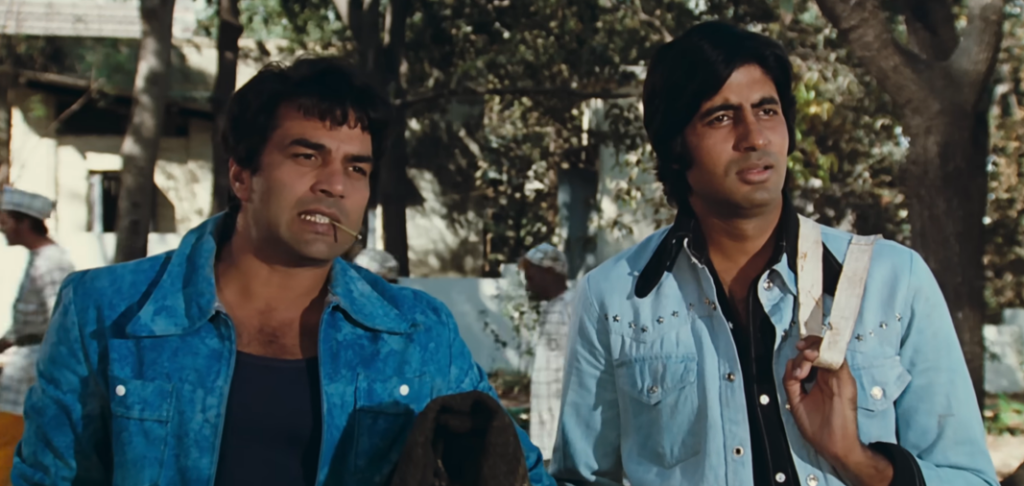
You can see why many future filmmakers were so awestruck by Sholay. Heck, when I first interviewed Thiagarajan Kumararaja, who came on the scene far later, he cited Sholay and Deewar as examples that commercially successful films can be artistically successful too. One of the most memorable lines in Sholay is when the Hangal character says, “Itna sannata kyun hai bhai!” He wonders why it is so quiet. The same could be said about the film. There’s background music during the action scenes, for instance, but otherwise, it’s hard to find such a long mainstream film filled with so much silence. Essentially, Sholay proves that if the writing and staging and performances and cinematography work, there’s no need for background music. The late Dharmendra, Amitabh Bachchan, Hema Malini, Jaya Bhaduri, Sanjeev Kumar – the entire cast explodes. If there’s one reservation I have, it’s the excessive enthusiasm the Jaya Bhaduri character (Radha) shows during her Holi-flashback sequence. It’s there for a reason, to contrast who she was as compared to the near-mute person she is today. But it grates a bit.
But minor flaws and all, this is still the greatest masala movie made in India. When Jai dies, it’s in front of Veeru who can’t stop talking, and Radha who’s as silent as a stone. When the thakur approaches a weakened Gabbar at the end, for revenge, he walks through the very pillars where his hands were tied when Gabbar cut them off. The songs are a virtual textbook on the various genres of the Hindi film song: the happy and sad versions of the friendship song, the festival song, the item number, the keep-the-clock-ticking-till rescue-arrives dance in the villain’s den, and the roothna-manaana song, with the hero pacifying the annoyed heroine. The latter number (‘Haan jab tak hai jaan’), this time, reminded me of ‘Pyaar kiya to darna kya’ from Mughal-e-Azam, in the sense that it’s a proclamation of love in front of a tyrant.
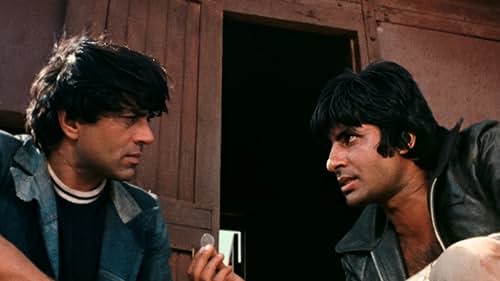
Was that a possible inspiration? Much has been written about how Sholay steals from this film and that one. The basic template comes from The Seven Samurai. But as someone said, it’s not where you take things from, it’s about where you take them to. Take the coin toss, which is introduced in the ‘Yeh dosti’ song sequence. In a regular action film, one that had nothing on the agenda but to give us an explosive good time, Jai and Veeru would have been introduced in the song, ‘Yeh dosti’. It defines them. It tells us all we need to know about them – that they are thick friends, that they are rogues, that they settle things through a coin toss. But in Sholay, Jai and Veeru are introduced in the thakur’s first flashback, in an altogether heavier scene on a train, where we witness other qualities of theirs – their suitability for Gabbar-vanquishing, their code of honour (despite their inherent roguishness), and their dependence on the coin toss, which, now, assumes greater significance than in the ‘Yeh dosti’ song, where they were just competing for a girl’s attention. What we sense in the flashback is the moral weight behind the coin toss, along with a fact that becomes clear only at the end, that Jai is the decision-maker. He makes up his mind about what should be done, and ensures, through the loaded coin toss, that Veeru gets on board. A mere action film rarely invites such reflection.
When I interviewed Ramesh Sippy a long time ago, I asked him if he was sick of being asked to talk about Sholay. He said, “It’s the defining film as far as my career is concerned – with respect to performances, technique, and the box office, which ultimately outweighs everything else. It’s the biggest blockbuster of all time. That’s one crown that belongs to me. I don’t mind talking about it.” Later, he admitted that the film’s staggering success cast a long shadow over the rest of his career. His subsequent efforts – Shaan, Shakti, Saagar – were seen as disappointments. He said, “At a cost of 6 crore, Shaan doing business worth 12 crore is nothing when Sholay, a film costing 3 crore, does something like 25 crore in its first run. Today, you invest 3 crore and get back 5 crore and you’re called successful.” He added, “Seeta Aur Geeta cost 40 lakh, but with Sholay, I wanted a bigger budget. I wanted to make the film a certain way, with no compromises, and I gave myself one crore. It ended up costing three crores. By the time the first 50 lakh was spent, with hardly two reels in hand, the corporates would have stopped the shooting.” In other words, a Sholay probably could never be made today. Subhash Ghai tried with Karma. Dharmesh Darshan tried with Mela. We have films that use masala elements today, sure, like the current blockbuster Dhurandhar – but in a far more realistic form. The tropes are almost unrecognisable. Maybe we can label these films as neo-masala. But Sholay remains what it is, a great movie and – yes – the greatest masala movie made in India.