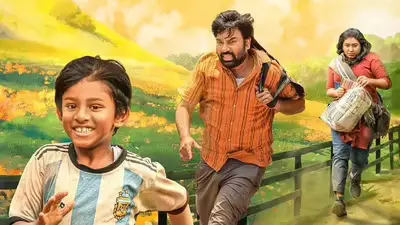
Shiva, Grace Antony, and Mithul Ryan play an urban family that, like the title says, learns to fly away. The sweet, gentle, musical feel of the film makes even the feel-bad moments of life seem like a feel-good experience. The rest of this review may contain spoilers.
Ram’s endearing new film is called Paranthu Po, and like the title suggests, it is about freedom. We are all tied down by life. If we are children, we are tied down by school. If we are grown-ups, we are tied down by work and EMIs and the fees for children who are… tied down by school. What if we could snap these ties, leave our responsibilities behind, and fly away, like the title says – even if only for a little while! The film opens with an eight-year-old boy who is trapped in a cage. It’s actually his home in Chennai, but his parents are out and so they have locked him in. We see him framed through the grill gate just outside the door. His name is Anbu. He is supposed to be doing summer classes over a laptop, but his mind is elsewhere. He yearns for freedom. He tells the teacher that her classes are boring. He is still young enough to say exactly what he thinks. This is another kind of freedom, available only to the young and innocent.
Anbu’s parents are an inter-religious couple, Gokul and Glory. They are out at work. Gokul is out of the house, and Glory is out of the city, in Coimbatore. Like most middle-class parents, they are trapped in a cage, too – a cage made of debt. They want the best for their son. So they have to pay for expensive summer classes, and an expensive school, and expensive chappals so that Anbu will fit in amongst the rich kids in that expensive school. Gokul thinks that this is the friends’ circle that will help Anbu in the future. He’s not wrong. But look at Anbu, who seems obsessed with his expensive waveboard, but – without a moment’s hesitation – trades it in for a simple spinning top because that begins to fascinate him more. Anbu lives in the moment. It’s not about the cost. It’s about the experience.
Paranthu Po gets going when Gokul and Anbu set out on an unplanned road trip. This, again, has to do with money. It is instigated by a loan collection agent. And the father-son duo travels from the confines of their cage, the city, and “fly” to smaller places with wide-open spaces. Every stop is a new episode, a new delight for Anbu. He is finally free, and slowly, Gokul learns to be free, too – at least for the duration of this unplanned road trip. At one point, we see him sleeping on the branch of a tree. In Coimbatore, Glory gets her own moment of freedom, when she frees herself of her attachment to money. She has gone there to supplement the family income, but in a fit of kindness, she thrusts a big chunk of cash into the hands of someone whose needs are greater. Like Anbu, she is living in the moment. Tomorrow can wait.
Paranthu Po is the sweetest, nicest, gentlest, kindest Tamil film since Meiyazhagan. In a way, it is like Ram’s other films. It is about the angst of urban life. It is about the angst one undergoes with children. There are many metaphors for middle-class life and parenthood. It is like climbing a hill with weak knees. It is about seeing your kid in a pond and not knowing how to swim. It is about playing catch-up all the time. Anbu is always two steps ahead. It is about the hope that an ordinary duck’s egg will hatch into something as exotic as a dinosaur. It is about the awkwardness when you try and do something nice, and end up in an embarrassing situation – which happens with Glory’s assistant. Why does she do it, then? Because of love, compassion… Maybe there is a reason this film’s central character is named Anbu.
But all these Big Points are narrated so casually that you hardly feel their weight in the movie, which has Ram venturing into two new genres (or to be more precise, two new tonal flavours). One is comedy. Paranthu Po keeps you smiling. A major reason for this is Shiva’s performance as Gokul. After Soori in the Viduthalai films, Shiva makes a strong case for comic actors to be cast in more serious parts. Gokul isn’t as serious a part as Soori’s character in Vetri Maaran’s movie. But Ram tones down the actor’s natural pitch, and we get a man-child with heavy burdens but who handles them with as much lightheartedness as he can. When Anbu swears in a restaurant and Gokul is asked if he knows how to raise a kid, it’s a laugh-out-loud moment, but Shiva also makes us feel the surprise he feels about how little he knows about his son.
Grace Antony is equally brilliant. Glory is struggling under her own burdens. Away from home, she is living the life of a single working woman. She has to face shady men while walking home at night. She has to handle her business, with just one assistant. She has to face the temporary separation from her husband and son. But even if Grace and Gokul are separated by distance, they seem to be closer than most couples who live together. Shiva and Grace Antony make us see a husband and wife deeply in love, always communicating on the phone, sometimes lying to each other so that the other person does not worry… They are so connected that even their problem areas are similar. He is a smoker. She has asthma. In other words, both have lung issues. And yes, how cute are their matching G and G names!
The other new tonal flavour for a Ram movie comes in the form of the lovely songs by Santhosh Dhayanidhi, with words by Madhan Karky. Paranthu Po is like a French New Wave musical, with small, quirky musical bits that sound like conversational commentary. “Open panna oru ooru ya / Chennai dhan adhu peru ya” – that’s a sample from the opening number. “Where is Anbu / Anba kaanavilla” is another sample. This comes at a point when Anbu goes missing. Perhaps my favourite songlet is the one that appears when Gokul slaps Anbu and the boy goes into the bedroom and slams the door. The words we hear are: “Adanjadhu kadhavu / Odanjadhu manasu”. Gokul does not want to be the strict, disciplinarian father that his father was. And yet, children have a way of bringing out your worst side. The merging of emotions and music and words is beautiful.
But one thing hasn’t changed, and that is Ram’s interest in Nature as a supporting character. We get trees, hills, lakes, sunflowers, teenagers named Maina and Kuruvi, and an unexpected spell of rain that leads Gokul to the characters played by Anjali and Aju Varghese. (She is good; he is magnificent.) When Gokul meets Vanitha (the Anjali character), she is bathing by a pond, and she is utterly casual about the fact that she isn’t fully clothed. And neither does Gokul look away. Perhaps concepts like shame come up only when there’s dirt in the heart and mind, and these are clean souls. In fact, there isn’t a single “unclean” person (or villain) in this story. From the auto guy to the husband who isn’t jealous or suspicious, from the ultra-rich man who doesn’t look down on those lower down the social ladder to the homeless man with a big heart, everyone is nice.
When Vanitha finds out something embarrassing about Gokul, she doesn’t find it awkward to discuss it with him and he isn’t awkward about it, either. The camera observes them casually, as light strings play in the background. A potential Big Moment has been reduced to a simple acknowledgement that shit happens. Shit happens in a more literal way when Anbu learns to relieve himself in the open. Here’s another form of freedom, the kind we find in other creatures of Nature. Ram often cuts to wide shots to emphasise the smallness of us, like the one where two men on a moped are reduced to the size of insects, as we see the vastness of their surroundings. At a time of breathlessly paced cinema, this is a film that breathes. It is a series of incidents that are not really connected, but as we think about them as a whole, a big picture comes together.
Given the episodic nature of Paranthu Po, some of the incidents may make you wonder if they are really needed. I found the tone of the episode with Vijay Yesudas was not consistent with the subtler pitch of the other episodes. But even here, there are great father-son moments. Many bits have solid payoffs, and yes, even if the payoff with an old woman and a sari may seem a tad forced, the intent is so good-natured that you don’t feel like complaining. The film’s glue is Mithul Ryan’s extraordinarily intuitive performance as Anbu. As a character, he has to be fun and frustrating and adorable and annoying and many other things, and he does it all without being that one thing many screen kids are: irritating. The farcical ending portions are perfect, in how they emphasise both the absurdity of life and the seriousness with which we think about it. For a couple of hours, Paranthu Po asks us to step out of our cages and fly away without trying to control and overthink every single moment. At least on screen, it’s a beautiful fantasy, and Ram’s finest film to date.