Farhan Akhtar plays a real-life war hero, and the film shows a battle that played out during the Indo-China war, which has also been dramatised in Chetan Anand’s ‘Haqeeqat’ in the 1960s. The writing follows familiar genre beats, but the actors are great and the filmmaking is fantastic. That’s the short take. A longer review follows, and it may contain spoilers.
In the early 1960s, as we see documentary footage of Jawaharlal Nehru, India still thought of China as a friendly neighbour. But the sentiment was not reciprocated, and war broke out in 1962. The Chinese army began to make inroads into Ladakh, with the larger goal of capturing Jammu and Kashmir, and one of their plans was to use the very narrow pass named Rezang La. That’s not an easy crossing and you’d not expect a battalion of 3000 Chinese soldiers to squeeze in through there. Even the higher-ups in the Indian army think that China will choose to take over the village of Chushul, which offers easier access through the mountains. But Major Shaitan Singh Bhati has that thing called instinct, and his instinct tells him that the Chinese will choose the least-expected option, which is Rezang La. He is proved right. Razneesh Ghai’s film, written by Rajiv G Menon, takes us through the events of that fateful battle, where all Shaitan Singh had with him were his 120 soldiers… his 120 Bahadur.
The film is a standard-issue war movie, and every war movie has standard beats. It is unavoidable. It is the nature of the genre. So we have Shaitan Singh’s wife (Raashii Khanna) telling him that she understands that his uniform is not just about heroism but also sacrifice – and yet, she doesn’t want him to talk about the possibility that he may not return. We get the camaraderie between soldiers over bars of chocolate and a love for Madhubala. We get a song on the lines of “Sandese aate hain,” where the soldiers remember their loved ones left behind. We get solidly melodramatic lines like “Baat zameen ki nahin… sarzameen ki hai”. I really liked a line towards the end where a survivor is asked if the war really happened – because all evidence, all the bodies, are buried in the snow. The man says something like, “Baraf mein khoon milega – aur woh khoon chhaati ka hoga, unke peeth ka nahin.”
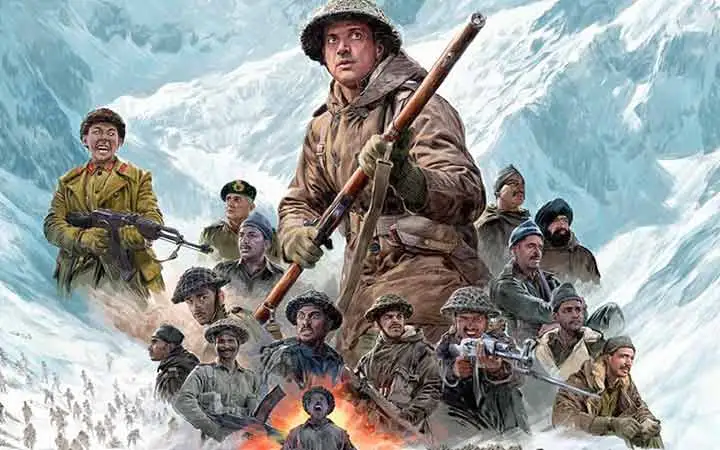
All war movies need a USP. Here, it is the fact that Shaitan Singh’s 120 brave soldiers are from the primarily agricultural Ahir community. They are from the plains. Unlike the Chinese, they are not used to high altitudes and low oxygen levels. This is the thing that could have made for a truly different war movie, but this fact is mentioned and shown and dropped quickly. We get a line that Shaitan Singh has made his men march up and down the hills a bunch of times to acclimatise them, but we don’t see this, and it doesn’t become a strong point in the war that follows. When Shaitan Singh radios his Commanding Officer and says that the Chinese army has around 3000 soldiers and they are just 120 men, he is asked to retreat. But Shaitan Singh decides to stay back and fight, and the decision – and his inevitable big speech to his men – has more to do with motherland-type abstractions than practical considerations like the cold and the terrain they are not used to.
Instead, a large portion of the first half is filled with warm-fuzzy flashbacks about family and to establish Shaitan Singh as a kind of legend. The man can read the wind and predict where a bullet will fall. Seeing this in action, an awestruck soldier says, “I have only heard stories about his bravery. Now, I am actually seeing him in action.” But Farhan’s inherent persona of being laidback helps a lot. Yes, he has to kick up the pitch several notches when uttering some of the more melodramatic lines, but we also see the other side of Shaitan Singh with his wife. In those portions, Farhan stays away from melodrama and acts his natural self. This balance gives Shaitan Singh more texture than the material would seem to suggest. One of the major strengths of 120 Bahadur is the all-round excellence of the actors. There’s not one bad performance, and even the Chinese are well-cast. They come across like humans and not cartoon-monsters. Sparsh Walia is especially terrific as the rookie radio operator who becomes this war’s eyewitness.
The other major strength is the staging and the cinematography by Tetsuo Nagata. The colour palettes are the expected warm/cold contrasts. Shaitan Singh’s flashbacks are filled with the rich hues of Holi celebrations and the soft lights of Diwali, and at the Chinese end, we see brown-yellow uniforms and lovingly shot food in a riot of colour. The actual war, meanwhile, unfolds in the near-monochrome of ice. But beyond that, the staging of both the regular scenes and the war scenes is outstanding. I have had my fill of show-offy single shots – but even that technique, here, is used for a very specific and very dramatic purpose, to follow Shaitan Singh as he runs through little alleys of a village, killing enemies. He kills the last one and we think he’s done when the scenery opens up and he stumbles upon a vast visual that shows why he isn’t even close to being done. 120 Bahadur could have used better writing, but it does get better as it goes along and there are some affecting moments towards the end. If you decide to watch it, make sure you pick the biggest screen near you.