Dulquer Salmaan, Samuthirakani, and Bhagyashree Borse give excellent performances as film people involved in a complicated relationship both on and off shoot. The juicy story is about power and passion and crime, and it doesn’t always land, but the end result is a solid achievement. That was the short take. A longer review follows, and it may contain spoilers.
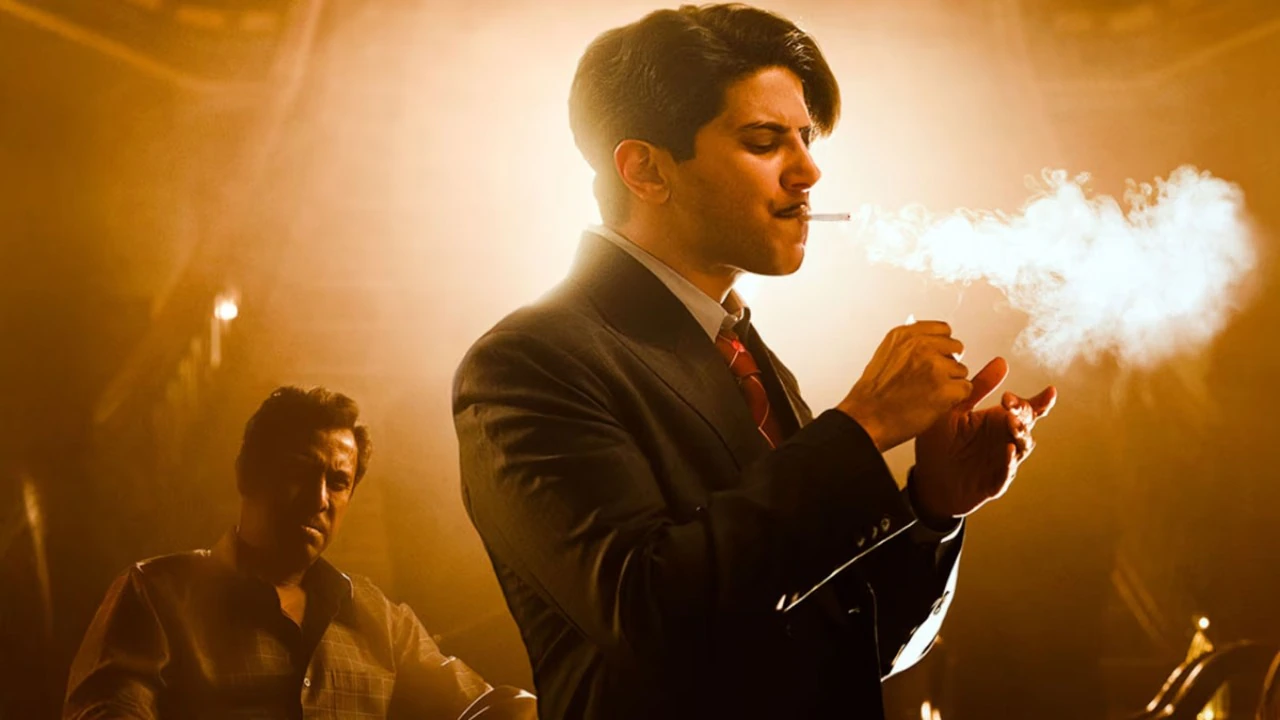
Kaantha is a film that’s set in the past, and it looks and feels like a film that’s set in the past. Yes, the score is somewhat modern. Yes, the superb, shadowy, smoke-and-mirrors cinematography by Dani Sanchez-Lopez wouldn’t have been possible without today’s technology. But the soul of the film is satisfyingly old-fashioned – and by that, I mean that I was reminded of old-style Hollywood noir, of films like Sunset Boulevard that mixed romance and cynicism and a brutal will to survive in the film industry. The opening scene, set in “Modern Studios” is pure noir. There’s rain, a shadow-figure wearing a fedora, and a gunshot. The rest of Kaantha, which is beautifully directed by Selvamani Selvaraj, builds up to this moment, through the triangular relationship between a director called Ayya, a big star-actor named TK Mahadevan, and a newcomer-actress named Kumari. These characters are played by Samuthirakani, Dulquer Salmaan, and Bhagyashree Borse.
The pre-interval portion takes us through the making of a Tamil movie, which is shown in dazzling transitions between black-and-white and colour. The stylised acting borders on dance. The dialogues border on poetry. But the real drama is happening off-camera. Ayya and Mahadevan have a complicated past, but circumstances have thrown them together and the ego wars begin almost at once. At one time, Ayya was Mahadevan’s mentor. Now, Mahadevan is a huge singing star, whose films play for 1000 days the way a Haridas did. The power games are amplified when Kumari gets between them. She, too, is someone Ayya discovered and mentored, and at first she is fiercely loyal to him. She stands up for Ayya when Mahadevan keeps insulting him. But slowly, her behaviour changes. One, she discovers Mahadevan is not the Devil she thought he was. And two, she discovers that Ayya isn’t the God she thought he was.
Ayya, in fact, is a man with a God-complex. He wants his pupils to worship him, and he metes out horrific punishments when he thinks these pupils are out of line. Samuthirakani gets a good role after a long time, and he shows us how controlled an actor he can be. He makes us feel the godlike power a director seeks and the feelings that ensue when that power is stripped away by a “mere actor”. Whether intentional or not, this becomes a commentary on present-day cinema, where star-heroes are considered bigger than directors. Ayya’s God-complex emerges again with Kumari, and he is enraged when she drifts towards Mahadevan. And the film’s structure slowly begins to fall into place. Ayya’s fall from grace becomes a motive for murder, and we see that even as Kaantha distracts us with the mechanics of making an old-time movie, the writing keeps introducing various characters whose actions suggest that they, too, have a motive for murder.
The other beautiful aspect of the writing is the way the on-screen film melds truth and fiction. Ayya may have written a fictional screenplay based on something very personal, but as the shoot progresses, this story takes on shades from the Ayya-Mahadevan relationship, the Ayya-Kumari relationship, and the Kumari-Mahadevan relationship. Bhagyashree Borse is lovely. She has the earnestness and newcomer-nerves of Aishwarya Rai from Iruvar, and she shapes Kumari beautifully. Selvamani doesn’t oversell any moment. If Mahadevan and Kumari are falling in love, we get a shot where they are holding hands and their fingers linger a little longer than what’s needed for the scene being shot. Dulquer’s talent as a romantic hero was never in doubt, but watch him take up an acting challenge from Ayya where Mahadevan has to change moods within seconds, or note the smallest tremors in Mahadevan’s voice when he and Ayya finally talk in a static shot, and you see a range an actor rarely gets to explore. He is magnificent.
The second half of Kaantha sprouts from the seeds sown before interval. The film being shot was a ghost story, and now, the murdered person becomes a ghost who hovers over the story. The screenplay shifts gears and becomes a whodunit, with Rana Daggubati playing the cop on the case. For some reason, this character is written and played out as broad and hammy – not in the broad-hammy sense of a 1950s movie, but in a more self-aware way. This creates some tonal issues. But a bigger problem is that the smaller characters floating around as red herrings never make us feel that they could have done it. And when the ending arrives, it isn’t as emotionally shattering as it should be – especially with a plot point involving a recording device that feels too forced. But flaws and all, the immersion into a period and the small touches throughout make Kaantha well worth it. Mahadevan’s moustache is something fake, something he peels off – and these cinematic illusions are amplified by the constant use of mirrors that reflect the on-screen actors and the characters they play in the film inside this film. Kaantha is ambitious, and for the most part, it gets its hands on what it is going after. It’s a solid achievement.