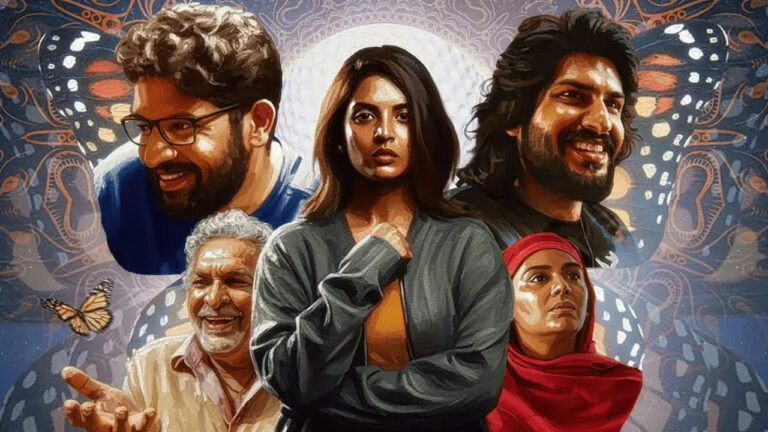
A terrific Sobhita Dhulipala plays a true-crime journalist who begins to track a serial killer. What works better than the genre parts of the film is the subtext, which says a lot about women. And sometimes, men. That’s the short take. A longer review follows, and it may contain spoilers.
On the surface, Cheekatilo is a mystery about catching a serial killer. But writer-director Sharan Koppisetty and co-writer Chandra Pemmaraju do something interesting. They make this more than just a solid genre movie. The trademarks of the genre are all there. The serial killer leaves a signature. The big reveal is about who they are and why they did what they did. There is some BDSM stuff. There are quite a few scenes of throats being cut and blood spurting out. There’s a chase sequence where Sandhya, our fearless protagonist, pursues a masked individual. (Sobhita Dhulipala plays Sandhya.) But the real movie lies beneath these tropes, and it begins when we see Sandhya in a cinema hall reliving a traumatic memory. She was groped and pushed around by frenzied fans of the star whose movie was playing. This happened when she was a teenager, and when she told her mother, she was asked to keep quiet, to forget about it.
Sandhya is the anchor of a popular crime show on television, and she begins to look into the serial killer when someone close to her becomes a victim. But another reason for her interest is the trauma in the cinema hall, which has never really left her. She still carries within her the memory of those groping hands. When she was younger, she wanted to take action on those fans. Her mother refused to allow this. But now, by solving the crime, she hopes to take action on another predator. The investigation, thus, becomes a form of closure and therapy. Sobhita plays Sandhya beautifully. There is no hysteria in the performance. At one point, Sandhya organises a press conference for survivors of sexual abuse. When an insensitive man asks if the women she has produced are actually serial actors, Sobhita doesn’t burst out with righteous indignation. She plays the scene with a look that suggests “Oh please… come on ya…”!
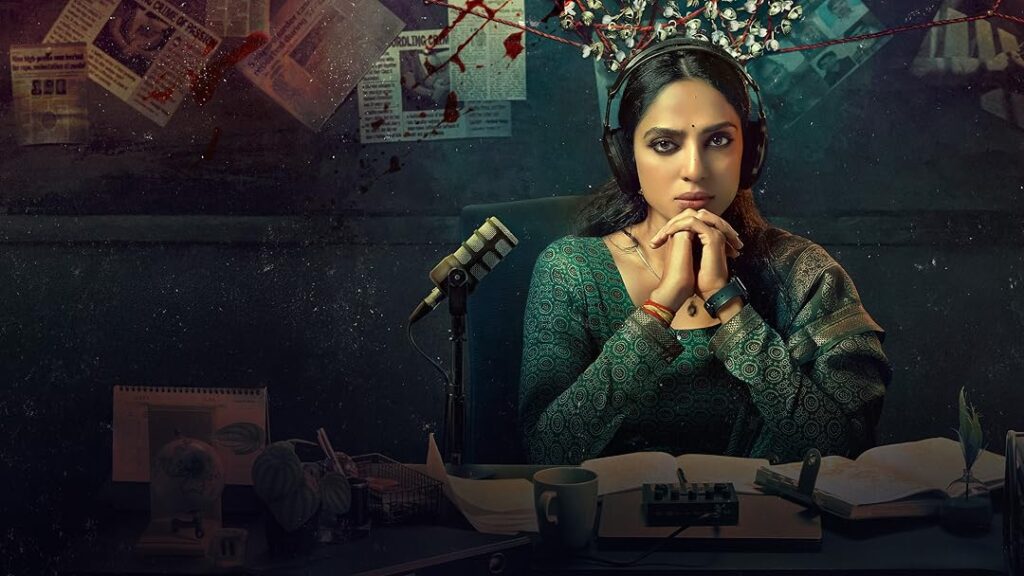
This matter-of-fact behaviour is echoed in the movie, which shows scene after scene of women who have been hurt in some manner – and by now, no one is surprised or angered. Everyone’s used to the indifference of our society. Sobhita’s eyeroll in that press conference says it all. It’s all… a matter of fact. In one of the most touching scenes in Cheekatilo, we see a middle-aged woman tell Sandhya that she got married young, and had no time to form female friends because life became all about managing a family. This is as much a tragedy as the ones in the serial killer track of the movie, because here a part of a woman’s youth has been murdered. In another scene, Sandhya asks a rape survivor if she went to the police. The woman says that her husband drove her away after the incident. When there is no support from the man she married, how can she expect anything better from the men in khaki! This sad acceptance is inherently dramatic, and the film dignifies these women by not using them for cheap, momentary melodramatic highs.

The genre part of the film isn’t as strong as the subtext. It’s still solid, but Cheekatilo isn’t exactly a nail-biting thriller – and to be fair, perhaps it does not want to be one. The big reveal did not land for me. It fits in with the film’s thesis that “they live among us”. Predators aren’t from outer space. They are often closer than we think they are. But the predator is shown as too self-aware as they recount the reasons for their actions. I would have liked it if these explanations (reminiscent of a 1970s Tamil film) had come from someone else. But I liked that Sandhya is not shown to be perfect. She catches the wrong people. One of them becomes a warning about the hidden cost of such investigations. The interrogation process inevitably rakes up old wounds, but while this helps the case, what does it do for the people with those wounds? The wounds that have half-healed over time become fresh all over again.
Cheetakilo is thoughtfully and beautifully shot and staged (Mallikarjun is the cinematographer), and it works because of its empathy. It makes a quiet point about the sensationalising of crimes. It makes a quiet point about the irrelevance of caste and age gaps in marriage. It stages a major action sequence in a kitchen, which is traditionally considered a woman’s domain. There’s no unnecessary ego-clash drama between Sandhya and the cops on the case. After some initial friction , they come to regard her as an ally. I liked the plot point that Sandhya quits at one point, preferring to carry on with her personal life. Some of the supporting actors don’t register strongly, but that doesn’t become a deal-breaker. And while the scenes with unsympathetic cops, for instance, tell us that men can be monsters, the film shows us that women can be monsters, too. Cheekatilo never becomes a shrill social-message movie, but in its own quiet way, it says a lot about the society we live in. That’s an impressive achievement for a genre film.