This remake of Mari Selvaraj’s ‘Pariyerum Perumal’ makes some interesting changes in tone and treatment. There’s a love story, a gender angle. All of this makes the film engaging on several levels. The rest of this review may contain spoilers.
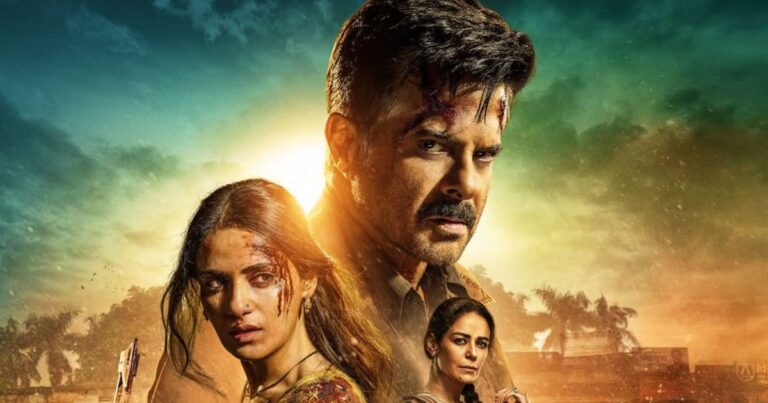
When Sairat was remade as Dhadak, we got a bland star-launch vehicle. Dhadak 2, based on Mari Selvaraj’s debut feature Pariyerum Perumal, is a lot better. It is not just a remake but also a thoughtful reimagination, and it opens with a quote attributed to Thomas Jefferson: “When injustice becomes law, resistance becomes duty.” But these words do not apply to Neelesh (Siddhant Chaturvedi). Despite the various oppressions he has faced as a Dalit (a term used in the film), he does not want to fight back. While applying for a seat at a law college in the city, the principal hints that he will form a political group and become some sort of leader. Neelesh replies: “Neta banne ke liye ladaai karni padti hai, aur woh mujhse hota nahin.” His battles are more internal, and this is his coming-of-age story.
The solid screenplay by Rahul Badwelkar and director Shazia Iqbal stays close to the original in terms of the big picture. Neelesh has to stop hiding. He has to stop being ashamed of his surname in a classroom where almost everyone else is a Gupta or an Agarwal or a Varma or an Upadhyay. He has to stop being ashamed that his English is not very good. He has to rebel, like that Thomas Jefferson quote said. And the point that transforms him is when he is horribly humiliated at the wedding of his girlfriend’s sister. (Tripti Dimrii plays the girlfriend, Vidisha.) But inside this broad outline, we get some carefully considered changes. Vidisha is no longer an innocent angel. She is no longer a symbol of an ideal (or blind) society. She is a flesh-and-blood woman who dumped an ex who had what she calls “mardon waali beemari”. The guy was toxic, and she smiles when she tells Neelesh that he does not have that illness.

This decision to make Neelesh and Vidisha a couple and focus on their love story (with some very good songs) gives us something we did not see in Pariyerum Perumal. Dhadak 2 is also the girl’s coming-of-age story. If Neelesh has to fight his surroundings, represented by Vidisha’s casteist cousin Ronnie, Vidisha has to fight her family, which sees her identity as defined by her gender. She is aware of her privilege, and she realises that what Neelesh is going through is not just something that happened long ago in villages. When Neelesh pulls away from her, thinking that this romance is doomed, she keeps fighting for them. She keeps fighting to find out what happened at the wedding. She keeps trying to understand how her father – a strong, fair, loving man who raised her after her mother’s death – can remain silent in the face of violent casteist acts. Vidisha gets the equivalent of the symbolic “cups of tea” ending of the original. Here, she suggests that a woman’s scream of rage is loud enough to stop a bullet.
Another change is the addition of a Dalit student leader named Shekhar (Priyank Tiwari). He is the first member of his family to attend college, and he thanks reservation policies for that. When Neelesh says that he is not into politics, Shekhar utters the film’s most powerful line. He says that Neelesh entered politics the day he was born. This is a world that’s slightly better than that of Pariyerum Perumal. For instance, there are NGOs that send lawyers when Dalits are taken in by the police. But otherwise, the oppression is similar. As Neelesh tells Vidisha, his colony is filled with manual scavengers and domestic helps. And as the dialogues suggest, the laws of the jungle still apply. You are safest when you stick with your own kind. Kill or be killed.
There are interesting changes in the screenplay structure, too. The scene where the protagonist’s dog is killed by men from a dominant caste comes early in Pariyerum Perumal, and then we get the introduction of the assassin who is out to “purify” society by killing Dalit men who step out of their circle and fall in love with non-Dalit women. So the progression is from the private to the public, from a few dominant men oppressing a single Dalit man to a dominant society that is out to teach a lesson to all Dalit men. In Dhadak 2, we move from the public to the private. We first see the assassin, and thus we see the society, the world Neelesh lives in. And much later, we get the scene with the dog, which is narrated as a flashback to Vidisha. So the audience and the privileged girlfriend learn about this atrocity at the same time.
I liked the way the assassin moves casually in and out of Neelesh’s life. His scenes are not separate. He is part of the picture. And the big showdown at the end is different, too. Neelesh faces the assassin, then he chases Ronnie, and finally, he argues like a lawyer in front of Vidisha’s family, putting his degree to use. Mari Selvaraj’s film framed this as a private moment between the protagonist and the girl’s father. Shazia Iqbal turns this into a public spectacle. It plays out on the road. All of this is captured beautifully by Sylvester Fonseca’s unflashy cinematography. The only exception to the director’s understated handling of this material is the melodramatic background score, which is a general drawback in most of our films. That’s why Vidisha’s father’s advice to Neelesh after his humiliation at the wedding registers so strongly. When the man speaks, there’s no music. There’s just the weight of his words, which fall on Neelesh like ten-ton bricks. Vidisha’s love, the kiss she initiated – these had begun to make him come out of his shell. But now he is put in his place.
A couple of passages of dialogue feel lecture-y. A moment with Shekhar and a pen comes back full-circle at the end, in a hopeful ending that does not feel earned. But the performances are uniformly good. Siddhant conveys shyness and awkwardness beautifully, as though the life Neelesh has led has made him process every action in his mind before actually doing it. And later, when he sheds this trait and erupts in anger, it hits you hard. Tripti is very good, as is Anubha Fatehpura as Neelesh’s mother. She is another strong woman, a fighter long before her son becomes one. Vipin Sharma as Neelesh’s effeminate father, Priyank Tiwari as Shekhar, Saad Bilgrami as Ronnie are all solid, and Zakir Husain is a standout as the principal who shows no favours but also knows when it’s time to make Neelesh understand what he is up against. Dhadak 2 does not carry the visceral punch of the original, but I couldn’t say whether this was because I have seen Mari Selvaraj’s film many times or because the angst is presented in a lower pitch. But this is a respectable companion piece, and that is no small achievement.