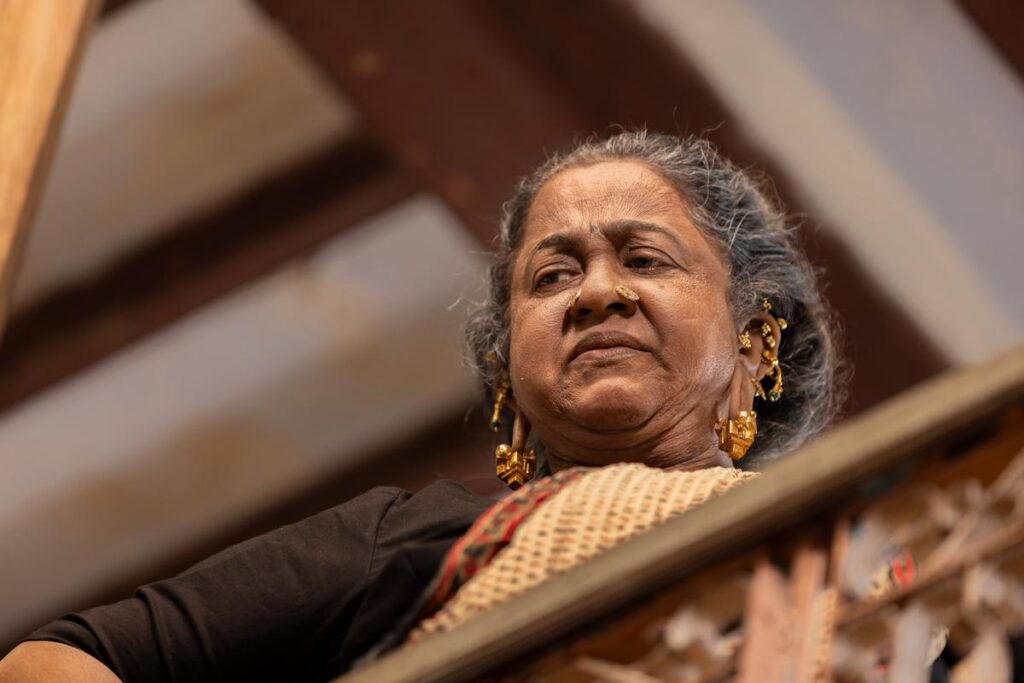
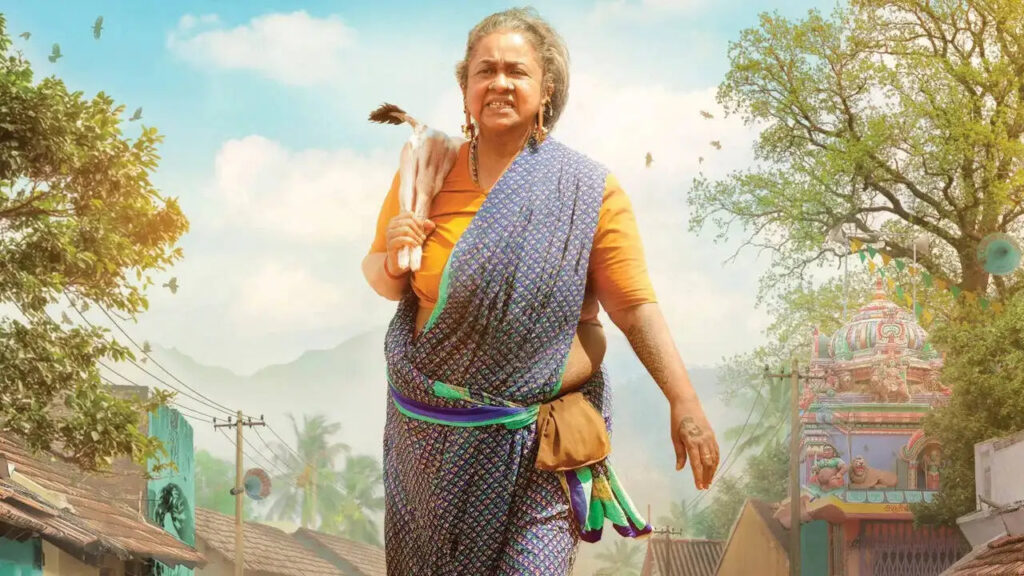
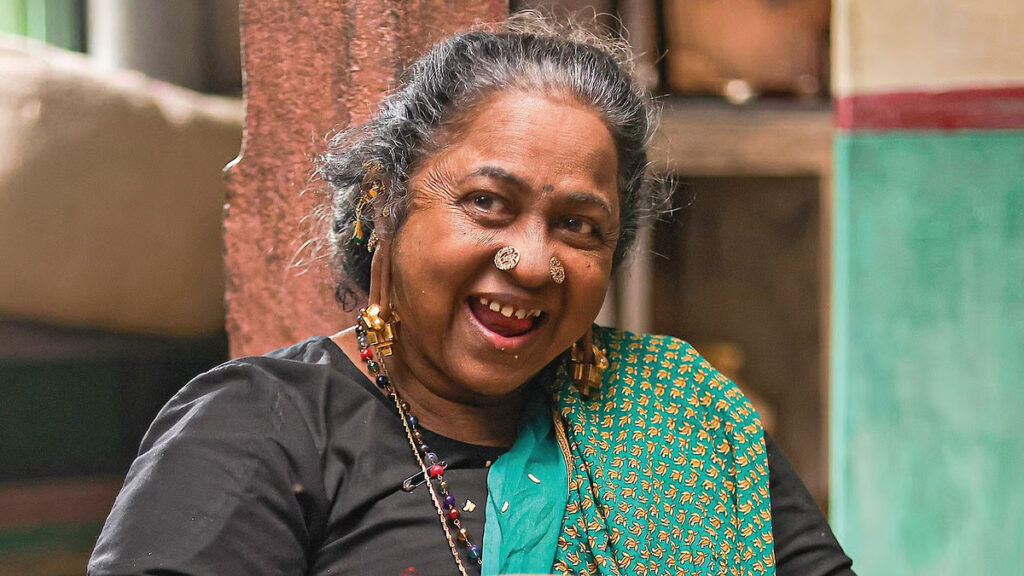
Radikaa Sarathkumar gives a broad and very entertaining “mass-hero” performance in Thaai Kizhavi. A song calls her “Sungadi selai katti vandha Superman”. She’s a moneylender, a boss-lady, a kinda-sorta “don”. Everyone in the village fears her, they want her dead – and they’re delighted when she’s bedridden. But once that happens, Radikaa disappears from the screen until the end, and we are left with a film that’s not as super as its star. Thaai Kizhavi is certainly entertaining at a basic level, with colourful characters and imaginative one-liners. In fact, the writer-director Sivakumar Murugesan seems to have laboured more on these “funny bits”, and the serious story he’s trying to tell – with serious messages – takes a backseat. Let’s begin with the part that really works. This is the arc that begins with a flashback. Pavunuthaayi’s (that’s the Radikaa character’s name) husband has died, and her sons demand a share of the property.
 And now for the longer review, which may contain spoilers.
Pavunuthaayi refuses. She says their father was a useless drunkard, and all this “property” they are after is what she has earned. And because she has earned it, it is hers to do what she wants with it. (The big reveal about what she really did with a lot of this money is a hoot.) While watching a story, I almost always go with what the story is, not the story I wish to see. But the marketing has hyped up Radikaa’s presence so much that it’s disappointing to see that she’s just there for a small portion of the film. And whenever she’s not in the frames, the narrative takes a dip. I’d have liked to see much more of Pavunuthaayi, and this made me imagine an alternative plot-line. In a differently written movie, you could make the case that Pavunuthaayi’s experience with her husband has made her understand that money should only be shared with those who can use it usefully. You have to prove yourself worthy of that money, and the rest of the plot might have been about each son trying to prove that he is the most deserving of the lot. That way, Pavunuthaayi would have been present throughout the film.
 But on paper, Sivakumar Murugesan’s approach is interesting, too. He writes the three sons (and their wives) as cold-hearted schemers who are out to get their mother’s property. And thereon, the writing is filled with melodramatic convenience, with characters who listen to one noble lecture and change overnight. And their subsequent change of heart is super-convenient. The lectures abound. Most unnecessary of all is a lecture that a Chinese head doctor (who speaks Tamil!) gives his staff about speaking to attenders in a language that they understand. This is no doubt an important message, but it doesn’t belong in this movie. (Like a lot in Thaai Kizhavi, this situation is very “manufactured”.) The other issue I had with the film is that it uses older (mostly Kamal Haasan) film songs to manufacture emotion – as opposed to the emotion arising from the writing, which is super-convenient, too. What happens to the selfish daughters-in-law, at the end, doesn’t seem like something Pavunuthaayi would do. It feels like something that’s easy to hang a lecture-message on.
 One character that really clicked for me was the “gold seller” played by Ilavarasu, who appears in exactly two scenes. He plays a tragi-comic character. The film could have used more of him, because the character connects with the central theme of money and greed. There’s also a potentially interesting character played by George Maryan. Had he been worked in more organically, he could have been what the film constantly keeps aiming for, a mix of the tragic and the comic. The two best scenes belong to Munishkanth (as a middle-aged bachelor) and Raichal Rabecca (as Pavunuthaayi’s silent daughter who speaks up exactly when she needs to), and these are dramatic scenes. I wondered if Thaai Kizhavi, with its “women need to be independent” message, would have been better as a full-on drama with bits of comedy. What we get is a full-on comedy with bits of drama, which works in parts.