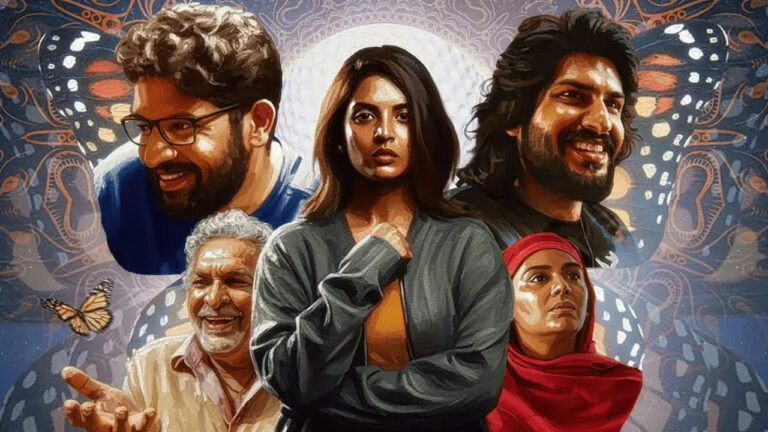
Yami Gautam Dhar and Emraan Hashmi play a Muslim couple that ends up in court when they get separated and he refuses to pay for her maintenance. The story is solid and moving, and it is told very effectively. That’s the short take. A longer review follows, and it may contain spoilers.
In Haq, Yami Gautam Dhar gives a career-best performance as Shazia. The character is based on the real-life Shah Bano Begum, who took her husband to court when they separated after 14 years and he refused to give her a monthly allowance. Emraan Hashmi is rock-solid as Shazia’s husband, a successful lawyer named Abbas. He isn’t a bad human being. He gets Shazia a tailoring machine. He supports her wish to have a garden filled with flowers. In short, he is okay with her being a woman, doing “feminine” things like tailoring and growing blue roses and bearing children. But he isn’t happy when she visits his office. He is not exactly a practicing Muslim. He drinks. He is not regular with his prayers. But he conveniently believes in Muslim law, which empowers him as a man and allows him a second wife and allows him to triple-talaaq Shazia.
In Abbas’s eyes, he has given Shazia everything she could possibly need. He has given her a house. He says that the second wife (Vartika Singh) will live in the outhouse and the main house will still be Shazia’s domain. He even says that perhaps the younger (and prettier) wife can help Shazia raise the children. In his eyes, this is love. In Shazia’s eyes, this is not love. This is humiliation. She moves out with the children, and the legal proceedings begin. Shazia cannot understand what went wrong. They seemed so happy. But slowly, director Suparn Varma and writer Reshu Nath begin to fill in the facts. We learn about Abbas’s life before he met Shazia, and we realise why he has now grown tired of her. Yami gives a powerful, outsized performance and Emraan is restrained, and this clash in acting styles is in perfect sync with the film that follows.

Haq is not one-sided. Shazia can sometimes be clingy and needy, and we see how this annoys Abbas, especially when he gets constant calls from her while at work. The second wife, Saira, isn’t a bad person. She tries to get along with Shazia, until there comes a point when she realises she has to put her foot down. As for Abbas, he yells at Saira for coming to his office, but after she leaves, he looks at her picture on his table. His face is reflected on the glass frame of the photograph, and at least at that moment, husband and wife are merged. At that moment, he feels guilt. But more than these individuals, the film is about Islamic law versus secular law. For instance, why do divorced women from other religions have a right to alimony, while Muslim women have to depend on the “kindness” of their husbands? These are among the many issues debated by Shazia at court, with the excellent Sheeba Chaddha and Aseem Hattangady as her lawyers.
Shazia is ostracised by her community and she faces many troubles, but she is unwavering in her determination. Haq takes care to show that not all Muslim men are like Abbas. Some men, like Shazia’s father, do stand up for what their conscience says is right rather than what the Muslim law says. (This character is beautifully played by Danish Hussain.) But a poisonous cocktail of patriarchy and personal interpretation of Islamic teachings have resulted in an unenviable position for Muslim women, and that is what we are left with – the point that a Muslim woman is also an Indian woman, and she deserves every consideration that other Indian women get from the Constitution. Haq is simple and straightforward, and this unfussy approach suits the material. I would have liked some more personal detailing – for instance, the reason Abbas comes across as someone who doesn’t really care about his children. But all the big things fall into place satisfactorily, and we get a movie that has a solid story and also lets us hear from the unheard voices of the society we live in.