The film is about many things. It’s about law versus justice. It’s about the small changes in the character of the protagonist. It’s about the details of police work. And it’s about what it means to belong to a minority community. All these ideas come together in a very cohesive manner. A more detailed review follows, and it may contain spoilers.
Vikram Prabhu gives a solid performance as the leading man of Suresh Rajakumari’s Sirai, but he is not the hero. He is the protagonist, a cop named Kathiravan who is basically a nice guy. But even nice guys can have their prejudices. In an early scene, set in Vellore in 2003, a prisoner tries to run away, and Kathiravan shoots him down. When summoned by an enquiry commission, he is unapologetic. He stands defiantly and says that either way, he’s screwed: he gets blamed if the prisoner escapes, and he gets blamed if the prisoner is shot while escaping. End of scene. Now let’s look at a stretch towards the end of the film, where a similar situation happens. Another prisoner tries to run away. But this time, Kathiravan doesn’t shoot. And he tells his men not to shoot either. He tells them to run after the prisoner and catch him, but without using guns.
What caused this change? That’s the crux of the story, written by Tamizh, who directed Taanakkaran, where, again, Vikram Prabhu played a cop. Tamizh was a policeman before he became a writer-director; you could call him the equivalent of Malayalam cinema’s Shahi Kabir, whose experience as a cop led to police-themed films like Joseph, Nayattu, Officer on Duty, and Ronth. Here, the focus is on law versus justice, and it gets going when Kathiravan and two of his men escort a prisoner to his court hearing. This prisoner’s name is Abdul, and he’s played with vulnerability by LK Akshay Kumar. Akshay has the kind of looks that make you want to protect him, but there’s also the cold fact that Abdul is a murderer. This is something he himself has confessed. So what really happened? How could this innocent-looking boy have committed a murder? And if there are extenuating circumstances, why does he keep trying to escape from Kathiravan and his men?
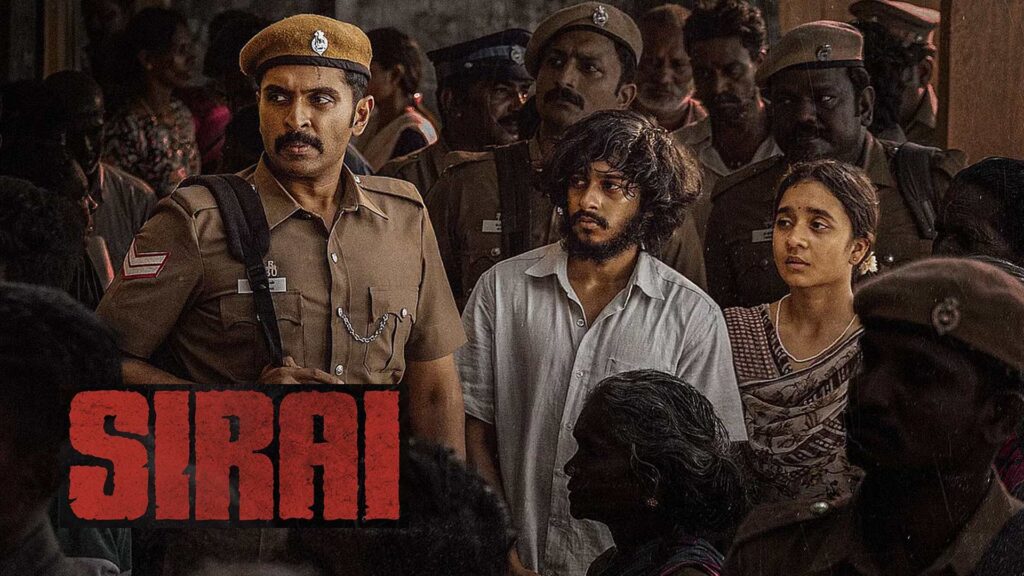
All of this is explained in the flashback portions of the screenplay, by Tamizh and Suresh Rajakumari. We meet a girl named Kalai, nicely played by Anishma Anilkumar. She has an older sister who supports her decision to love Abdul, because she does not want Kalai to end up like her. The writing is strong and melodramatic, and in parts, I was reminded of the Telugu drama Court. The older sister gets only a few scenes, but that’s enough for us to understand why she is needed in this story. In the present day, we have the character of a troublemaking cop. Again, in just a few scenes, his impulsive anger becomes a key catalyst in the story. Ananda Thambirajah plays Kathiravan’s wife. She, too, makes an impression in her handful of scenes. We see that she’s a steadying presence in his life. In addition to these characters, the details in this drama are enjoyable and educational. We learn, for instance, the exact process through which a cop can take leave while another cop volunteers to do his duty. This involves a permission slip called a passport.
The strength of Sirai is that it’s tight and cohesive and focused. Yes, we may have seen some of these plot elements in other films, but barring a couple of nicely tuned songs by Justin Prabhakaran, there are no distractions. Along with the law versus justice theme that plays out in Abdul’s story, we also see small, slow transformations in Kathiravan. For instance, he is an atheist. Early on, he’s annoyed when his mother comes to him to apply some viboothi. But slowly, he changes. He becomes more tolerant. His personal beliefs remain the same, but he allows Abdul to do the namaaz. As for the bigger picture, there is a genuine sense of what the stakes are because it’s not easy to guess how this story is going to end and what’s going to happen to Abdul. His religion creates issues. Lawyers are not taking up cases of Muslims after bomb blasts. Even the cops with Kathiravan treat Abdul differently, which is highlighted in a superb scene in a police station.
And that becomes another angle. Had Abdul been, say, Abraham or Alagappan, would he have been denied a trial for so long? There’s a line Kathiravan tells Abdul: “Unnoda kural dhan unakku balam… dhairiyama pesu.” Right from his time at home, Abdul has been told not to stand up for himself and not to stand out. His mother is a bold woman, but even she advises him to be part of the invisible minority. So for Kathiravan to tell Abdul to speak up, it means something. The melodrama peaks towards the end, in the style of Tamil and Telugu cinema, and it works because you are genuinely invested in Abdul’s situation and you genuinely want him to be released. Sirai is the rare film where even the message goes down easily, because it comes during a class in police training. The ending is very satisfying, and once again, we see that these so-called “smaller films” are the highlights of 2025.