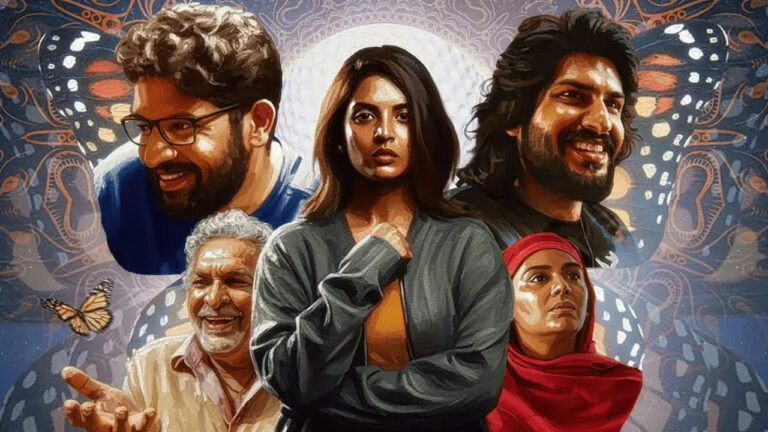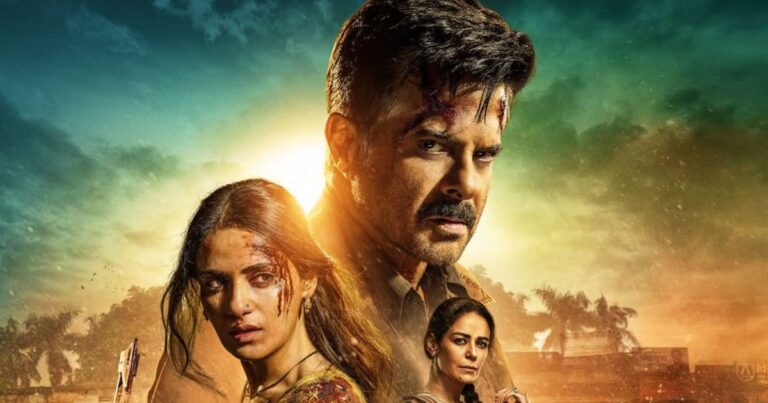
Shane Nigam, Shanthnu, and a few others play kabaddi players who are drawn into a bigger game, thanks but no thanks to loan sharks. The action is top-notch, and their fight for survival is a satisfying watch, even if you feel the drama needed better writing. That was the short review. A longer review follows, and it may contain spoilers
The world of Balti is set in the Kerala-Tamil Nadu border, and it is built around impoverished people from a “colony”. Shane Nigam plays Udhayan, a butcher. Shanthnu plays Kumar. Siva Hariharan and Jeckson Johnson (one of them sells lottery tickets) complete this group of friends. They are skilled kabaddi players, and they use the sport to vent their aggression and frustration. The director Unni Sivalingam works closely with the cinematographer Alex J Pulickal to convey the rush of energy in every scene. During the kabaddi sequences, the camera moves like one of the players. It stays close, at eye level, and rarely goes for establishing shots. Even the fights are choreographed like the raids in kabaddi. Early on, as Udhayan and his friends are cornered by the police, they use their signature moves to dodge them. A huge, huge shoutout to the stunt choreographers, Action Santhosh and Vicky. They make the movie.
The physical sport is not the only thing Balti is about. Udhayan and his friends get involved with a loan shark with the impressive name of Porthamarai Bhairavan, played by Selvaraghavan. At first Bhairavan wants the youngsters to play for the team he owns and win kabaddi matches for him. There’s something personal here, because his rival also owns a kabaddi team. (This is another loan shark, called Soda Babu, and he is played by Alphonse Puthren) Slowly, Bhairavan realises that Udhayan and his friends are more useful to him outside the kabaddi ground. He uses them to carry out low-level gangster-type activities. In effect, they become low-level henchmen – and these kabaddi players end up playing a very different (and more dangerous) game. They have to do the figurative equivalent of their kabaddi “moves”, in order to survive. We begin with a story about kabaddi players. We move into a story with people playing the game of life, so to speak.

Even the way the heroine is written into the movie is interesting. Preeti Asrani plays Kaveri, a flower seller. The parts where Udhayan sheepishly courts her are nothing new but they’re fun, especially during the joyous Jaalakari song. But Kaveri comes into this world not just through Udhayan but also through her brother, who is – again – a kabaddi player. He ends up owing money to Bhairavan, and this, in turn, tests Udhayan’s loyalties. You really feel for Udhayan when he lashes out at Kumar, saying that he takes decisions on his own and expects the others to fall in line. Shane is fantastic, here. But Kumar’s character is confusing. The film wants to keep us guessing about his loyalties, but his relationship with Udhayan and what he turns into at the end are not convincingly sketched out. His ties with a third loan shark (played by Poornima Indrajith) are even more puzzling. Even so, the Subramaniyapuram vibe of hot-headed youngsters being manipulated by higher powers is always absorbing.
The action blocks alone kept me riveted, because these youngsters are not invincible. You wonder if they might die. We are used to fights that are larger than life. Here, the fights are… smaller than life. There are many tiny “mass” moments, and I loved the energy and the mix of performing styles. Selvaraghavan demonstrates a theatrical kind of hamminess. Shane Nigam and Alphonse Puthren are flashy but controlled, as we’d expect from the Malayalam-cinema school of acting. Shanthnu is more from the Tamil-cinema school. His face displays every emotion so it’s always clear what he’s feeling. There’s been a lot of talk about Sai Abhyankkar. His songs and score fit in very well. He goes for unusual cues. He may use a solo violin for a sad scene, but he reworks this cliché by having accompaniment from an acoustic guitar. There’s electronic music. There’s folk. He seems to have no rulebook, and at least here, this eclectic style worked for me.
Had some of the writing issues been fixed, Balti could have risen above being enjoyable and become a minor classic. The Alphonse Puthren character is certainly fun to watch, but the menace is missing because he vanishes after a point. Bhairavan’s way of humiliating those who cannot repay his loan becomes repetitive after a point. There’s a small, lovely scene between Udhayan and his mother, which shows that even the most hot-headed of men sometimes need a calming maternal touch. And it’s beautiful how Udhayan’s arc finishes with a wish his mother expressed very casually early on, almost in passing. But between the sensational fight in the lodge or in Soda Babu’s factory, there’s the sense that the drama could have used more polish. But again, whenever the generic beats work, Balti is very satisfying. Udhayan undergoes a change of heart, a “boy becoming a man” moment. I was totally rooting for him. Balti is proof that, even with imperfect writing, you can have a decent-enough film if your casting works and if there are highlights, like the action here. The film may not hit its targets all the time, but it’s never boring.