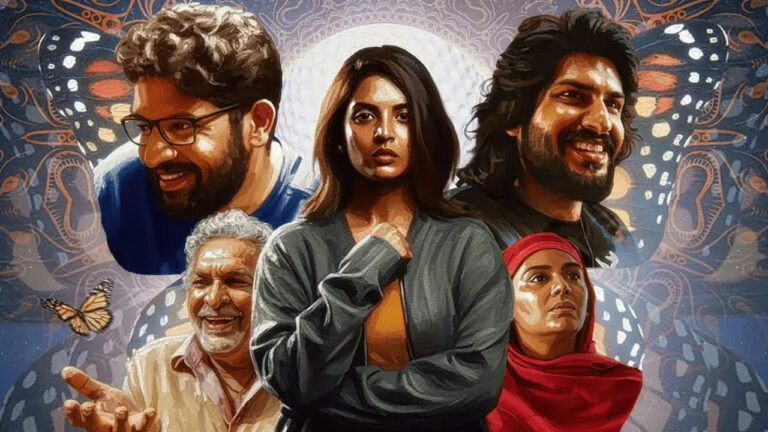
Anjali Sivaraman plays a girl who is “different” from those around her, and the film doesn’t judge her or feel sorry for her or even explain her. We are just asked to see her for who she is. The rest of this review may contain spoilers.
In Bad Girl, Anjali Sivaraman plays Ramya across a span of time. She is a middle-class Tamil Brahmin from a conservative family, and we see her evolve from a rebellious pimpled schoolgirl in the Orkut era to a rebellious working woman in her thirties, in the age of laptops. The title is a bit misleading. The film is not calling her a bad girl. The title lands on Ramya’s face with the force of a rubber stamp. It’s as though society has labeled her a bad girl. At one point, Ramya attends a family ritual, where a child is made to sit on its mother’s lap in front of the fire. The baby is crying with all the heat and smoke. Ramya takes it away to a cooler place and makes it comfortable and happy, and the crying stops. But the child is soon snatched away by a relative and re-deposited on the mother’s lap in front of the fire, and the crying begins again. This is not exactly a subtle metaphor, but it shows how we function. Rules matter. Tradition matters. The individual’s comfort and happiness can take a hike. And it begins right from when we are a baby.
Writer-director Varsha Bharath takes great joy in smashing cinema’s patriarchal rules of how women should be portrayed. The traditional smoking-boozing scene that we’ve seen with men, we now see with women. We get a woman’s gaze of how a man can be sexualised. Ramya is fascinated by the trickle of sweat running down her classmate Nalan’s face. (Hridhu Haroon plays this character beautifully, from boy to man.) Later, when the opportunity arises, she and Nalan lie beside one another. Ramya wonders how this can be wrong. “Ramya Wonders…” could be the tagline for the movie. Ramya wonders why she cannot be like some of her friends, who seem happy in monogamous relationships, having babies and what not. Ramya wonders why she is… “like this”! Ramya wonders how her parents can talk to others about her without her consent. Ramya wonders how her mother can be blind to her husband’s patriarchy. Ramya wonders about the passage of patriarchy from grandmother to mother to her. She says, “If they cannot shake off their chains, they put them on us.”
The school Ramya studies in is a parody of one of Chennai’s most famous Brahminical schools, and when Ramya gets low marks in class, her female teacher screams at her that she not only acts like a boy but has also “failed like a boy” – as though the male gender holds the sole prerogative to get bad report cards. But this also shows the insane expectations society places on girls, and how stifling it can be, like the bra that Ramya casually slips out of while at home. To the extent possible, Ramya’s parents try to be understanding. One of the film’s finest “messages”, if you will, is that you don’t need to have strict parents who threaten to lock you up for bad behaviour. Yes, Ramya’s mother does take away phone and computer privileges at one point. But on the whole, the parents seem to love her. They seem to care for her. But here’s the problem. They love her and care for her in “their” way, in their unconsciously patronising and unseeing way, and sometimes, this makes Ramya even madder.
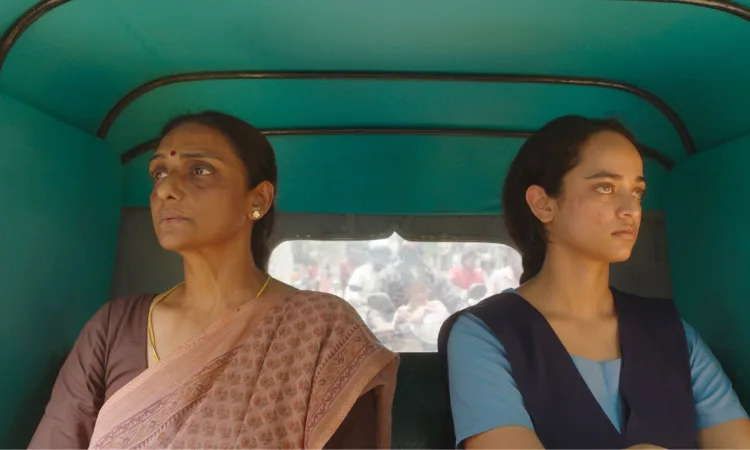
Shantipriya plays Sundari, Ramya’s god-fearing, society-fearing mother. It’s a wonderfully empathetic performance (often caught in extreme close-ups) that makes you see a woman who is so brainwashed by patriarchy that she’s unable to even begin to understand her daughter. There’s a sad-funny moment at the end when we realise that despite all of Ramya’s rebellions, Sundari continues to be the dazed deer in society’s headlights. There’s a startling scene where Sundari herself is slut-shamed by her mother-in-law, for wearing colourful clothes and going to work. But if there’s hurt, Sundari doesn’t let it show, and Varsha Bharath doesn’t let it show. Bad Girl is not a treatise about women or womanhood. It is a series of dear-diary entries about this one particular woman, this one particular fish out of water: Ramya.
Sundari becomes the target of all the hate in Ramya, and I was often reminded of Shuchi Talati’s Girls Will Be Girls, which was also about sexual awakening and the complicated bond between a mother and daughter. Bad Girl is a broader film. It spells out things a little more, for instance in a stretch about a missing cat that becomes an elaborate metaphor. There are also a few lines like “we should heal ourselves”, which sound like mini-slogans. But these are minor misgivings in a film that looks and feels totally new. At first, during Ramya’s psychedelic adolescence, the conversations are cut or they overlap, and the frames are chaotic. Gradually, the camera eases up, the rhythm of the dialogues become steadier. Anjali Sivaraman plays Ramya perfectly as a creature that is all nerve endings at first, her emotions right on the surface. She has a meltdown when a boyfriend moves to another city and distances himself. It’s borderline-embarrassing to watch something so naked and vulnerable, the emotional equivalent of a train wreck.
You want someone to shake some sense into her, and that is what her girlfriends do. Saranya Ravichandran anchors the film with her performance as Selvi, the one woman who appears sorted and clued in. She is that one sane friend we all wish we had. She makes Ramya understand that her mother may be flawed, but that does not make her any less deserving of love. The awkward reconciliation between mother and daughter is perfect. Bad Girl knows better than to tie things up neatly and solve all of Ramya’s issues by the end. There is a long and difficult road ahead, but we leave the movie with the relief that Ramya has grown up, at least to the extent that someone like Ramya is capable of growing up. In the 1980s, the disruptive character Revathy played in Mouna Raagam became a stand-in for stifled young women of those times. Bad Girl shows how little things have changed, and also how much. The film opens with Ramya dreaming of the perfect home with the perfect man. At the end, Ramya gets at least the house she wanted. The man is optional.