Kavin and Andrea Jeremiah play around with a lot of money and black humour and old-school sentiment. The mix sounds good in theory, but the film doesn’t come together fully. But it does have its moments. That’s the short take. A longer review follows, and it may contain spoilers.
In Mask, Kavin plays Velu. The film calls him a hacker, a blackmailer, a scammer – but he’s really some kind of private detective who’s hired by people who want to know if their spouses are having affairs or if their daughters are doing drugs. This is a perfect part for Kavin. Velu is from the Nelson school of characterisation. He plays dumb but he is full of surprises. Andrea Jeremiah is equally well-cast as Bhumi, who runs an NGO with a look of steely amusement. One of the conceits of this film is that Bhumi isn’t who we think she is, either. In other words, everyone wears a mask. The story wears a mask, too. You think it’s a black comedy with a tone derived from Aaranya Kaandam. It turns into a Shankar movie with a flashback filled with middle-class victims.
Money is at the centre of this first feature by writer-director Vikarnan Ashok. GV Prakash pumps in huge shots of adrenalin with his trippy score, and the song that plays over the opening credits has this line: “Naalaikku news flash / moochu vida venum cash.” Basically, everything and everyone is driven by money, from the fringe-party politician wanting to make it big to the very ordinary woman who covets the jewels worn by actresses in mega-serials. Even the film’s opening has to do with money. A large amount is stolen by men wearing MR Radha masks. The other real-life pop-culture legend who is invoked is Ilaiyaraaja, whose songs play non-stop. One of the funnier jokes in Mask has to do with the song ‘Raja raja chozhan naan’ and the character Mohan played in the film where it appeared. The song connects Velu and Rathi, played by Ruhani Sharma.
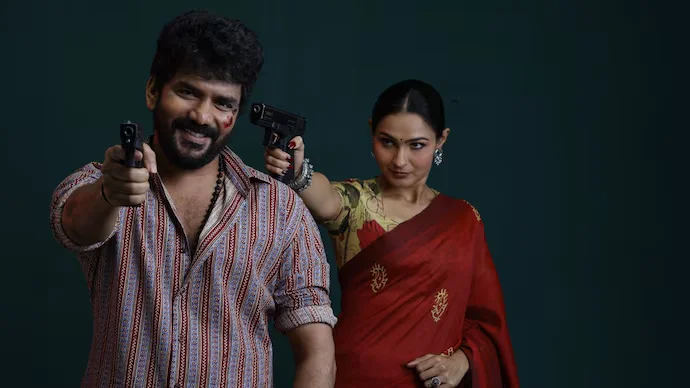
The basic story has to do with Velu and Bhumi, who become enemies. (I use the word loosely, in order to not reveal much about them.) Had that thread been followed from Reel One, Mask might have become a mighty entertainer. But the writing keeps taking detours about fish biriyani and strawberry-flavoured condoms and couples therapy and more excuses to fit in Ilaiyaraaja songs. By the time a character asks his wife to dance to a Neengal Kaettavai number, I began to wonder if the movie was just about the cast and crew having fun for a little over two hours. There are many amusing bits, sure – the prize going to the look on Velu’s face when he squeezes into a supermarket. But there’s also the question of where all of this is headed, and this is not helped by the hectic, overlapping editing that keeps placing scenes from one part over lines from another part.
Finally, a little into the second half, the story begins to come together – and we realise that a lot of the first half was just filler. Or maybe a more linear narration would have made things look more coherent. You understand why they chose the non-linear route, because this allows the big reveals to come later – but this also makes the early portions look clumsy and unfocused. Mask is entertaining in parts but its biggest problem is that it can’t find a tone that can bring all the elements together and make them stick. On the one hand you have Charlie playing a lathe factory owner and unleashing a pun on the word “shooting”. On the other hand, you have a young girl threatened with sex work as the brothel song from Nayakan plays in the background. The big winner for me was the superb colour palette, which is fabulously exploited by cinematographer RD Rajasekhar. Mask may not always come together, but you won’t be able to tear your eyes off the screen.