The film had its world premiere at the New York Indian Film Festival. On the surface, it’s a genteel Agatha Christie-type murder mystery set in a small town. But dig deeper, and it says a lot about who we really are. The rest of this review may contain spoilers.
In Kaisi Ye Paheli, Sadhana Singh plays a mother who’s known simply as Ma. She lives with her son Uttam (Sukant Goel) in Kalimpong. In their first scene together, Ma prays to the wall-photo of her dead husband, and when she asks Uttam to participate, he recoils. One, he blames her for his father’s death. Two, he does not want her in his life. He does not want her forced attempts at conversations about Modi and movies and cricket. But what else is a lonely woman to do, given that Uttam does not want to talk about his work? Ma reads a lot of crime fiction and fancies herself an amateur detective, and this annoys Uttam even more. He snaps at her that “Feluda-type stories” do not exist in real life. But they do, and the sleepy town soon sees a murder. The cause? A poisoned pedha.
This may sound ridiculous, at first, but it all ties up very neatly at the end. But more importantly, I got the feeling that the writer-director Ananyabrata Chakravorty isn’t after realism. In the final stretch, we see that this is not the movie we thought it was – and that the premise is quite fantastical. But until that bit of rug-pulling, we are gently drawn into the story of Ma and Uttam and the cops on the case. Ma’s theories from crime fiction seem sensible, after all. Uttam grudgingly begins to tolerate her, and later, they actually seem to have something of a bond. At one point, we see him cradling her in his arms. That is exactly what Ma wanted from him. She also gets the other thing she wanted, which is to apply herself to the case, which may be another way of saying that she needed something to keep herself occupied.
Kaisi Ye Paheli is a study of loneliness, which can get worse in a sleepy little town. Even the investigation is lethargic, and Bondo (Rajit Kapur) has to come in from Kolkata to take over. In one of the many small touches that make you smile, this is a man who has solved 99 cases. He can’t wait to score a century. In another mildly absurd moment, Ma brings up an Agatha Christie novel to suggest a motive (or the lack of one). The others around her are bewildered. And at yet another point, we get to see Uttam’s innermost self, when he declares that the biggest lie is that a mother does everything for her child. His reasoning is that she does things for herself, too. The performances are perfect, and they are even better when you think back about the movie.
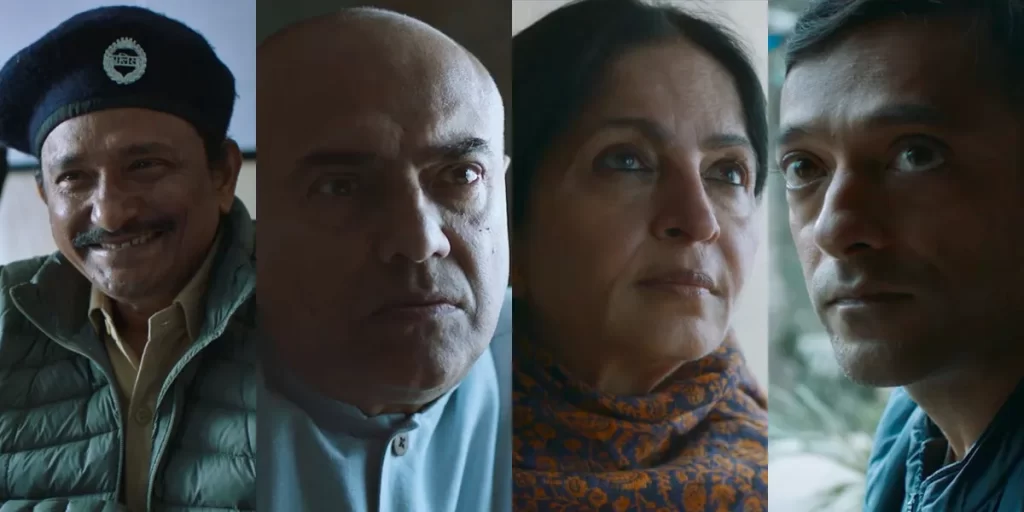
The writing gives us slow reveals about characters and events. The film is paced like a genteel crime drama, where the point isn’t thrills or sensation or the biting of nails but the depths of desperation that transform a human being into a killer. Like in the novels Ma likes to read, there is a lot of compassion – and a lot of clues, like hand-written notes from the killer. Ma gets into situations of grave danger, but she also gets closer to her son. What will you do for love? How far will you go for companionship? What price are you willing to pay to keep away loneliness? These questions coexist with the main mystery, namely: Who is the killer? Given the subdued tone of the movie, the ending is a tad melodramatic, with quick cuts and higher music notes. But I suppose it can be no other way. Because it is a melodramatic reveal. This is a film that grows quietly on you, and then hits you on the head with a hammer. I was taken aback, impressed, and also very moved.
That’s it with the review, but I’ll leave you with the director’s note about a mother: “While she is often seen as a symbol of love, care, and sacrifice – celebrated across all forms of literature – she is also someone who, at times, stands in the way of our privacy, independence, and identity in ways we rarely acknowledge or talk about. She is a paradox. Through this film, I have tried to observe her more as a human being with basic, universal desires like love, care and respect, especially from the child to whom she gave something as precious as life itself.” After watching Kaisi Ye Paheli, you’ll see that that’s the film, and that’s also the title. The paheli – or riddle – is twofold. The first one is, of course, about who the killer is. But the second, more interesting, riddle is about who we really are.