The story of the martyr Arun Khetarpal, the youngest recipient of the Param Vir Chakra, is told in a non-linear style. The film doesn’t quite deliver the emotional impact that we seek, but it’s solidly made. It’s watchable. That’s the short take. A longer review follows, and it may contain spoilers.
There are three timelimes in Sriram Raghavan’s Ikkis. The most recent one is just after the Kargil War, when retired Brigadier Madan Lal Khetarpal visits Lahore for the centenary celebrations of the college he studied in. His host in the Pakistani city is Brigadier Nisar. (These characters are played by Dharmendra and Jaideep Ahlawat). Nisar’s daughter – with her camera – is a kind of documentarian of what’s happening here (in these scenes, and in the film as a whole). She’s the new generation, witnessing this gathering of the older generation. She is recording a part of history that’s been lost, a part of history whose lessons should not be forgotten. At one point, she remarks that Brigadier Madan Lal looks so much at home. Her father replies, “He is home.” Madan Lal was born in the city of Sargodha in Pakistan, and a little later, the narrative takes a detour for a homecoming. The house that once belonged to Madan Lal’s forefathers is now occupied by a Pakistani family. They welcome him with love. They express the desire to visit India, especially Mumbai, because of the movies made there. They still listen to old Hindi film songs. When a neighbour objects to this Indian visitor, Madan Lal instantly identifies the man as a former soldier. He embraces this man (played by Deepak Dobriyal) and soothes his anger.
Had Ikkis not come so close to Dhurandhar, we might have thought that the film is a calculated white flag-waving response to the blood and bullets in Aditya Dhar’s mega-blockbuster. Two questions arise. One, what is Sriram (with co-writers, Arijit Biswas, Pooja Ladha Surti) doing in this warm-fuzzy “aman ki asha” territory? He not only invokes older Hindi music and lyrics like Kaifi Azmi’s “Kar chale hum fida” from Haqeeqat, which happens to be another war movie with Dharmendra. He also evokes a long-ago era when the default mode of Hindi cinema was “Hindu-Muslim bhai-bhai”. The second question comes from this film’s title, which refers to the age of 21 when Madan Lal’s son, Second Liutenant Arun Khetarpal, died. (Agastya Nanda plays Arun.) The title suggests the story of a short but brave life that made Arun Khetarpal the youngest recipient of the Param Vir Chakra. But here’s Arun entering Pakistan in a tank – during the 1971 war – and marvelling that everything looks the same as back home in India. The Pakistanis, too, share this sentiment. When Indian tanks pass through their village, they think these are the Pakistani army. They revel with shouts of “Pakistan Zindabad”.
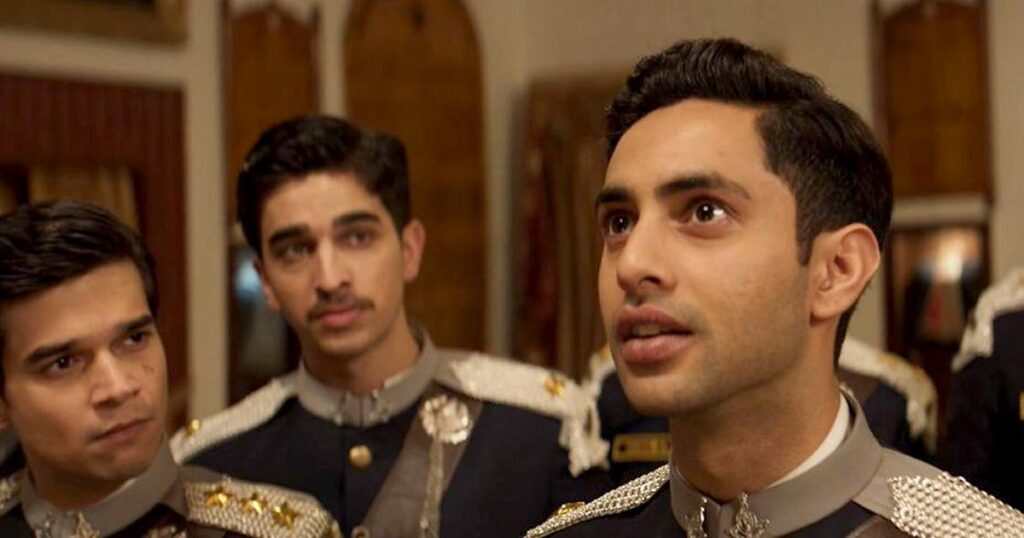
So what Sriram has made in this imperfect but interesting movie is not exactly a biopic. He has used a few snaches of Arun Khetarpal’s life to craft an anti-war drama. And we enter the second timeline in Ikkis, at the NDA, which opens with a birthday cake being plastered on Arun’s face as he turns 21. This section is the closest the film resembles a biopic, because it has hints of Arun coming of age. At one point, he rats on a teammate who broke a rule. Later, as his resentful teammates give him the silent treatment, he wonders what is more important to a soldier, loyalty or duty. His senior officer tells him that he chose the harder right over the easier wrong. Arun reads Ernest Hemingway’s novel, For Whom the Bell Tolls – though we are not told what effect this anti-war narrative had on him. Later, he becomes a rule-breaker himself, in an incident involving his girlfriend Kiran (played by Simar Bhatia), and this leads him to an important decision. In these stretches, we see a boy trying to become a man, and some of his rule-breaking during the war might have been the subconscious result of him trying to prove himself to his troops that he is indeed a man.
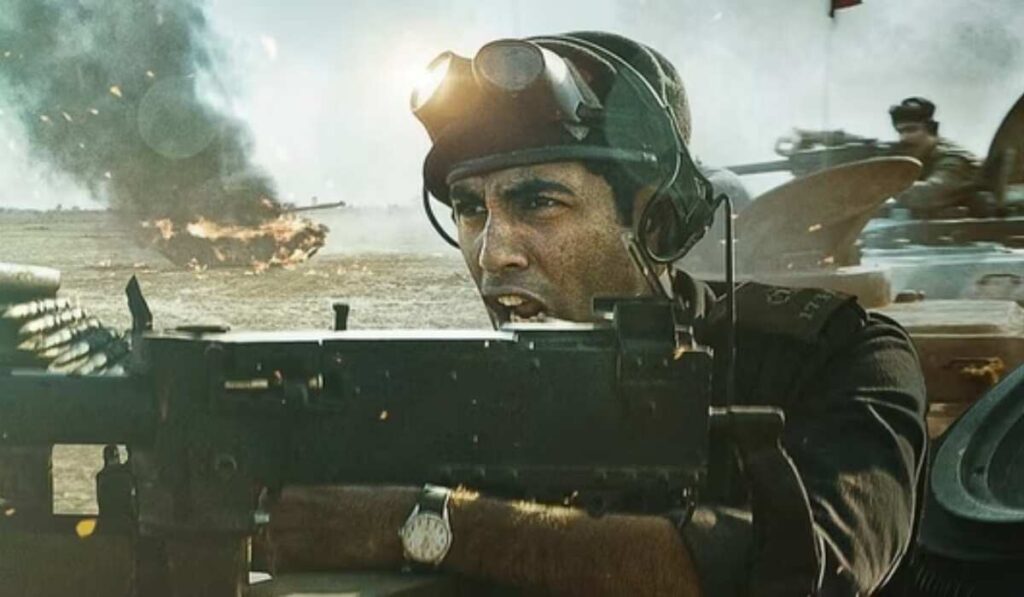
The third timeline in Ikkis depicts the part of the war that led to Arun Khetarpal’s death. He is, by now, a tank commander, and I found it rather lovely to see a battle being fought with slow-moving tanks that look like lumbering elephants on uneven terrain. Our movies have led us to see war as a collection of slick action set pieces. Here, the slickness is dialled down. We see war as a documentarian might have filmed it, even if the cinematographer is Anil Mehta. The editing by Monisha Baldawa is exquisite, with the silken transitions reminding you of Sreekar Prasad’s work. In terms of the technical collaborators, the only major letdown is by the composers Sachin-Jigar. The background score is not only generic, it’s also poured on thick – thus reducing the dignity of several scenes. You almost wonder if this was Sriram’s decision or something that came down from higher powers.
The director, meanwhile, juggles with an odd mix of sentimentality and matter-of-fact-ness. When men from the ISI are tailing Madan Lal and Nisar, they wonder if the people at headquarters will be listening to all the silence in the car ahead or whether they’ll fast-forward through this. This feel of events happening as though they are non-events – it’s fantastic. Nisar carries a big secret. But Ikkis does not use that secret to keep us at the edge of the seat. When Arun says he is going to war, his mother simply says, “Khaana khaake jaana.” She is the daughter, the wife, and the mother of soldiers. She is not going to get sentimental over something that’s a given. When Arun fumbles while killing a goat as part of a ritual, the event is again reduced to a non-event. The aftermath is quickly glided over. Even major events that could have been dramatised, or at least revealed later, are narrated by Madan Lal. Before we see what happens with Arun and his girlfriend, Madan Lal tells us about it. Before we see what happened when Arun receives orders to retreat, Madan Lal tells us about it.
But very strangely, other parts of Ikkis are blatantly sentimental. Nisar tells Madan Lal that Arun was an example not just to the Indian Army but also the Pakistani Army. When Nisar, bearing his big secret, enters a school, we see this motto: “Do what’s right not what’s easy.” It’s as though heaven has sent him a message about what to do. When a newly married soldier dies, a radio beside his corpse echoes with Lata Mangeshkar singing the lines “kehne ko bahut kuchh tha” (from a song in Adalat) – it’s as though the wife and now-dead husband have so many things yet to be said. Madan Lal’s big speech at the end about how life goes on despite war is lovely, but its poetry belongs in a different movie – as does the pointed visual of a bullock cart over land that was once a war zone. With its varying timelines and fluctuating emotional temperatures, Ikkis suffers from a lack of connect. A lot of things happen, but they don’t cohere in a way that results in an emotionally impactful narrative. I admired many aspects of the movie, but I also wished it had drawn me into it, inside it, rather than keeping me at a distance.
Jaideep Ahlawat is the film’s star performer. He is fantastic as Nisar. He does not overdo the guilt that comes with his secret. He acts like the soldier that he is – except that he is a soldier with a big heart. Agastya Nanda looks right for the part and he is not asked to “act” – he just is. That’s exactly what this part needs, and we register the transformation from early enthusiasm to self-doubt to courage. Sikandar Kher and Vivaan Shah fill out their stock characters rather nicely. As for Dharmendra, it’s a mixed-bag performance – mainly because of his frailty and his slurred speech. These very qualities elevate his big anti-war monologue at the end, but other times, I wonder what a slightly younger and more able actor might have brought to the part. Ikkis could have been better, but it’s also the kind of mixed-bag movie that can be made only when a good director is determined to do something different with a story whose basic outline has been outlined in many other war movies. That, sometimes, is a bigger battle than the wars we see on screen.