A barren village loses the only tree it has. The next day, all the villagers find that they are unable to speak normally. They begin to sing. This is a film filled with non-stop inventiveness, especially for fans of musicals, and maybe only this director could have pulled it off with such conviction. That’s the quick review. A more detailed analysis follows, and it may contain spoilers.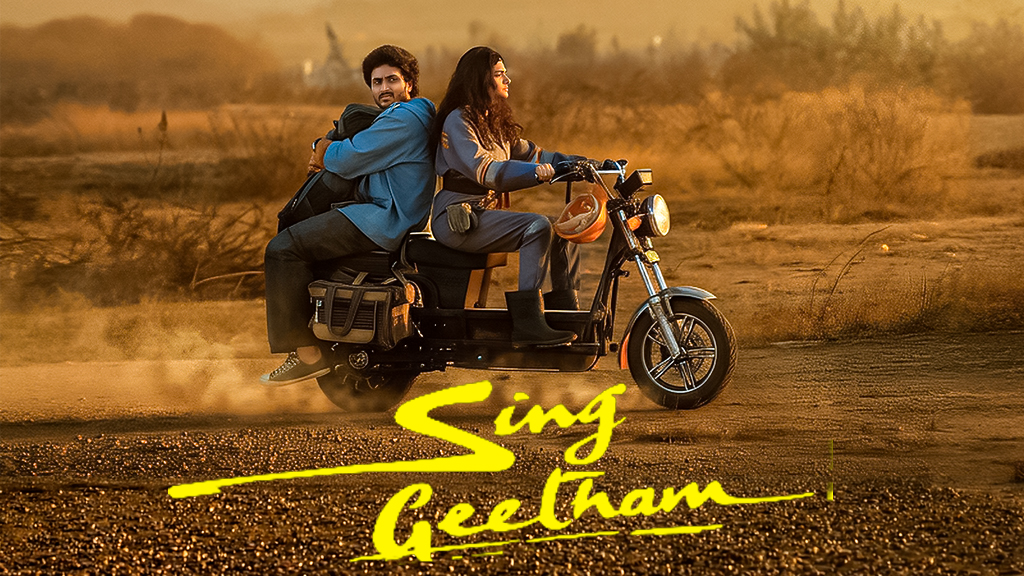
Some of the most touching stories in cinema have to do with younger filmmakers championing the work of legends. When Akira Kurosawa was having trouble with finances for Kagemusha, George Lucas used his Star Wars clout and got studio money to complete the film. Nag Ashwin has gone one step further. He has produced Singeetham Srinivasa Rao’s new film, titled Sing Geetham. He has also helped execute the director’s vision by functioning as his assistant. The fact that Singeetham Srinivasa Rao has directed a movie at his age – he will be 95 in a few months – is impressive and inspiring, but it is also a fact for the record books. For the purposes of a review, what’s important is whether the film works – and that it does. Sing Geetham is quirky, unique, and if you get on its vibe, it’s quite a ride. It’s also a companion piece to this director’s Pushpak. That film was full of silence. This film is filled with songs.
We are used to what Western theatre calls the “book musical”, which has spoken portions and then it’s time for a song and we get a stretch where lyrics are set to music, and then it’s back to the spoken portions. Sing Geetham is the other kind of musical: the “sung-through musical”, where everything including the dialogues is set to music. Only the opening and closing portions and a flashback contain “spoken” dialogue. Otherwise, even a rooster’s crowing is in some sort of tune. This sort of thing is very difficult to pull off, because at least to us, it is an alien, operatic style. But Devi Sri Prasad does something clever. The point where the film switches from spoken words to sung words is through a song that goes “Emaindhi emaindhi / baboi edho aypoindhi.” This chorus is repeated over and over till it stamps itself in our mind as the way forward. And then, for us, the singing becomes as natural as speaking.
The plot is pure Singeetham Srinivasa Rao, in the sense that it contains his trademark playfulness. The sole surviving tree in a barren village is cut down, and it results in a strange phenomenon where the villagers are unable to speak normally anymore. They sing. The starting portions (the hero introduction, the introduction of the gold mine that drives the story) are a little shaky, but the film quickly finds its rhythm. The local priest says that all this singing is a curse. The local doctor says it’s a disease. So what is it? What really happened, and how will these villagers switch back from singing to speaking? The rest of the film keeps finding small, inventive ways to keep pushing this plot. At one point, everyone starts speaking the truth. At another point, we get a backstory that talks about the theme of greed, featuring cameos by Rahul Ravindran and Nivetha Pethuraj. At yet another point, people speaking gibberish slowly begin to make sense.
Something’s always happening, even after you think the film has found a logical end point. Sing Geetham is basically an eco-fable, and had the lines been spoken, they might have been too messagey and moralistic – because many other movies have preached to us about being good to the planet. But the singing sets it apart. As do the eccentric characters: the girl who lives in a tree, the African man named Swahili, the doctor who keeps running around in a white coat, the shady priest, the drunk man, and two men who keep fighting because of a very amusing reason that’s revealed later. The main cast has Ayaan, Ahilya Bamroo, Shalini Kondepudi, and Tulasi. None of them wears makeup, and all of them jump into this cartoonish world with full-on conviction. Even if one actor had looked embarrassed about singing and gesticulating all the time, the film could have fallen apart.
The only reservation I had was that even at two hours and fifteen minutes, the film feels a little stretched. But the non-stop inventiveness keeps you watching. We even get an Indiana Jones-style climax. And the filmmaking is a great example of maximising a budget. Ankur Sanjeev is the cinematographer. A lot of the time, the camera keeps moving within small spaces and gives us the feel of a small location change – so even visually, this is a very inventive movie. Will Singeetham Srinivasa Rao make another movie? He just might. But in case he doesn’t, Sing Geetham is a fitting end to a career filled with non-stop searching for what new to do next. This is a sweet, entertaining, and often quite joyous film that I quite frankly had doubts about, due to the director’s age and the all-singing concept. I am happy to say that I was proved wrong.