Indrans and Madhoo play a Malayali and a Tamilian who meet in Banaras. She needs help. He agrees to help her. What follows is a set of conversations that talk about coming to terms with life by setting aside the big questions and enjoying the small things. That’s the quick review. A more detailed analysis follows, and it may contain spoilers. 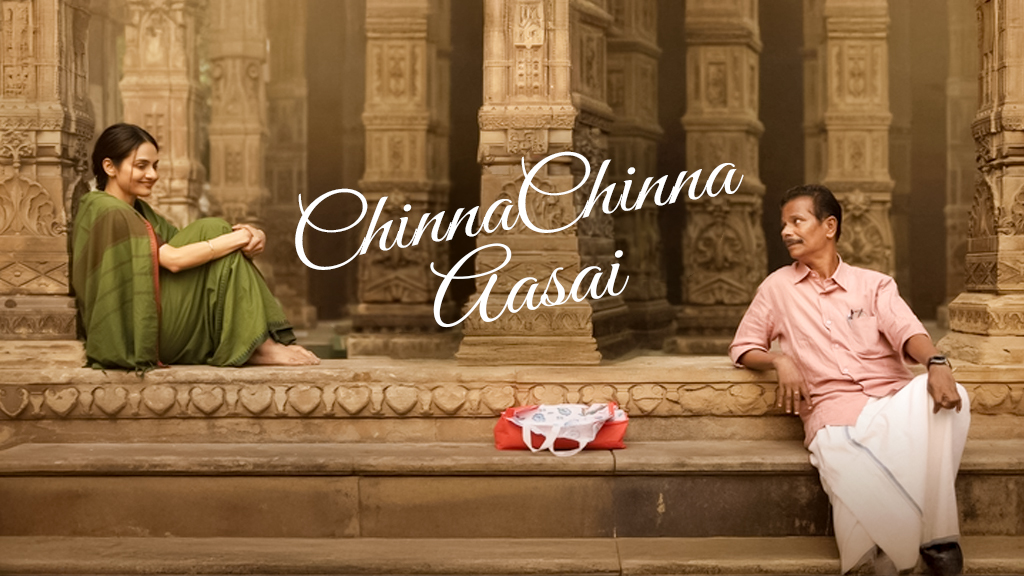
Writer-director Varsha Vasudev makes an impressive feature debut with Chinna Chinna Aasai, where Indrans and Madhoo/Madhubala play Madhavan Master and Leela. They are in their fifties, and they meet in Banaras. She is part of a tour group that doubles as a metaphor for a stifling society, bound by rules. He is free as a bird. He smiles a lot. She’s grim. Madhavan Master talks to everyone, everyone seems to know him. Leela doesn’t even speak to the members of her tour group. Leela meets Madhavan Master when she gets separated from her tour group. She is robbed of her purse, her phone. She weeps. He approaches her cautiously and takes it upon himself to help her, and the film that follows unfolds in a mix of their mother tongues, Tamil and Malayalam. The third language in Chinna Chinna Aasai is Govind Vasantha’s soulful music. It’s been a while since I heard the beautiful sounds of the sarangi on a soundtrack.
Banaras is a holy place and something seems to connect Leela and Madhavan Master. If her husband passed away a year and a half ago, the time he spent with his wife before she died is also a year and a half. But it’s not all about the big things. It’s about small things, too. They drink lassi. He flies a kite with local boys. They travel by rickshaw. She runs her fingers through Banarsi silk saris and delights at the sensuousness of the material. They go to a home where the aged come to die, because dying in Banaras means you attain moksha. She dances to the tune of a flute played by one of those hippie-foreigners who comes to India seeking something. He floats paper boats in the Ganges. She floats lamps. She asks if he believes in God. He doesn’t feel the need to answer. And as they sit on the steps on a ghat, a woman behind them sets up an easel and a canvas and paints them. In a way, Leela and Madhavan Master become immortal.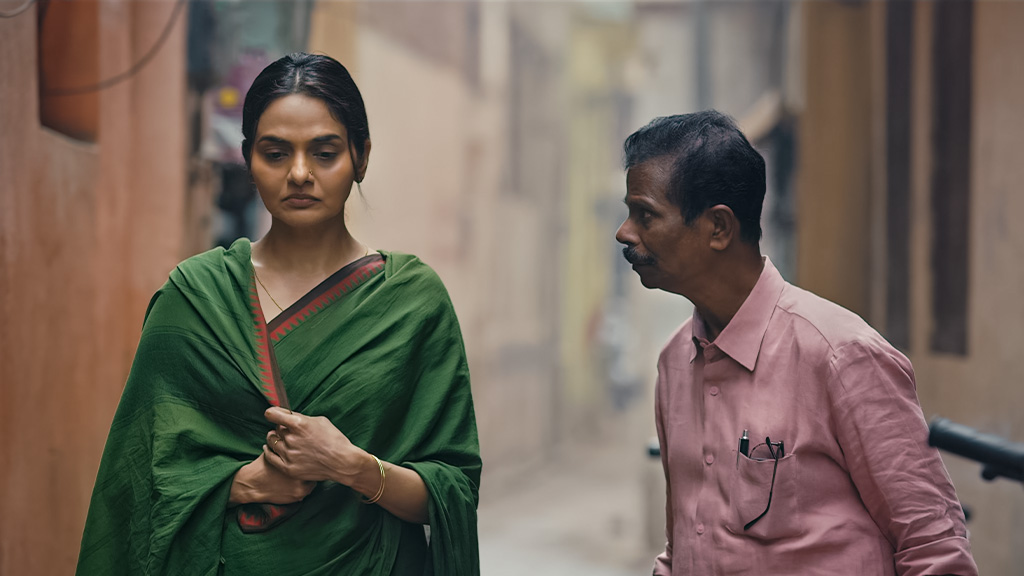
Chinna Chinna Aasai is beautifully framed, beautifully shot by Faiz Siddik in the best parts of Banaras. This is not a “realistic” movie. This is not about rotting corpses and filthy streets. This is about the beauty of human relationships, even the accidental ones like what we see between Madhavan Master and Leela. For an unhurried two hours and fifteen minutes, we see them go from strangers to soulmates. There’s always a yin and a yang. Looking at a young couple clicking pictures non-stop, Leela says that they spend their lives inside their phones. Madhavan Master is more realistic. He says the phone has its uses, too. A man who finds Leela’s purse says he gave the thief a small sum. “Avanum pozhakkanum, ille?” he says. The thief, too, needs to survive. Barring a few times, none of this becomes precious or overly philosophical. Leela asks a man who speaks many languages where he is from. He replies that he is here at present. The film feels like opening up about existential nothings to someone sitting near us on a train or flight.
Sometimes, we may feel Leela has a tendency to be too literal. She puts everything into words, like “Is this kind of friendship allowed at our age?” or “Why did God give me a life like this?”. But then, she has never really had anyone to talk to and she has probably bottled up all these thoughts inside her for years. In fact, her first words to Madhavan Master are whether she can trust him. They speak about her marriage, his marriage. They reveal their quirks. Whenever Leela feels distant from someone, she pulls her sari pallu tight around her, as though retreating into herself. When it loosens, you know she is losing her inhibitions. With the exception of Thambi Ramaiah as a comic character, all the performances are quietly affecting. Aparna Balamurali has a small part as Madhavan Master’s daughter. She says thanks when she talks to Leela over the phone. A little later, Leela wonders why. Chinna Chinna Aasai may not be particularly deep, but in moments like this it captures what it’s like to feel connected to someone and to feel wonder at these strange connections. Like the title suggests, this is a small movie with small, delicate emotions. It’s about finding freedom – or as they may say in Banaras, mukti.