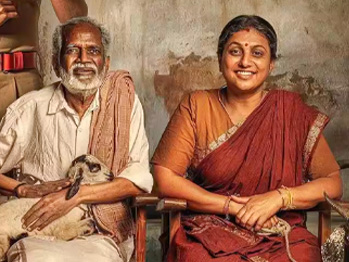
Kiran Abbavaram plays Steven Shankar. He’s an orphan. He wants to become a filmmaker. Sri Gouri Priya plays Nivi, a corporate-sector worker who is depressed and has started drinking after being ditched by the man she was going to marry. Steven and Nivi are in Chennai, and they slowly fall in love. And then, there’s a big twist in their story. Kiran and Gouri Priya give strong performances in a love story that’s really different from what we usually see. The first half is solid. But after the big twist, things turn predictable, and the three-hour running time becomes a slog. Even so, ‘Chennai Love Story’ is an interesting film that keeps you thinking about it long after you exit the theatre. That’s the basic storyline and the quick review. A longer analysis follows, and it may contain spoilers.
Right from the start, we see that Chennai Love Story is going to be a very different kind of love story. Just as she is about to get married, Nivi gets news that the boy doesn’t want to go ahead. (Trigun plays the groom-to-be, named Ajay.) Our sympathies are entirely with Nivi, but the film does not make Ajay some kind of cold-hearted villain. He thinks he may have fallen for someone else. He hasn’t told that person anything, because he’s himself not sure what these feelings are. He is confused, and in this state of confusion, he doesn’t want to get married. We are not invited to judge him. After this shock, Nivi spirals into sadness and begins to drink. The first time she picks up a bottle, one of her male friends steps forward to stop her but a female friend stops him. This girl probably knows that Nivi is at an early stage of grief and victimhood and self-pity, and the last thing she wants is well-meaning advice. It’s probably better to be around her and protect her while she gets through all this. Again, there is no judgement.
The director Ravi Namburii has made a “no judgement” film, namely, a film that’ll probably work best if you’re not the kind of viewer who judges flawed characters on screen. He’s made the kind of film we find only in Telugu cinema. When Steven is asked why he is pitching his stories in Chennai and not in Hyderabad, he says that his stories are full of heart, and they are more likely to be accepted by Tamil audiences than Telugu viewers. But he may be barking up the wrong tree. For a while now, love stories in Tamil have become a near-dead genre – or at least, no one seems interested in infusing anything new and grown-up and provocative into the genre, the way someone like Selvaraghavan did in 7G Rainbow Colony or Ameer did in Paruthi Veeran. Only in Telugu cinema do we find romances that do not play safe, films like Arjun Reddy, RX 100, Uppena, and more recently, Baby, whose writer-director Sai Rajesh is this film’s co-writer and producer.
These films are filled with fascinatingly flawed people with grey shades that often tend towards black rather than white. And through these characters, these stories show us the extreme (and extremely uncomfortable) things men and women can do in the name of love. These stories show how being in love is a result of so many external circumstances that go far beyond “I like you, you like me”. With Steven and Nivi, it isn’t even that. He is homeless and he’s moved into the flat that Nivi shares with her friends. She is indifferent to him. In his case, too, it isn’t “love at first sight” or some such thing. His aim is to write a story and find a producer and direct a movie. But he sees Nivi sad and drunk and he feels sorry for her. He barges into her room when she’s not there, cleans it up, and puts up cheery-cringey motivational posters on the walls. He is a simple man. He has no concept of concepts like “invasion of privacy”. Nivi is furious, naturally. But that’s Steven. His motivational captions and cheery-cringey way of speaking lead very organically to Mani Sharma’s beautifully composed ‘Guruthunda’, where every line is a motivational quote. (The lovely children’s chorus in this song reminded me of ‘O rendu prema meghaalila’ from Baby.)
Steven is such a simple man that even when he asks if Nivi has had sex with her ex Ajay, she is more annoyed than angered. By then, she knows that this question is not coming from a toxic place, but from some place innocent – and Kiran plays this character with an assured mix of over-the-top-ness and the optimism of someone who has nothing and therefore everything is a gift. Even when rejected by a producer, he smiles because he at least got to meet someone and narrate a story, which is better than nothing. Sri Gouri Priya does the best acting of her young career as someone who is angry about the things happening to her. Nivi is so traumatised by the repeated blows from fate that, in the second half, she retreats into a comforting la-la land. Even when the writing gets awkward, Sri Gouri Priya’s performance never does.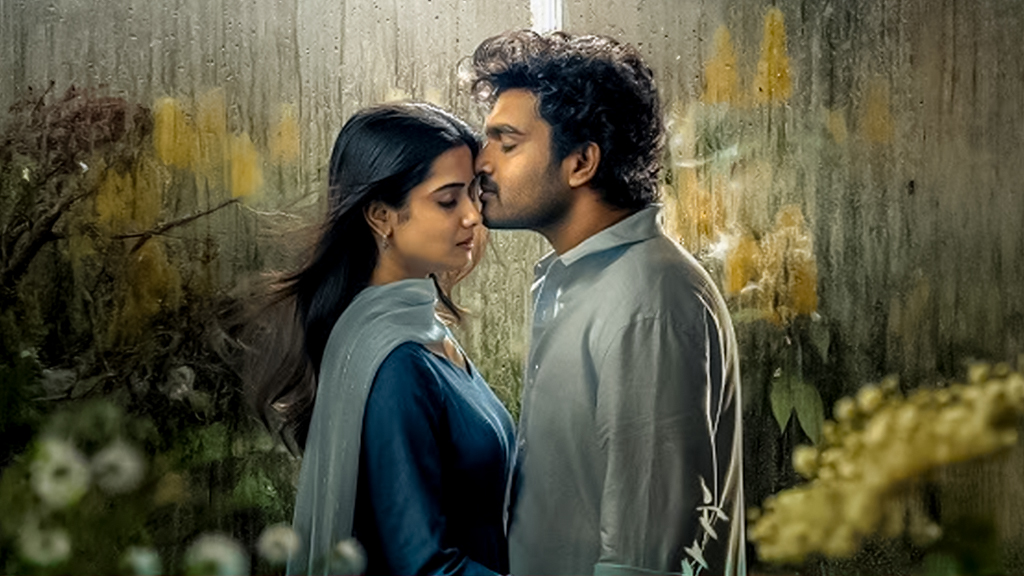
In the first half, the writing mostly works. There are no wasted scenes, no filler scenes. Even the smallest moments are significant. There are many clues that have payoffs in the post-interval portions. Steven gives Nivi the bangle that he’s had since he was a child. In the second half, this bangle plays a major part. If we see Nivi doing a heart-emoji gesture with her ex Ajay, that gesture comes full circle when she repeats it with Steven. Steven’s real name (which is revealed in the premises of a temple) pays off in the part where he becomes a saviour and performs an act that comes off like a divine intervention, and later, when Steven becomes the object of someone’s worship. This temple is the home of Lord Murugan, and we get a character named Murugan who talks to his dead father in a way that points to a key development in the second half.
The character of Murugan is also used to establish the concept of korika, or wish, or desire. Steven wishes to be a director, and in the second half, he “directs” real-life scenes, where Nivi functions as his actor, mouthing the lines that he gives her. Steven says he will die only after making a movie, and in a way, he “writes and directs” a real-life movie that helps Nivi move on. Chennai Love Story is not subtle. It wears its big heart on a big sleeve. The big background works because it’s all about emotion, and sometimes at a second level, too. When Nivi calls up Ajay and yells at him, she is letting go of pent-up anger, but there is also the sense that she is really yelling at herself for keeping him in her thoughts for so long. When there’s a scene that reminds you of Karthik in Mouna Raagam, it happens in front of a big poster of the Mani Ratnam film. You can’t miss it!
So the problem with the second half isn’t the lack of subtlety or some such thing. The problem is that it becomes very predictable. Now, if the hero dies at the interval point in our cinema, he is either going to return in a double role or as a ghost. And when Ajay steps back into the picture, we know what the ending is. I still hoped that they might subvert our expectations with another surprise, but that does not happen. The film adopts a sometimes-jokey tone, and the music turns jokey, too, when things should have been “dead” serious. Because two things need to happen. One, Steven needs to realise that he cannot be with Nivi forever, and two, Nivi needs to realise that she needs a real partner and not a ghost. This realisation happens way too late, and through a really miscalculated scene of attempted rape. This plot point and the action block that follows are so tonally off. Earlier, the film was all melodrama. Now, suddenly, we are in “mass” territory, and it’s utterly tiresome.
It’s also all over the place. Where the first half seemed so organic, the second half has random scenes like the one where Steven gets a lot of money and he buys Nivi a necklace. We need to feel her sadness about being with someone she cannot touch. We need to feel Steven’s jealousy about not being able to do the things that Ajay can do for her. The film needed to be as mad, as unhinged as the plot points indicate. The events should twist your heart and make you weep. Instead, we seem to be in a regular, over-the-top love triangle where the decision at the end is not mutual but appears more like a “sacrifice” that the hero makes. Nivi begins to look more like a puppet in Steven’s hands, far from the independent-minded working woman she was earlier. The korika to know how they’ll get to the inevitable end point kept me going, but there’s no denying that there’s a steep fall from the writing in the first half to the writing after the interval. The acting is what keeps us watching.