Rishikanth and Sananth are absolutely terrific as Karthi and Subbu. They are best friends, soulmates – and then Dorothy, played by Keerthy Suresh, comes to their village. As a director, this is one of Karthik Subbaraj’s finest films, with Tirru’s extraordinary cinematography and Ganesh Siva’s furious editing. Ilaiyaraaja delivers a grand score, though whether this minimalistic movie needed this kind of music may be a matter of debate. But the writing isn’t confident. The plot, the storyline, is fantastic. The destination is brilliant, but the journey is shaky. After watching the film, there’s the sense that the screenplay was trying to work its way backwards from the last scene, and the transitions from one emotional state to another aren’t fleshed out convincingly. There’s a lot of repetitive messaging, and the propulsive energy in this director’s best work is missing. That’s the storyline and the quick review. A longer analysis follows, and it may contain some minor spoilers.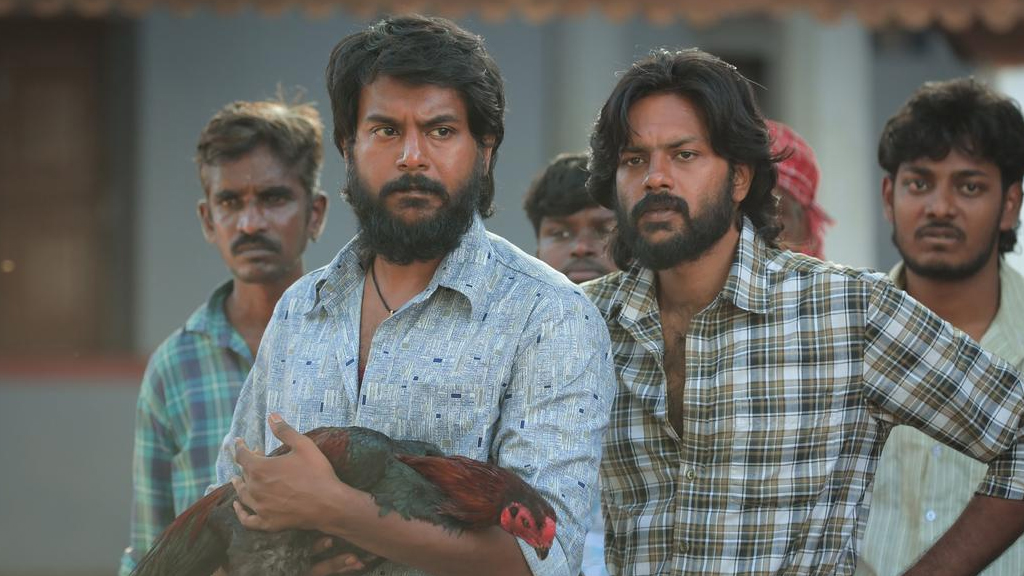
There’s the traditional sense of some qualities being “masculine” and some qualities being “feminine”, and all of us – to varying degrees – are a mix of the masculine and the feminine. This binary is no longer accepted in most circles, but it is a useful tool to begin talking about Karthik Subbaraj’s Dorothy. The director seems to have split his masculine and feminine selves and created two characters containing his names: Karthi and Subbu. The setting of this story is a village filled with head-butting rams and cockfighting and much talk about virility. Karthi has the hairstyle of a rooster, and he has grown up with the idea that men don’t cry, but when we first see him, as a grownup, his eyes are filled with tears. This is the present day, which is shown in black-and-white. The past is depicted in colour. When Karthi and Subbu meet as schoolkids, Subbu boasts that his father and brothers have been in jail, and he speaks about how his mother and sister died. Again, Karthi weeps, but Subbu tells him to be brave. This is what Subbu’s been taught. As Karthi’s mother says, “Eduthu solla aalilladha pillai.”
In this setting, then, the women seem to be capable of accepting human behaviour as it is and not as it “should be”. We find this quality in Karthi’s mother, who teaches Subbu that it is okay to cry. We find this quality in Subbu’s friend, Dhanalakshmi, who bears his secrets and cares deeply about him. (I would have liked a scene or two with her.) And we find this quality in Dorothy, played by Keerthy Suresh with exquisite grace. This is really one of her finest performances, as it requires her to be little more than an angelic presence. Dorothy appears abruptly, as though dropped from the heavens for a specific purpose, and she disappears just as abruptly. But all this nurturing by all these women has to be done in secret. Because outside, patriarchy is rampant. It pervades the atmosphere like the dust clouds that drift across the screen. And it’s suffocating.
Dorothy is about what happens to (and between) Karthi and Subbu after the title character enters the picture, and let me first talk about the portions of the film that don’t need spoilers to understand. The kiss between Rishi Kapoor and Dimple Kapadia in Saagar becomes a kind of benchmark for adulthood. This is a film set in the 1990s, and I liked that Karthik Subbaraj picked a Hindi film to show a kiss. One, a non-Tamil film being screened in this village adds to the sense of “otherness” that Dorothy talks about. And more importantly, during that time, romantic kissing was taboo in Tamil cinema and, by extension, Tamil culture. You can quote Punnagai Mannan from 1986, but that was not a romantic kiss. It was a traumatic, pre-death kiss. We get a glimpse of the lovemaking scene from Nayakan, which came a year later, but there was no kissing there.
When Dorothy comes to the village, her beauty makes her a bit of an “other”, as well. Karthi and Subbu are fascinated. And though she is married, we think that we are in for some sort of love triangle, with a competition between the friends to translate that on-screen kiss from Saagar to real life. But what follows is utterly unpredictable. It involves caste violence, gender violence, matters of honour, and an examination of what it takes for a purely emotional relationship to enter the realm of physicality. As pure plotting goes, as far as the “what happens next” question goes, Dorothy is fantastic. But in terms of “how it all happens”, I was not convinced by the writing. I wished the friendship between Karthi and Subbu had been fleshed out in stronger terms. When we see Kaali and Anbu in Madras, among many other movies, the bond is unmissable. We know what these two men mean to each other. Here, we don’t feel that sense of closeness. We believe Karthi and Subbu are close because we are asked to believe it.
I had many questions. Why does Subbu confide in Dorothy? Yes, at that point, he is frustrated and she seems to be the kindest, most sympathetic person around. But women can be as patriarchally conditioned as men. Someone who has lived in fear all his life, as Subbu has, has no way of knowing how Dorothy will react to his big news. It would have been nicer – I felt! – if Dorothy had sensed something about Subbu and asked him, and then he told her everything. Now, take Karthi. Early on, we get a wonderfully ironic scene where ‘Manidhan enbavan dheivamagalam’ plays on a radio, and in contrast, the person listening to this song is the most animalistic man possible. He keeps whistling. This becomes his trait. And later, when Karthi suffers a heartbreak, he takes up ‘Ponaal pogattum poda’, but he whistles this song. He, too, has borrowed that other man’s trait and become an animal. And I felt I needed more scenes to flesh out his transition back to a human being.
Rishikanth is wonderful at portraying a kind of performative masculinity. He wants to be a man’s man. When he is dumped, the girl he loves instantly becomes a “pottachi”. How did a sensitive young boy grow up to be this way? And with Subbu, we ask the reverse. How did a young boy who said that men don’t cry get to be a softer man? These are interesting developments, but they become blunt thesis statements rather than emotionally affecting scenes that build gradually. The way characters transition from one state to another feels rushed. Karthik Subbaraj may have felt that there is no need to explain everything – and yes, that is a valid form of filmmaking. It’s something we find in films in festivals. But then, what explains the huge Ilaiyaraaja score, which is very Indian in the way it keeps underlining emotions and telling a parallel story!
Taken as pure music, as something you’d like to listen to on headphones, whatever Ilaiyraaja has done here is grand and majestic. But as a score for this film? At least the songs are fun on screen, especially the snatches of the prelude and interludes of ‘Naan thedum sevvandhi poo idhu’ that we hear with crystal-clear production on today’s hi-tech theatre speakers. Karthik Subbaraj seems to have specifically asked for modern-sounding rehashes of super-successful Ilaiyaraaja templates from the 1980s. But the score? When a crucial character dies, we get a huge stretch of orchestration with a booming male chorus, and it distracts you from the poignancy of the scene. At another point towards the end, you feel the maestro is conducting his own personal piano concerto at a corner of the screen. The minimalism and the art-housiness of the movie often clash with the bigness of the score. This, of course, is a matter of taste, but I don’t think there’s going to be much disagreement about Tirru’s excellent cinematography and Ganesh Siva’s editing, which has rhythms that are unusual for a mainstream movie. That ‘Vertigo shot’ that takes us into Subbu’s face as he eats… it’s just one of those Karthik Subbaraj things!
Sananth gets the role of a lifetime, and it’s incredible how he modulates his body language gradually, from the sexualised hip-thrusting in his dance for Kalyana virundhu to something altogether different. Some character transitions are easy enough to accept. At one point, Karthi sees Subbu in danger and saves him. Much later, Karthi sees Subbu in danger and does nothing to save him. We connect these two states of mind easily enough because the groundwork for this transition has already been laid. But elsewhere? And herein begin the real spoilers, because I cannot talk about the rest of the film without revealing serious plot points. And in case you are stopping here, let me tell you that Dorothy is well worth a watch if you like a different kind of cinema. Even if you don’t agree with all of it, there is enough filmmaking to enjoy and human life to discuss. And it’s always a good sign when a filmmaker steps out of his sandbox. From macho gangland thrillers to Dorothy is the sign of an interesting journey that’s going to remain interesting for a long time to come! So on to the big spoilers now!
The big reveal is that Subbu feels like a woman trapped inside a man. Identifying your sexuality is one thing, and accepting it is quite another. I was not convinced that Subbu would embrace her womanhood so easily, and with such an air of “I don’t give a shit what the world thinks”. Yes, you could say that the merciless killing of a crucial character has hit Subbu hard, but this isn’t clear! There’s a scene where Karthi and Subbu meet after Subbu has embraced her female identity. What might Subbu think at that point? You’d think she’d have doubts or concerns or hesitation or maybe even some embarrassment about how her very masculine friend will react upon seeing her in a sari. But she runs towards him as though they’d just met yesterday. There’s one terrific scene where Subbu, as a man, beats up a transwoman. All the self-loathing in Subbu manifests itself as physical violence against the kind of person that he (at that point) is terrified of becoming. We needed more such insights into the inner workings of the characters in the film.
And what about Karthi? He is disgusted. Okay. But if he really loved Subbu, isn’t he also curious about what happened to result in this transformation? Something was not convincing here, and in the portion where Karthi agrees to kill Subbu. Yes, we can extrapolate all we want and arrive at answers, but I wanted answers from whatever’s in the frames. I wasn’t convinced that one messagey speech from one empathetic man would convince Karthi that his friend who is now a woman is the love of his life. This is the sort of emotional transition that should take a lot of processing. At one point, Dorothy turns into a road movie. The film makes it look like this long travel with Subbu strips away the hate and disgust and confusion from Karthi’s mind. But I also wish that we had been shown a part of this process, maybe through dialogue or however.
Also, just like that one man who is all heart and all for embracing love regardless of gender, it may have been interesting to have a woman who did not empathise with Subbu. Because it takes all kinds to make up this world. Dorothy is a movie with a message, and I wish Karthik Subbaraj had found a form for it, the way he wrapped the environmental message in Mercury in a genre thriller. When that happens, psychology becomes less important. Dorothy is a bit shapeless. It is a drama, and it feels as though the director thought of the final image and then struggled while working towards that point. The sure-footedness we usually see with Karthik Subbaraj (even in the films that don’t entirely work for us) is missing. Scenes don’t slip organically into one another, especially in the second half. The lines, with phrases like “paalina paagubaadu”, sound like slogans. And perhaps my biggest reservation was that Subbu is less a person than a saint: “aandavan padacha padaippu”, as Dorothy calls her. I would have liked a flawed and real and complex human being like Shilpa in Super Deluxe, but there’s no denying that Karthik Subbaraj has made a brave movie. Baby steps, I guess. And important steps.